Dr Hollis “Chalkdust” Liverpool is the 2017 Calypso Monarch, winning a record 9th title at Sunday’s Dimanche Gras show.
Chalkdust now also holds the title of most Calypso Monarchs ever won by a calypsonian, having been tied with The Mighty Sparrow on eight before Sunday night’s victory.
Chalkdust took home the $700,000 first prize after performing last in the competition with his tune, “Learn from Arithmetic”.
His song focussed on the issue of child marriages, with a refrain, “75 can’t go into 14”.
Karene Asche placed second, performing “Caught in the Whirlwind” in position number 11.
She took home a second prize of $400,000.
Heather Mac Intosh was 3rd with “Games” which she performed in position number 16 to take home a purse of $200,000.
Terri Lyons was 4th with “The Phrase”, taking home $75,000.
All other contenders from 5th to 17th won $25,000 each.
The following is the full results:
1st. Chalkdust – Learn from Arithmetic [LISTEN]
2nd. Karene Asche – Caught in the Whirlwind
3rd. Heather Mac Intosh – Games
4th. Terri Lyons – The Phrase
5th. Rondell Donawa – Lip Service
6th. Devon Seales – I Carmona
7th. Chucky Gordon – Wha Yuh Doing
8th. Queen Victoria – The Call to Prayer
9th. Lady Gypsy – Plight of my People
10th. All Rounder – To Be an Icon
11th. Cro Cro – Final Send-Off
12th. Gypsy – Angry Land
13th. Kurt Allen – My Corn Tree
14th. Sasha Ann Moses – Main Witness
15th. Fya Empress – Guilty
16th. Lady Adanna – Social Media
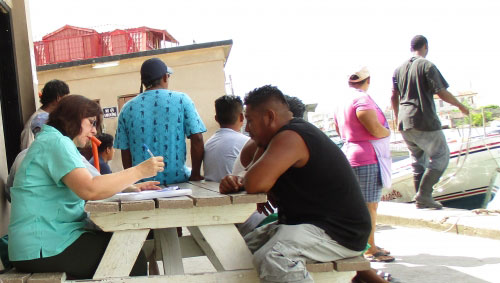
Claudia Stella Beltrán Turriago, economic consultant, interviewing fishers at Northern Fishermen's Cooperative in Belize City, Belize
A landmark study to look at the impacts of rising cost factors on fishing operations in the Caribbean has been concluded, and the Caribbean Regional Fisheries Mechanism (CRFM), in collaboration with FAO, will convene a validation workshop at the United Nations House in Christ Church, Barbados on Monday, February 27 and Tuesday, February 28, to review the findings and chart the necessary course of action.
At the upcoming event, CRFM Executive Director, Milton Haughton, will present a general overview of the project and explain what the workshop is expected to achieve. The background, findings, conclusions and recommendations of the study will be presented by Claudia Stella Beltrán Turriago, economic consultant, for final refinement.
The study, carried out in select CRFM Member States, focused on factors such as capital, labor, maintenance and energy costs. At next week’s meeting, participants will review and finalize the formal report on the findings of the study, as well as propose workable policy options and strategies to improve efficiency, productivity and sustainability in the fisheries sector. The broader aim is to improve competitiveness and profitability at the local, regional and international levels.
The initiative will also inform strategies to protect against future economic shocks, reduce barriers to market access, and compensate for price fluctuations for fisheries produce by building on the value-added dimension of the industry.
Last May, the CRFM convened a meeting of fisheries experts in Barbados to create a roadmap, including the best methodology for the study. They also selected the beneficiary countries targeted for fieldwork and remote surveys, which entailed surveys of small-scale and industrial fishers, suppliers, traders and exporters.
Later that same month, the consultant commenced field visits to Belize, St. Kitts and Nevis, and St. Vincent and the Grenadines. She also conducted remote surveys for Guyana, Grenada, Colombia, and Trinidad and Tobago.
All 17 states which are members of the Caribbean Regional Fisheries Mechanism, as well as countries covered by a UN/FAO project on the Sustainable Management of Bycatch in Trawl Fishing in Latin America and the Caribbean (the REBYC-II LAC), funded by the Global Environment Facility (GEF), are expected to benefit from the broader application of the study’s findings.
The CRFM will prepare a policy brief for action by Caribbean leaders, to highlight the major findings and recommendations, including policy options and strategies to increase efficiency, productivity and sustainability of the fisheries and aquaculture sector, while reducing economic risks.
Violence against women and women’s and children’s health are priority interventions
CARICOM Heads of the Government have agreed to champion the Every Caribbean Woman Every Caribbean Child (ECWECC) initiative and other activities focussed on addressing violence against women and women’s and children’s health.
The ECWECC initiative revolves around opportunities to improve the lives of women, children and adolescents. It focuses on four priority issues: teenage pregnancy; violence against women and children (including trafficking in persons); cervical cancer and mother to child transmission of HIV (MTCT)in the Caribbean.
Assembling for their 28th Inter-sessional Meeting on 16-17 February, in Guyana, the Heads received a report on the initiative from Prime Minister of Antigua and Barbuda, Hon. Gaston Browne. Prime Minister Browne had earlier attended the Forum of CARICOM First Ladies and Spouses on the EWECC initiative, hosted by Guyana’s First Lady Ms. Sandra Granger, at the Marriott Hotel on 16 February 2017.
At that Forum, the prime minister addressed the gathering of First Ladies and Spouses, government officials, the UN Special Envoy for HIV and AIDS in the Caribbean, Dr. Edward Greene, UN and other agencies, the Gilead Sciences Inc., among others.
The prime minister cited the less than flattering state of play in the Region as it related to the referenced issues, and called for urgent “remedial action” and an accelerated response.
“We leaders of the region must accelerate our response to meaningfully tackle these problems that severely threaten to undermine our human development and contribution of our most precious human resources —our women, girls and children— to the development of this region”, he said; adding that “the economic costs of inattention to the priorities of ECWECC Initiative [will] be staggering”.
In July 2016, the Hon. Timothy Harris, Prime Minister of St. Kitts and Nevis who has lead responsibility for Human Resources, Health and HIV brought the priorities of EWECC to the attention of Heads of Government meeting for their 37th Regular Meeting in Georgetown, Guyana. That meeting endorsed the initiative.
A comprehensive review of the current status of the CARICOM Single Market and Economy (CSME) was among the matters before Caribbean Community Heads of Government at their just ended 28th inter-Sessional Meeting in Guyana.
The review, mandated by the Heads at their previous meeting in July 2016, spoke to the achievements to date, the matters being held up by Member States or Community Organs, work that is in train or still to be done, and the challenges being faced.
The Meeting agreed that there was significant progress in the implementation of the CSME, and noted that the areas of achievement include legal and institutional measures and mechanisms to support free movement of goods, services, skills and the cross border establishment of businesses.
The Heads were however concerned that for some areas, decision taken were not complied with in Member States and they agreed that the necessary action will be taken to effect compliance. They identified some impediments to further development of the CSME, including capacity constraints at the national level, the need for effective consultative mechanisms, and the necessity for timely meetings of the responsible Community’s Organs and Bodies. Some priority areas noted for attention going forward include, the challenges with payments for goods and services traded in the Region, and completion of the protocol relating to facilitation of travel.
The CSME, conceived by the Caribbean Community in 1989 and given various priority areas for focussed attention over its existence, is intended to better position Member States to grow by accessing and using their combined, rather than individual resources. Its successful Legal and Institutional measures and mechanisms include transforming regional arrangements into domestic law. There have also been agreements and arrangements to establish and operationalise various Community institutions, needed for the effective operation of the CSME. These include the Barbados-based CARICOM Regional Organisation for Standards and Quality (CROSSQ), the CARICOM Competition Commission (CCC) headquartered in Suriname, the CARICOM Development Fund (CDF) in Barbados, and the Trinidad and Tobago based Implementing Agency for Crime and Security (IMPACS).
Under CSME provisions, CARICOM Nationals have a right to enter a Member State and be given a stay of six months. Member States have also moved towards the use of common embarkation/disembarkation (E/D) forms and the introduction of CARICOM/non CARICOM lines at immigration points at ports of entry.
Progress has also been made in the area of movement of skilled nationals. Participating Member States have removed work permit requirements and accorded indefinite stay for agreed categories of persons with a Certificate of Recognition (Skilled Certificate). The first group included university graduates, media workers, sports persons, artistes, and musicians. Other categories added subsequently are in varying stages of implementation and include nurses, teachers, holders of associate degrees, artisans with (Caribbean Vocational Qualifications) CVQs, and domestics with CVQs or equivalent. Since the inception in 1996, around 16,000 Skilled Certificates have been issued.
Work has advanced in shaping regional policies and strategies in the productive sectors to achieve increased production, competitiveness and exports of goods and services.
In Agriculture, the focus has been on addressing the constraints to reducing the Region’s high food import bill, increasing exports and achieving food and nutrition security. In the Services sector strategic plans are being developed for professional, cultural, entertainment and sports, health and wellness, educational, financial, construction, tourism and ICT services. The Energy sector has benefitted from increased attention and funding, particularly in renewable energy and energy efficiency, and has seen the establishment of a new Regional institution, the Caribbean Centre for Renewable Energy and Energy Efficiency (CCREE), based in Barbados. A plan of action for Small and Medium Enterprises (SMEs) is to be finalised, and will following-on from the recent adoption of a regional policy. A Regional Transportation Commission is focussing on increased coordination among airlines for a more integrated service to the public; addressing the movement of agricultural products across the Region; the possibility of a fast ferry; and completing the multilateral air services agreement. A roadmap for a single ICT space has been developed and was approved by Heads of Government at their just ended Inter-Sessional Meeting. The Heads emphasised that the Single ICT Space would be one of the driving forces for social and economic development of the Community as it would support the Digital Economy, implementation of the CARICOM Strategic Plan and development of the Digital Agenda 2025. A Commission on Human Resource Development is also working towards international competitiveness in the development, production and delivery of goods and services. These areas however require additional work and the Meeting identified the need for the full commitment of all stakeholders to complete the process.
Progress has been recorded in the technical work required for the development of an enabling macro-economic environment, including the areas of debt reduction, fiscal sustainability, investment promotion and export development. It was however noted that successful completion depends on increased support from the Regional Organs and Bodies which provide oversight, and the Member States.
Other areas which also require further action include some lingering elements of the movement of Community nationals such as recognition of the newer categories of skilled persons and recognition of some forms of qualification. There are concerns about the lack of harmonised processes and duplication in the implementation of the skilled certificates regime. The need for further training of public officers in the frontline of intra-regional travel has also been identified.
Areas for pending action and enhancement include an initiative to facilitate the establishment of and ease of doing business, including activation of a fully automated and connected Regional Companies Registry. Consumer protection, including a CARICOM Rapid Alert System for the Exchange of Information on (non-food) consumer goods (CARREX) is also getting attention this year. There will also be some focus on the development of an enabling environment for e-commerce across CARICOM, which is expected to contribute significantly to the CARICOM Single Market’s objective of trade expansion. There is also expected to be a complete review of the CARICOM Common External Tariff and Rules of Origin and the continued engagement with Community nationals through the public education campaign.
The various elements of the CSME journey are expected to meet the expectations of the CSME stakeholders, including the average CARICOM national who wants to travel easily across the Region, to stay and find employment and access a greater variety of regional goods and services; the businesspersons who, among other things, want easier means for doing business including cross border services, more profitable opportunities including production integration and increased markets for good and services; and the governments, with the CSME addressing the objectives of their Member State.
The Heads of Government, in their recent deliberations, agreed to the importance of continually reviewing the impact of the CSME in both achieving the objectives of the Revised Treaty, and on the lives of the people of the Community. The have decided that outstanding issues will be addressed at their next meeting in July 2017.
Transport Minister - Hon Edmond Castro and Mexican Ambassador - Carlos Quesnel
Mexico’s Ambassador to Belize H. E. Carlos Quesnel met yesterday in Belmopan with Minister of Transport and National Emergency Management Hon. Edmond Castro.
The Minister and the Ambassador discussed opportunities for cross-border operations for motor carrier services between Belize and Mexico. A memorandum of understanding is being prepared and should be signed shortly to establish the framework under which such services will be provided. Ambassador Quesnel described the meeting as “very productive”. Hon. Castro thanked him for the visit and says he is pleased with the deepening of the longstanding friendly relations between our two countries.
The CRFM Secretariat is seeking a qualified candidate for the post of Programme Manager, Research and Resource Assessment with the CRFM Secretariat. Please see attached Job and Position Description with details about the post.
Applications are invited from suitably qualified nationals and legal residents of CARICOM/CRFM Member States and Associate Members.
Applications in English Language with full Curriculum Vitae should reach the CRFM Secretariat no later than 28 April 2017.
Documentary by Saint Lucian Filmmaker Kendal John to be featured in New York
In observance of Saint Lucia’s thirty-eighth year of independence, the Consulate General of Saint Lucia in New York invites all nationals and friends of Saint Lucia in the tri-state area to a screening of Who are You?, a documentary by Saint Lucian filmmaker Kendal John exploring the island’s rich history and culture.
This groundbreaking film will have two showings, on Saturday, February 11, and Sunday, February 12, 2017, starting at 4:00 PM. Both will take place at the Taipei Economic and Cultural Center, One East 42nd Street in Manhattan.
“The consulate takes great pride in having Who Are You? included in this year’s festivities. It is a wonderful and loving tribute to our nation and its people,” says Jeremiah Hyacinth, Vice Consul at the Saint Lucia Consulate in New York.
Who Are You? recounts the fascinating history of our enchanted country, discusses the origins of its longstanding customs and traditions, and explores the magnificent architecture and abundant natural beauty that has made Saint Lucia one of the Caribbean’s most beloved tourist destinations. By drawing attention to the rich cultural tapestry that makes our homeland so unique, it becomes much more than a travelogue. Featured are interviews with local historians and scholars, providing intriguing and little-known insights about virtually every facet of Saint Lucian life.
Adds Mr. Hyacinth, “I am certain that every Saint Lucian will find this film every bit as entertaining and educational, eye-opening and compelling as I did. You, your family and friends, and anyone seeking to learn more about our lovely and fascinating country are encouraged to attend.”
For tickets and more information about attending the screening of Who are You?, please contact the Consulate General of Saint Lucia, via e-mail, at sluconsulateny@govt.lc, or by phone, at 212.697.9360, ext. 203.
Secretary-General of the Caribbean Community (CARICOM), Ambassador Irwin LaRocque has commended the progress Grenada has made as it celebrates its Forty-Third Anniversary of Independence on 7 February, 2017.
Grenada’s strides towards a better future, he said, is reflected in the theme of the celebration “forging ahead together for continued national development.”
“The progress made by Grenada over these forty-three years is commendable. The belief, resilience and determination shown by the government and people of Grenada, to overcome all obstacles as they strive to build their nation, is an example to many,” the Secretary-General said in a congratulatory message to the Prime Minister of Grenada, Dr. the Honourable Keith Mitchell.
Mr. LaRocque noted the Community’s appreciation for the “vital role” the country has been playing in science and technology and in regional integration.
“The Caribbean Community is most appreciative of the vital role that the Government of Grenada plays in contributing to the integration process and in building the Community’s capacity and advancing development in the area of Science and Technology. I look forward to your Government’s continued leadership in ensuring that at both the regional and international levels, this critical issue remains at the forefront of discussions and actions,” he said.
The OECS has begun engaging citizens of Member States on issues impacting their lives, the challenges facing the region, and the development opportunities for the OECS and its people.
The Public Education Forum Series, dubbed Vini Koze – Kweyol for ‘Come chat’ – is aimed at educating and informing the people of the OECS on the social, economic and political benefits of Regional Integration. It seeks to ensure citizen engagement and active participation in the Regional Integration process.
Each Forum features a Panel comprising representatives of government, the private sector, an international organization, civil society, and the NGO Community. The Forum is held before a live audience who engage panelists in discussion through a moderator.
The Forum Series commenced in the BVI in mid-January. The BVI Forum evoked discussion on successes in Education in the OECS, and created greater awareness of deficiencies. It also generated a range of fresh ideas, strategies and possible solutions that can be applied in creating a better education system across Member States.
Head of the Education Unit at the OECS Marcellus Albertin, notes that while the region has recorded some success in Education, an estimated 70 percent of students within the secondary school system are under-performing, with some eventually becoming high school ‘dropouts.’
The second Forum on Youth Empowerment and Development was held in Anguilla. Director of Youth and Culture in Anguilla, Bren Romney, notes that youth account for about 60 percent of the global population. He says society has a responsibility to create an environment conducive to the positive growth and development of youth.
Elbert Ellis, a Social Analyst and Operations Officer at the Social Sector Division of the Caribbean Development Bank, believes Caribbean society must guard against policies, measures and approaches which could frustrate young people.
The Anguilla Forum also addressed youth unemployment, youth crime and violence, the juvenile justice system, as well as development opportunities for young persons, especially in the areas of education, sports, and the arts.
The OECS Public Education Forum Series (PEFS) will run until March 2017. It is being staged across six (6) OECS Member States including The BVI, Anguilla, Dominica, Grenada, St. Vincent and the Grenadines, and Martinique and will be televised across the OECS upon completion. The Forum Series is part of the public education component of the Economic Integration and Trade Programme of the OECS region, funded by the 10th European Development Fund.
The next Forum is slated for Dominica this Friday, February 10th, from 1pm – 3pm at The Fort Young Hotel. It will focus on Climate Change, its impact on small island developing states, as well as adaptation and mitigation measures being implemented by OECS Member States.
An IMF mission visited St. Lucia during January 16-27, 2017, for the annual Article IV consultation discussions on economic developments and macroeconomic policies. [1]
Despite weak tourism activity, unemployment continued to fall in 2016 and the economy is expected to experience positive albeit moderate growth in 2017. The authorities are designing a bold program of economic reforms which they intend to outlinein the forthcoming budget. A credible medium-term fiscal consolidation plan and a rapid implementation of the reform agenda are needed to reduce policy uncertainty and ensure the success of the authorities’ economic program.
Weakness in tourism activity continues to dampen growth. Strong employment growth in agriculture and construction led to a significant reduction in unemployment in the first three quarters of 2016. Nonetheless, weak activity in tourism, transport, and manufacturing hampered GDPgrowth, which is estimated to have reached 0.8 percent in 2016. Declining exports are widening the current account deficit after improvements in recent years mainly owing to lower oil prices.
The short-term outlook is mildly positive, but presents some risks.Moderate growth is expected in 2017, primarily on account of continued strong performance in construction and agriculture. The overall outlook appears uncertain as positive developments in tourism—the expected increase in the number of hotel rooms and the opening of new direct flights from the U.S.— may be stifled by the impact of the new airport tax.
The medium-term outlook remains subdued as structural weaknesses impinge on competitiveness and potential growth . Risks are tilted to the downside, as low global growth would negatively affect tourism inflows; U.S. dollar appreciation would reduce competitiveness, and tighter global financial conditions could compress fiscal space by increasing interest costs on the high public debt. Upside risks are related to stronger-than-projected foreign direct investment inflows, especially if the authorities are successful in implementing economic reforms that address structural vulnerabilities.
The new administration is launching an ambitious program of economic reforms, but key policies are still being shaped ahead of the forthcoming budget. The broad pro-growth reform agenda is focused on lowering the tax burden, enhancing the efficiency of the tax system, and reducing tax compliance costs; reorganizing the public sector to rationalize functions and increase efficiencies; reviewing the Citizenship by Investment Program (CIP) to make it more competitive; and enacting structural reforms to improve the business climate and encourage foreign direct investment. This program addresses many areas that are critical to strengthening St. Lucia’s growth potential, but details of the policies are still pending and many of the reforms will take time to yield results. In the meantime, the fiscal package announced by the government under the “Five to Stay Alive” initiative, which includes a reduction of the VAT rate from 15 percent to 12.5 percent, will weaken the fiscal position unless measures are taken to mitigate its impact; and, by shifting the tax burden onto the tourism sector, risks having undesirable effects on competitiveness and growth.
A multi-year fiscal consolidation plan is necessary to stabilize the projected debt dynamics and attain the 2030 debt target of 60 percent of GDP. The high public debt — currently exceeding 82 percent of GDP— and a delicate fiscal situation need to be addressed promptly. A fiscal consolidation plan would help the authorities clarify their intentions, confirm their commitment to fiscal responsibility, and reduce risks while the economic program is being defined. By mapping the path to the debt target, the authorities would minimize the risk of sudden corrections, which typically involve cuts to capital projects, thereby gaining control over expenditure composition while improving its quality. The plan should be adopted as soon as possible and measures should be included in the FY2017/18 budget currently being prepared.
The adjustment effort should focus on broadening the tax base, controlling expenditure, and improving financing terms. Further cuts in tax rates should be preceded by a reduction of the extensive exemptions that undermine the efficiency of the tax system. Consideration should also be given to reducing the very high taxes and charges on imports, which are particularly harmful to external competitiveness. In view of the importance of the public sector wage bill, continued control of wage dynamics and intensified attrition in the context of a functional assessment of employment needs are key. Social spending should be preserved and gradually refocused from temporary work programs and non-targeted subsidies to targeted social assistance. Much needed investment in infrastructure, renewable energy, and natural disaster resilience should be financed with concessional lending rather than costly bond issuance, and partnerships with the private sector should be used when feasible.
The consolidation plan should address the need to prepare for the inevitable recurrence of natural disasters. St. Lucia, like other countries in the region, is extremely vulnerable to natural disasters, which entails significant costs in terms of lower investment, lower GDP, higher poverty, and a more volatile revenue base. Costs can be significantly reduced by preparing for these events with adequate domestic policies aimed at increasing resilience and reducing risks. These policies should be integrated into investment, debt, and public financial management frameworks. Financing should be arranged ahead of time through a combination of fiscal buffers, contingent financing plans, and risk transfer arrangements.
The implementation of the medium-term fiscal framework could be supported by an appropriate fiscal rule. Enshrined in a fiscal responsibility legislation, the fiscal rule would define appropriate institutional arrangements; the coverage of government and fiscal aggregates, with due consideration for capital spending; implementation procedures —including links with the budget process and escape clauses—; automatic correction mechanisms; and sanctions and supporting mechanisms for enhanced fiscal transparency and accountability.
Monitoring of the public sector should be extended to further limit fiscal risks. The definition of central government debt should be reviewed to comply with GFS guidelines. In addition, the authorities should consider expanding their definition of debt to the consolidated non-financial public sector to make sure that all public debt is monitored. A rapid approval of new legislation on public financial management and a new chart of accounts would also be important steps in improving the quality of fiscal statistics.
CIP revenues should be used primarily to reduce debt, and limits should be placed on amounts used to finance high-priority expenditure. After receiving relatively few applications in 2016, the authorities expect that the recent easing in the requirements and lowering of the costs to qualify for this program will encourage an increase in revenues. To minimize the risks of fiscal dependence on these revenues, which can be volatile and subject to sudden stops, and to reduce the impact of globally rising interest rates on public finances, priority should be given to amortizing existing debt. A capped amount could be used for investment projects of primary importance if public investment management can be strengthened further to ensure high quality investment. Transparency, appropriate governance, and careful due diligence remain paramount to reduce risks of sudden stops.
Banks are still burdened by nonperforming loans (NPLs) and the cost of corresponding bank relationships (CBRs) has increased . Swift resolution of NPLs is critical to revive credit and economic growth. Authorities should give renewed priority to the establishment of the regional asset management company (ECAMC). The Insolvency Act needs to be urgently adopted and legislative work to reform the resolution framework initiated to facilitate foreclosures and debt restructuring. The authorities have made significant progress in increasing compliance with international standards to mitigate the impact of reduced CBRs. Nonetheless, banks continue to suffer from increasing costs with correspondent banks owing also to the low volume of transactions.
Structural reforms to improve the business climate and address the skills mismatch should be implemented rapidly. The authorities have made significant progress in designing a reform strategy under the Caribbean Growth Forum aimed at addressing as immediate priorities: (i) skills and productivity; (ii) logistics and connectivity; and (iii) investment climate. In addition, a six-pillar Long-Term National Development Plan has been designed in the areas of building human and physical capital, strengthening institutions, improving social resilience, and mitigating and adapting to climate change. These efforts need to be supported by the elaboration of specific policies and timelines for their implementation, which the authorities intend to do in the forthcoming budget presentation. In light of the persistent skills mismatch and the large costs associated with the public education system, a review of the sector is overdue.
Statistics are among the most comprehensive in region and adequate for surveillance. However, a lack of resources is hampering quality in several areas. Data are subject to large revisions, which often reflect pre-existing weaknesses as methodological improvements are introduced. As St. Lucia intends to subscribe to the Special Data Dissemination Standard, these improvements need to be sustained by providing adequate resources to the Central Statistics Office for data collection and compilation. The timeliness of data provision by government agencies also needs to be enhanced.
[1] The mission included Mr. Leo Bonato (head), Mr. Gregorio Impavido, Ms. Veronika Sola, and Mr. Gonzalo Salinas.
St. Lucia: Selected Social and Economic Indicators, 2014–17
2014
2015
2016
2017
Est.
Proj.
Real GDP growth (at market prices, percent)
0.4
1.8
0.8
0.5
Real GDP growth (at factor cost, percent)
-0.7
1.2
-0.6
1.2
Consumer price index (annual average change, percent)
3.5
-1.0
-1.7
1.9
Overall fiscal balance (percent of GDP) 1/
-3.7
-2.6
-4.4
-5.3
Central government debt (percent of GDP) 1/ 2/
78.1
77.8
82.9
85.4
External current account balance (percent of GDP)
-8.9
-2.6
-9.4
-8.2
Sources: St. Lucia authorities; ECCB; and Fund staff estimates and projections.
1/ Fiscal year (April–March) basis.
2/ Including guaranteed debt, overdrafts, ECCB advances, and other outstanding payables.
The mission met with the Honorable Prime Minister Allen M. Chastanet, the Honorable Minister in the Ministry of Finance Ubaldus Raymond, Director of Finance Cointha Thomas and other senior government officials, the Leader of the Opposition, the Honorable Phillip J. Pierre, and representatives of the private sector and labor unions. The mission is grateful to the authorities for their valuable collaboration and kind hospitality.



 Chalkdust now also holds the title of most Calypso Monarchs ever won by a calypsonian, having been tied with The Mighty Sparrow on eight before Sunday night’s victory.