
7 Important Water Facts Everyone Should Hear Again
Carnival Queen Pageant Auditions – March 8th 2026
National Carnival Queen Pageant Auditions Slated for March 8th
The 2026 instalment of Lucian Carnival is finally upon us! On Sunday, March 8, a slew of hopeful delegates will audition for the National Carnival Queen Pageant. The Carnival Planning and Management Committee alongside the National Carnival Queen Planning Committee are facilitators for the event that will bring us one step closer to a new Carnival Queen for Lucian Carnival.
With registration officially closed, all auditioneers have been identified for the event that will coincide with International Women’s Day. The private audition comprises three key areas of assessment: swimwear, talent, interview and evening gown. Seven delegates will be selected for participation in the National Carnival Queen Pageant.
The National Carnival Queen Pageant, now in its 72nd year, is the pinnacle of grace, intelligence and national pride – the most prestigious platform on the calendar of events. Come Sunday, delegates will immerse themselves in months of rigorous training, all in preparation for a life of regality and servitude, while becoming advocates for Saint Lucian culture.
In addition to the coveted title, the 2026 Carnival Queen will be awarded a EC$25,000 cash prize, a university scholarship and boundless opportunities, opening doors for personal and professional development.
This signals the end of a riveting year for National Carnival Queen, Miss Emerle Tisson from the cultural capital of Saint Lucia, Choiseul. This year, the event is set for Saturday, July 4th, 2026, at the Pavilion on Rodney Bay.
To stay informed on updates on the National Carnival Queen Pageant and information on other Lucian Carnival events, visit www.carnivalsaintlucia.com or follow @CarnivalSaintLucia on Facebook, and Instagram.
2026 Dry Season Severe Droughts Updates
Dry Season 2026 – Met Office
The 2026 dry season in Saint Lucia is developing as a high-impact meteorological event, with characteristics comparable to the severe droughts of 2020 and 2009–2010. Current atmospheric and hydrological conditions show significant departures from the 1991 2020 climatological average, indicating a heightened drought risk and intense pressure on national water resources.
Current Meteorological & Hydrological Conditions
The transition from the 2025 wet season into 2026 was marked by notable rainfall deficits. December 2025 failed to provide the expected transition moisture, with Hewanorra International Airport recording a 41% deficit (58.3 mm) and George F. L. Charles Airport recording a 28% deficit (92.8 mm).
Key climate drivers include:
Temperature Stress: Night-time minimums have stayed elevated between 24°C and 26°C, increasing evaporation rates and domestic water demand.
Atmospheric Suppression: A strong North Atlantic Subtropical High is maintaining a persistent trade-wind inversion, limiting cloud development. ENSO Shift: A 75% likelihood of a mid-winter transition from La Niña to ENSO-neutral conditions has disrupted typical seasonal rainfall patterns.
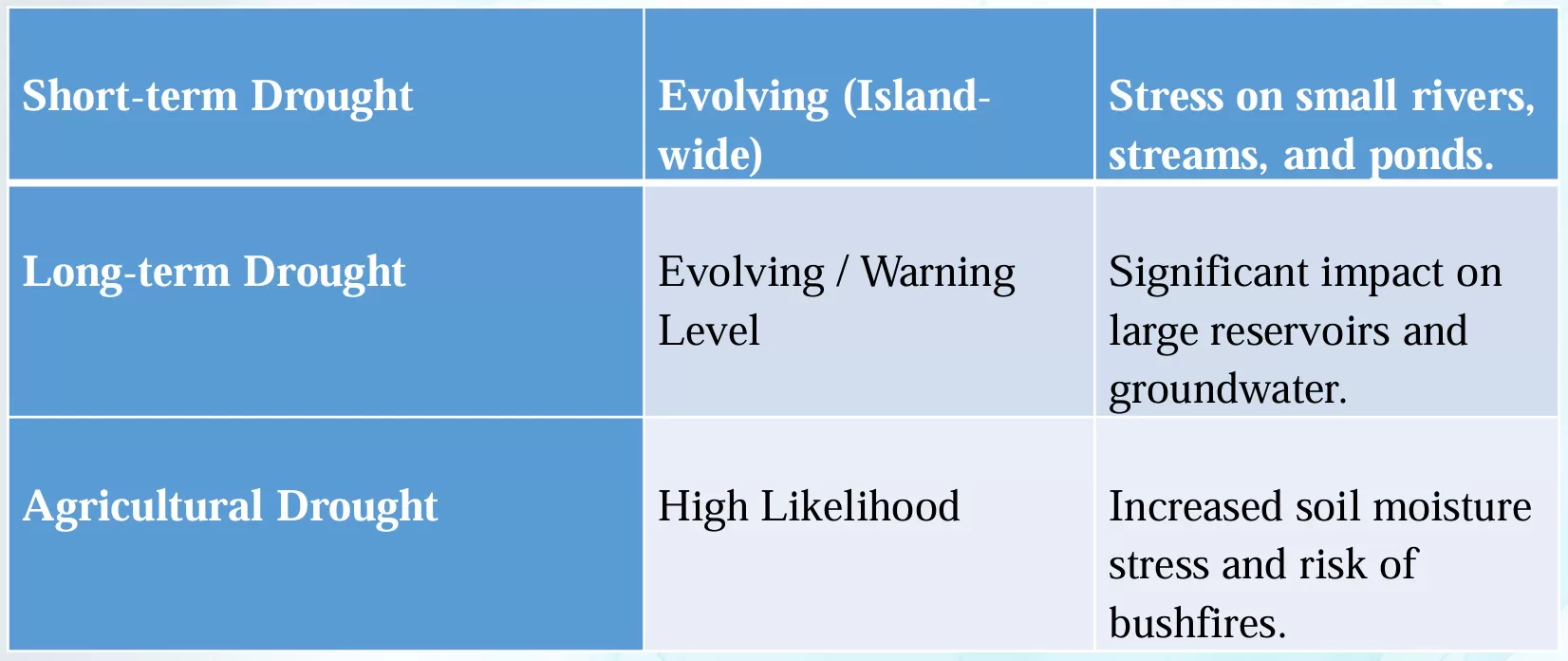
Drought Monitoring Status – As of January 2026, the Caribbean Institute for Meteorology and Hydrology (CIMH) and the Saint Lucia Meteorological Services have escalated monitoring levels based on the Standardized Precipitation Index (SPI):

The Water and Sewerage Company (WASCO) has already reported a 50% decrease in production on the southern network and significant intake reductions in the north, particularly affecting the Hill 20 Treatment Plant.
Seasonal Outlook & Expectations (January – June 2026)
While some near-normal rainfall may occur in the immediate January–March
window, the long-term forecast suggests a worsening trend:
April to June: Forecasts favor a drier-than-normal conclusion to the dry season, coinciding with the start of the heat season.
Water Resilience: The 2025 wet season delivered roughly 34% less rain than average. Because the wet season typically provides 70% of the island’s annual water, reservoirs entered 2026 in a “stressed” state with very low resilience for a prolonged drought.
Peak Heat: Peak heat conditions are expected between August and October 2026, which may further complicate water recovery if the 2026 wet season is also delayed.
Public Advisory
Saint Lucia is likely to experience a severe dry season.
The following measures are urged:
1. Water Conservation: Repair household leaks immediately and avoid non essential water use (e.g., power washing, garden hoses).
2. Storage: Utilize rainwater harvesting systems to supplement the central supply.
3. Fire Safety: Exercise extreme caution to prevent bushfires, which are more likely in these cured (dry) vegetation conditions.
Conclusion
Persistent dry and warmer-than-normal conditions will remain the dominant feature of the 2026 dry season. Coordinated water management and active public cooperation are essential to mitigate the socioeconomic impacts of this event.
CEOM To Saint Lucia – 2025
Caricom election observation mission (CEOM) to Saint Lucia
The Caribbean Community (CARICOM) has mounted an eleven-member CARICOM Election Observation Mission (CEOM) to observe the General Elections of Saint Lucia scheduled for 1 December 2025. The Mission comprises senior electoral and other officials from nine (9) CARICOM Member States, as well as two (2) members of the CARICOM Secretariat, who will provide administrative and logistical support.The CEOM is headed by the Chief of Mission, Mr. Ian S. Hughes, Supervisor of Elections, Antigua and Barbuda Electoral Commission.
The Caribbean Community (CARICOM) has mounted an eleven-member CARICOM Election Observation Mission (CEOM) to observe the General Elections of Saint Lucia scheduled for 1 December 2025.
The Mission was deployed in response to an invitation extended from the Government of Saint Lucia, issued in a letter dated 11 November 2025. The CARICOM Election Observation Mission will be in the country for the period 24 November – 3 December 2025.
The Mission comprises senior electoral and other officials from nine (9) CARICOM Member States, as well as two (2) members of the CARICOM Secretariat, who will provide administrative and logistical support. The CEOM is headed by the Chief of Mission, Mr. Ian S. Hughes, Supervisor of Elections, Antigua and Barbuda Electoral Commission. The other members of the CEOM are as follows:
- Mr. Harrison Thompson, Parliamentary Commissioner (The Bahamas);
- Ms. Maxine Pamela O. McClean, Member of the Electoral Commission (Barbados);
- Mr. Duncan Stowe, Chairman of the Electoral Commission (Dominica);
- Mr. Nicholas Alexander, Assistant Educational Testing and Measurement Officer, Parliamentary Elections Office (Grenada);
- Mr. Manoj Narayan, Commissioner, Guyana Elections Commission (Guyana);
- Ms. Daynia Harper, Manager, Public Relations and Communications, Electoral Commission of Jamaica (Jamaica);
- Mr. Kamlesh Virender Ganesh, Member of the Independent Electoral Council (Suriname); and
- Ms. Leslie Ann Crichlow-Billy, Acting Registration Supervisor, Elections and Boundaries Commission Elections and Boundaries Commission (Trinidad and Tobago).
The CEOM is supported by the following CARICOM Secretariat staff:
- Mr. Brian Bellevue, Programme Manager, Directorate for Foreign Policy and Community Relations; and
- Ms. Denise Morgan, Directorate for Foreign and Community Relations.
The Chief of Mission and CARICOM Secretariat staff, who comprise the Core Group, arrived in Saint Lucia on 24 and 25 November 2025. The remaining members of the observation team are expected to arrive by 27 November 2025.
To date, the CEOM has met with the Honourable Allen Chastanet, Leader of the Opposition of Saint Lucia and the political leader of the United Workers Party. In the coming days, the CEOM is scheduled to meet:
Honourable Philip J Pierre, Prime Minister of Saint Lucia and Leader of the Saint Lucia Labour Party (SLP);
Ms. Maureen John Xavier and Members of the Saint Lucia Electoral Commission; Mr. Herman St. Helen, Supervisor of Elections;
Mr. Verne Garde, Commissioner of Police.
The team will also engage with other political actors, media and civil society institutions. These engagements are expected to provide the CEOM with a first-hand account of the pre-election atmosphere and assess the level of preparedness for the holding of the elections.
The role of the CEOM Observers on Election Day is to observe the electoral process, including preparations for the start of the poll, the casting of votes, the closure of the polling stations, the counting of the ballots, and the declaration of results. The CEOM will also assess the immediate post-election atmosphere.
Following the conclusion of the Election Day activities on 1 December 2025, and prior to the departure of the CEOM on 3 December 2025, a Preliminary Statement will be issued, outlining the Mission’s initial assessment of the electoral process.
A detailed Final Report providing a summary of the Mission’s comprehensive findings and recommendations will subsequently be prepared. This Report will be submitted to Dr. Carla Barnett, Secretary-General of the Caribbean Community, and subsequently made public.
The CARICOM Election Observation Mission values this opportunity to support the democratic process in Saint Lucia. The Mission expresses its appreciation for the warm welcome and cooperation received since its arrival and extends its best wishes to the electorate as they prepare to go to the polls
Caribbean Food Systems to Weather Climate Change Needs Action
Experts Warn Action is Needed for Caribbean Food Systems to Weather Climate Change
Caribbean agriculture faces an existential crisis as increasingly intense climate events devastate farming communities across the region, experts and development leaders warned at a critical side event during the 30th United Nations Climate Change Conference (COP30), which was held on November 10 – 21, 2025, in Belém, Brazil.
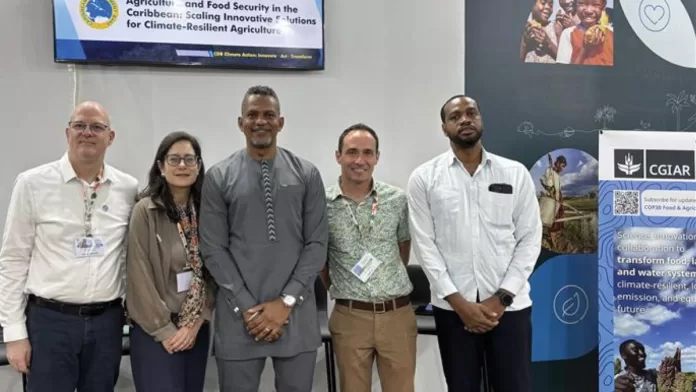
The Caribbean Development Bank (CDB, the Bank) convened panel discussion, “Agriculture and Food Security in the Caribbean: Scaling Innovative Solutions for Climate-Resilient Agriculture,” brought together representatives from the CDB, the Green Climate Fund (GCF), the Food and Agriculture Organization of the United Nations (FAO), and CGIAR to address the urgent need for transformative climate action in Caribbean food systems.
In opening the discussion, CDB President Daniel M. Best cited the devastating impact of Hurricane Melissa, which recently ravaged Jamaica, noting that the agriculture sector is often among the hardest hit by climate shocks. “These are not one-off or sporadic events, and these are not hypothetical future scenarios. Our region is suffering right now from increasing temperatures, declining precipitation and rising sea levels, and every year these challenges are being compounded by major storms that are increasingly intense and develop with unprecedented speed. This is a one-two punch that fundamentally threatens our prospects for sustainable development,” he said.
Dr. Todd Rosenstock, Director of Climate Action at CGIAR, noted that extreme events affect not only agricultural production directly but entire value chains and food systems, making it essential to protect both individual farmers’ productive assets and the overall supply chains that sustain Caribbean islands. However, he also underscored that for the Caribbean, the climate crisis is fundamentally a water crisis. “It’s the prolonged droughts. It’s the increased rainfall that’s reducing the productive capacity of agricultural land. Really, addressing the water crisis is of the utmost importance,” Dr. Rosenstock explained.”
Ms. Kristin Lang, Director for the Latin America and Caribbean Region at the GCF Secretariat, took a similar position. “We’re all seeing the issue of water security coming into play, and we can talk about food, but we can’t have any food if we don’t have any water.” Lang said, adding that “We need to address the issue of irrigation because you are going to see that rainfall is either too much or too little,”.
Mr. Martial Bernoux, Climate Change Team Leader at FAO, outlined three critical pillars necessary for transformation: policy frameworks, finance mechanisms, and data systems. However, he delivered a sobering warning on financing, citing the investment gap facing agriculture. “From the last two reported years, all sectors increased their amount of climate investment by 11%. Agriculture? 1%. This is the only sector that is not attracting enough investment.”
He emphasised that public money alone cannot meet the scale of transformation needed. “We need trillions. It’s not billions. And to have those trillions, we need to direct investment toward this sector and show that investing in this sector works.”
All panellists stressed the critical importance of placing farmers, fishers, and rural communities at the centre of climate solutions. The experts also agreed that while challenges are formidable, solutions exist and must be scaled urgently.
The panel discussion is one of several knowledge-sharing and advocacy events CDB hosted or supported at COP 30. The Bank’s main objective at the global forum was to amplify the deleterious impacts of climate change on the Caribbean’s sustainable development thrust and garner support for effective solutions.
Caribbean Sustainable Infrastructure Conference 2025 Concludes
Caribbean Sustainable Infrastructure Conference 2025 Concludes with Calls to Build Stronger and More Inclusive Region
The inaugural Caribbean Sustainable Infrastructure Conference (CSIC 2025) provided an unprecedented opportunity for governments, the private sector and development partners to unite and chart a bold new course for transforming the region.
Hosted from November 3–5 by the Caribbean Development Bank (CDB) in partnership with the UK Foreign, Commonwealth and Development Office (FCDO) and Agence française de développement (AFD), through funding from the European Union, CSIC 2025 reinforced that resilient infrastructure is the foundation for economic competitiveness, social inclusion, and environmental stewardship in the Caribbean.
From climate-resilient ports and housing to nature-based coastal defenses and inclusive urban design, the three-day event underscored how the Caribbean can move from vulnerability to vitality by building infrastructure that not only safeguards communities but also fuels opportunity, equity, and innovation. Discussions yielded actionable pathways and strengthened partnerships to accelerate climate resilience, deepen social inclusion, and unlock innovative financing for sustainable growth. Participants discussed how using data, smart design, and approaches that incorporate gender and disability inclusion can make infrastructure more adaptable. They also explored tools like CDB’s Road Sector Resilience Index and climate finance initiatives, which help scale up investment in resilient and inclusive development across the region.
Adding a forward-looking perspective, students from the Barbados Community College and the University of Technology, Jamaica, showcased innovative sustainable design concepts to revitalise Bridgetown. Their presentations demonstrated how youth creativity and academic collaboration can help to reimagine Caribbean urban spaces that meet diverse needs of communities and mitigate environmental and socio-economic risks.
In his closing address, CDB President Daniel Best encouraged participants to continue discussions after the event to find solutions that will strengthen climate resilience, promote equity in access to services, and mobilise finance for withstanding future shocks while supporting inclusive growth.
“Sustainable infrastructure is more than concrete and steel; it is a commitment to balance. It demands that we harmonise environmental stewardship, social equity and economic viability, while always placing the people of our region at the centre of every decision,” highlighted Mr. Best.
The British High Commissioner to Barbados and the Eastern Caribbean, H.E. Simon Mustard reminded participants that resilience must be a shared mission stating, “Resilience is not a luxury; it is a necessity. This conference has shown us what is possible when we work together. Let’s continue to build trust, deepen engagement, and work together to deliver infrastructure that is resilient, inclusive, and transformative.”
AFD Regional Project Manager, Financial Institutions, Mrs. Mylène Lerigab, reflected on conference key themes and urged participants to view resilience through hybrid solutions by integrating nature-based approaches, modern engineering, and state-of-the-art materials. She emphasised that the ultimate goal is the well-being of Caribbean people through sustainable development and mindset change explaining, “It is clear that we need to find resources to build projects, to be innovative to do more, as new financial products, public development fund guarantee of course. But, the first thing we need is to change our mind for sustainability. We need to change our mindsets to convince ourselves and those around us of the changes needed to build socio-economic resilience in the Caribbean.”
Minister of Planning and Development for Barbados, Dr. the Honourable William F. Duguid, J.P., M.P., underscored the importance of collective action adding, “The coming together of a wide range of local, regional and international practitioners to deliberate on themes such as tackling climate risks, promoting equity and gender inclusion, advancing innovation-led economic development and strong governance through collaboration is both timely and critical. The Caribbean must design finance and build as though its survival depends on it – because it does.”
CSIC 2025 closed with a strong call to action to advance initiatives that protect communities from climate shocks, expand access to essential services, and create equitable opportunities for all. This shared resolve underscored a collective vision for a more resilient and inclusive Caribbean driven by partnership and innovation.
GRIT Launches in Belize to Unlock an Untapped Engine of Growth
When Women Thrive, Nations Advance: GRIT Launches in Belize to Unlock an Untapped Engine of Growth
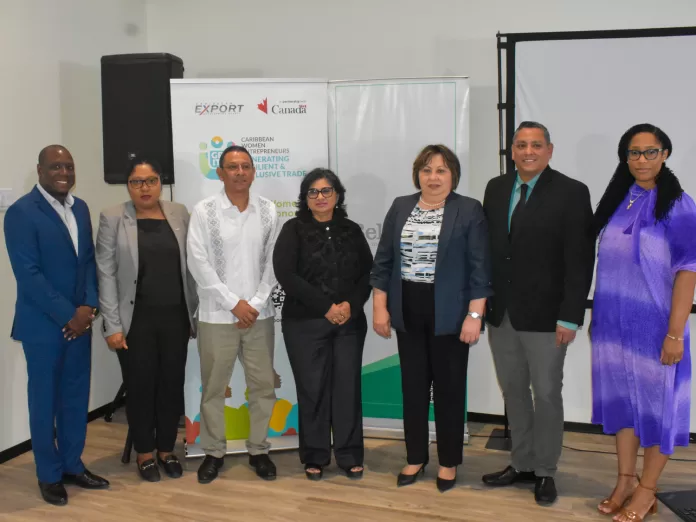
The Caribbean Export Development Agency (Caribbean Export), in partnership with Global Affairs Canada (GAC) and BELTRAIDE, officially launched the Caribbean Women Entrepreneurs Generating Resilient and Inclusive Trade (GRIT) initiative in Belize on November 12, 2025 — marking another milestone in the regional movement to empower women entrepreneurs and transform Caribbean trade.
Held at the Grand Residences & Resort in Belize City, the launch brought together representatives from government, business, and civil society to celebrate a shared vision — one where women-led enterprises are not only creating products but also shaping purpose-driven growth across the Caribbean.
Empowering Women, Transforming Trade
The GRIT project is a four-year, CAD $3.16 million initiative funded by the Government of Canada and implemented by Caribbean Export. It aims to strengthen the export capacity of women-led businesses across six Caribbean countries — Belize, Dominica, Grenada, Jamaica, Saint Lucia, and Saint Vincent and the Grenadines — by improving access to trade intelligence, resources, and international market opportunities.
Through GRIT, women entrepreneurs will benefit from technical assistance, training, digital transformation support, matching grants, and export readiness guidance, enabling them to compete more effectively in regional and global markets, including Canada.
Wayne Elliott, Manager of Technical Programmes at the Caribbean Export Development Agency, highlighted the transformational reach of the initiative, noting:
“GRIT is about meeting women where they are. It will directly support 800 entrepreneurs and indirectly impact more than 10,000 women across the Caribbean. We’ve already completed activations in Saint Lucia and Dominica, and with Belize now underway, we are preparing to expand to the remaining countries early next year. It’s crucial that we engage women within their own communities, so the support offered truly reflects their needs and ambitions.”
Mr. Ishmael Quiroz, Executive Director of BELTRAIDE, highlighted the agency’s long-standing commitment to advancing women in trade, stating:
“You are not waiting for opportunity. You are creating it. We are here to ensure the system meets your ambition. BELTRAIDE stands with you. EXPORTBelize stands with you. And through GRIT, the region stands with you.”
Partnership for Inclusive Growth
Representatives from key government ministries reaffirmed Belize’s commitment to inclusive, gender-responsive economic transformation — a cornerstone of the nation’s development strategy.
Narda Garcia, Chief Executive Officer in the Office of the Prime Minister and Ministries of Investment and Civil Aviation, emphasized that women’s economic empowerment is central to Belize’s development agenda and not a peripheral concern. She stated:
“Gender equality is not a social welfare project; it is a macroeconomic imperative. The full and equal participation of women in our economy is the single most significant untapped resource we have for driving sustainable growth, building resilience, and creating a more prosperous future for all.”
Carlos Pol, Chief Executive Officer in the Ministry of Economic Transformation, underscored the economic urgency of strengthening women’s participation in trade and entrepreneurship. He emphasized that empowering women is not only a social imperative but a national economic necessity, stating:
“According to the IMF, increasing women’s labour force participation could possibly raise GDP levels by 23 percent. That is no small contribution. We must understand that depriving women of the services they need to grow their businesses and themselves means that we are also depriving the country of significant economic growth.”
Adele Catzim-Sanchez, Chief Executive Officer in the Ministry of Human Development, Family Support and Gender Affairs, emphasized the national importance of GRIT’s mission and the transformative power of women’s participation in trade. She noted:
“This Project recognizes that when women thrive, families thrive, communities prosper, and nations advance.”
She further highlighted how GRIT aligns seamlessly with Belize’s long-term development frameworks, adding:
“Women’s economic empowerment is not a side agenda. It is central to national development, to achieving the goals of Plan Belize, and to realizing the vision of our National Gender Policy.”
Their remarks underscored the role of women as economic drivers and innovators in Belize’s future — and the importance of collaborative partnerships like GRIT in bridging gaps and creating sustainable pathways for women in trade.
From Vision to Venture
The event featured a fireside chat with two of Belize’s most dynamic women entrepreneurs — Wilana Oldman, CEO of Hot Mama’s Belize, and Nefretery Marin, CEO of Ostrich Organic Farm and Barzakh Falah Farms & Craft — who shared their experiences of navigating export markets, scaling businesses, and leading with creativity and resilience.
Their stories embodied the spirit of GRIT — courage, persistence, and purpose — inspiring attendees to see entrepreneurship not only as business but as a form of nation-building.
Canada’s Commitment to Inclusive Trade
Through GRIT, Global Affairs Canada and Caribbean Export continue to advance gender-responsive trade practices that ensure women entrepreneurs across CARIFORUM states can fully participate in and benefit from trade opportunities. The initiative is part of Canada’s broader commitment to inclusive economic growth, climate resilience, and women’s empowerment across the Caribbean.
EV Expo Set to Energize Saint Lucia
The AI Revolution – A Way Forward

The AI Revolution – A Way Forward
Artificial intelligence (AI) is rapidly changing our world. It has helped a few companies in
developed countries set record-breaking profits. This week, Nvidia, a leading US Artificial Intelligence company, hit a market value of USD5 trillion. Nvidia, together with the other six technology companies known as the Magnificent Seven, reached a market
capitalisation of USD22 trillion. This value easily eclipses the combined GDP of the
world’s 44 Least Developed Countries (LDCs), Small Island Developing States and
Landlocked Developing Countries.
These businesses continue to make massive investments in this transformational
technology. Not only are investments being made in AI for the future, but benefits are
also already being reaped as it accelerates global commerce and rapidly transforms
markets. According to the World Economic Forum, AI is streamlining supply chains,
optimising production, and enabling data-driven trade decisions, giving companies a big
competitive edge in global markets. Thus far, the beneficiaries have been those living in
the developed world, and a few developing countries with high technological capacities,
like India.
By and large, developing countries have lagged far behind this technological revolution.
The world’s 44 LDCs and the Small Island Developing States are those that have been
almost completely left out. According to UNCTAD, LDCs risk being excluded from the
economic benefits or the AI revolution. Many LDCs and Small Island Developing States
struggle with limited access to digital tools, relying on traditional methods for trade
documentation, market analysis, and logistics. This is happening as others race ahead.
This widening gap threatens to marginalize these countries in international trade and
underscores the urgency of ensuring they can participate fully in the AI-driven global
economy.
AI holds transformative potential for developing countries across sectors critical to
economic growth and trade. The World Bank has noted that in agriculture, AI-driven
tools can improve crop yields, forecast market demand, and enhance supply chain
efficiency. It can also strengthen food security and export earnings. In trade and logistics, Artificial Intelligence can optimize operations, reduce transaction costs, and help local producers access new markets.
Beyond commercial applications, AI can bolster disaster preparedness, enabling
governments and businesses to allocate resources efficiently and minimize losses. The
use of Artificial Intelligence can be a game changer in responding to massive natural disasters such as the one caused by Hurricane Melissa in Jamaica a few days ago.
Despite these opportunities, the poorest and most vulnerable countries face significant
hurdles in accessing and benefiting from AI. The International Telecommunications
Union has noted that many countries lack reliable electricity, broadband connectivity,
and computing resources, impeding the deployment of Artificial Intelligence technologies. This is compounded by human capacity constraints and limited fiscal space to make the
requisite investments.
Given this, what is the best way forward for the world’s poorest and most vulnerable
countries? Firstly, policy and governance frameworks for leveraging AI for development
transformation are urgently, and we can learn from others. For example, Rwanda, a
leader in the field of using technology to drive transformation has developed a National
Artificial Intelligence Policy. Another example is Trinidad and Tobago, which recently
established a Ministry of Public Administration and Artificial Intelligence.
Secondly, capacity building, especially for policy leaders, is key. This must be
augmented by making the requisite investments in universities and centers of
excellence. Given the importance of low-cost and high-impact solutions, building
partnerships with institutions in the global south is absolutely vital.
Finally, financing remains key. However, given the downward trends in overseas
development assistance, accessing finance, especially grant and concessional
resources from other sources will be important. Consequently, international financial
institutions, especially the regional development banks, have a critical role to play. Since
the countries themselves are shareholders, every effort should be made to establish
special purpose windows of grants and concessional financing to help accelerate
adoption of relevant, low-cost, relevant and high-impact Artificial Intelligence technological solutions.
In an adverse financing environment, achieving the above will be difficult. This is where
Tech Diplomacy comes in and must be a central element of a country’s approach to
foreign policy. This will be the subject of another piece.
In summary, Artificial Intelligence is shaping and changing the world now. For the poorest and most vulnerable countries, all is not lost. With strategic investments, forward-looking and inclusive policies, and international cooperation via Tech Diplomacy, AI can become a
powerful tool for their sustainable growth and development.
Deodat Maharaj is a national of Trinidad and Tobago and is presently the Managing
Director of the United Nations Technology Bank for the Least Developed Countries. He
can be contacted at: deodat.maharaj@un.org
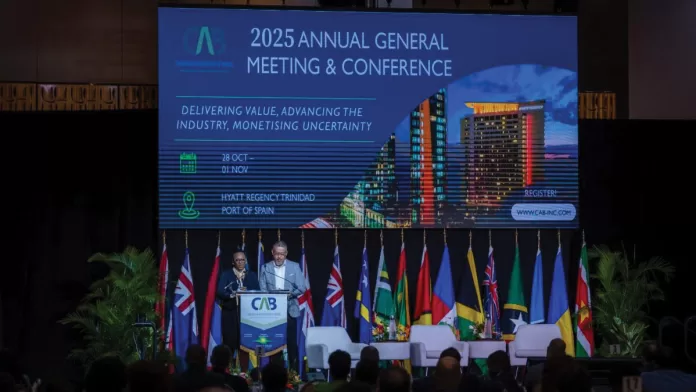
Caribbean Bankers Gather in Port of Spain for CAB AGM & Conference 2025
The Caribbean Association of Banks Inc. (CAB) is hosting its highly anticipated 2025 Annual General Meeting (AGM) and Conference under the forward-thinking theme “Delivering Value, Advancing the Industry, Monetising Uncertainty.”
From 28 October to 1 November 2025, the Hyatt Regency Trinidad, Port of Spain, serves as the epicentre of Caribbean banking excellence, bringing together the region’s leading financial minds, innovators, and decision-makers for five days of insight, strategy, and connection.
The conference kicked off on Tuesday, 28 October 2025, with the Sustainable Banking Roundtable, setting the stage for robust dialogue on the financial sector’s evolving role in addressing climate change, environmental and social governance (ESG), thematic bonds, and regulatory transformation.
As Caribbean economies continue to navigate global shifts, this session underscored CAB’s commitment to strengthening sustainability as both a business opportunity and a moral imperative for regional banks.
Concurrently, Republic Bank hosted the Small Business Workshop and Marketplace, which was well received, with over 30 participants gaining the opportunity to learn from leading entrepreneurs and financial experts on strategies for accessing finance, enhancing digital capabilities, and scaling operations in an evolving business landscape.
On Wednesday, 29 October 2025, CAB members gathered for the Annual General Meeting — a pivotal moment for reflection on opportunities and accomplishments over the term, strategic alignment for the new term, and the election of the new Board of Directors who will guide the association’s strategic imperatives for the 2025–2026 term.
The evening culminated in a Grand Opening Ceremony, a hallmark celebration of Caribbean banking excellence, innovation, and collaboration.
The featured speaker, Dr. Alison Gajhdar-Foster, delivered deep and thought-provoking insights on the values on which the sector must focus, reminding attendees of the importance of maintaining trust as a central determinant of customer loyalty, while driving a system-thinking approach to banking.
The plenary sessions on Thursday, 30 October 2025, brought sharp focus to the trends redefining financial services across the Caribbean and beyond:
● Banking as a Service – A Caribbean Focus
● Cybersecurity: A Determinant of Customer Loyalty?
● The Evolution of Relationship Banking – Where Are We Now?
● CDB Trade Finance Guarantee Program: Bridging Risk, Building Access
These sessions delivered deep insights and practical takeaways for leaders seeking to navigate volatility and monetize opportunity in an ever-changing financial landscape.
On Friday, 31 October 2025, the spotlight turns to the future of sustainable and digital finance:
● ECM, AI, and Low-Code as the New Core for Efficient Banking
● The Future of Intra-Regional Payments – CAPSS
● Sustainability Disclosure Standards: S1 and S2 in Focus
● Gen AI and the Caribbean Banking Sector
● From Awareness to Action: Strengthening Cybersecurity in the Caribbean Banking Industry
These discussions aim to sharpen the industry’s understanding of new disclosure standards, sustainability reporting, and the integration of ESG principles into banking operations.
The week concludes on Saturday, 1 November 2025, with a networking event designed to spark collaboration, celebrate the enduring spirit of Caribbean banking, and offer a relaxed switch from coffee and suits to cocktails and sandals.
CAB proudly acknowledges the partnership of its valued sponsors, whose support continues to elevate the conference’s impact and reach:
● Title Sponsor: Newgen
● Diamond Sponsors: Euronet, Howden, Republic Bank
● Platinum Sponsors: Berkeley Bank & Trust, Calibra, Crown Agents Bank, Creatio, ERI, Smart Solutions, Stratos-Cyber Inc.
● Gold Sponsors: First Citizens, Grant Thornton, Jack Henry, Advantaq, Ictual, Hitachi, Ernst & Young
● Other Sponsors: Diebold Nixdorf, ANSA Merchant Bank, MC Systems, GM Sectec, United Texas Bank, GISCAD, GGGI
● Education and Training Partners: Jamaica Institute of Financial Services, Keith Checkley & Associates, Institute of Banking and Finance of Trinidad and Tobago.