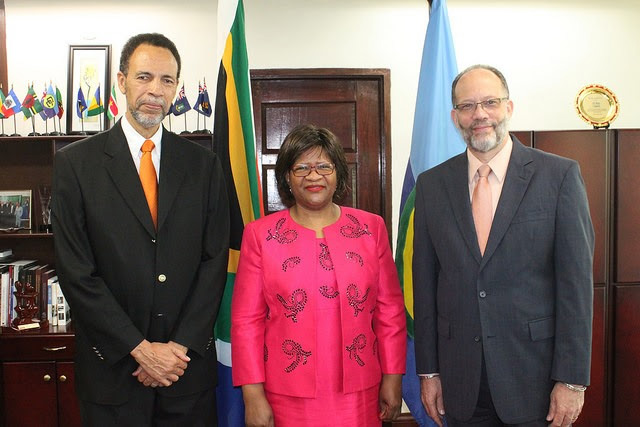
(L-R) Amb. Colin Granderson, Assistant Secretary-General, CARICOM, Plenipotentiary Representative of South Africa to the Caribbean Community (CARICOM), Her Excellency Xoliswa Nomathamsanqa Ngwevela and Secretary-General, CARICOM, Ambassador Irwin LaRocque.
The Caribbean Community (CARICOM) and South Africa on Thursday strengthened the long-standing diplomatic relations with the accreditation of a new High Commissioner, Her Excellency Xoliswa Ngwevela.
In accepting her letters of credence, Secretary-General Ambassador Irwin LaRocque said it was a “symbolic reaffirmation of the determination of South Africa and the Member States of CARICOM to augment a long tradition of friendship, solidarity and the promotion of shared values, not just amongst ourselves, but in the global sphere.”
He told the new envoy that CARICOM was counting on South Africa to articulate its concerns on the withdrawal of correspondent banking services, a practice that threatens to undermine the region’s robust efforts to ensure economic stability and growth.
“The de-risking activities of certain transnational banks that are resulting in their withdrawal of correspondent banking services, have the potential to delink our economies from the international trading system and global economy.
“Similarly, the practice by certain countries of unjustifiably blacklisting CARICOM Member States as non-cooperative tax jurisdictions makes a mockery of our efforts and documented success in complying with onerous international regulations in this respect,” the Secretary-General told the new South African envoy.
He also noted CARICOM’s concern about “the troubling tendency” by many partners to graduate countries from access to concessionary financing based on the fundamentally flawed categorisation of some Member States’ economies as middle income.
Such categorisation, based solely on GDP per capita, pays no regard to other factors such as our vulnerabilities as small-island and low-lying coastal developing states, SIDS, he said”
“Indeed, we ask South Africa to air these concerns and share our proposed solutions in all those fora that claim to have development at heart, including those fora to which South Africa has access, and CARICOM States do not, like the G20 and BRICS. We particularly seek South Africa’s support in calling for the means of measuring development to be revisited,” he stated.
In her remarks, Ms Ngwevela noted that South African Development Community and CARICOM were striving for similar goals of harmonising economic development. They both have developed milestone Strategic Plans to guide them and she feelt they can work together in this regard.
“Under your leadership, Sir, I have learnt that CARICOM has recalibrated and refocused its modus operandi and has adopted its “first ever” strategic plan that was approved by Heads of States and Governments in 2014. Similarly, in Africa, the Africa Union has adopted its own plan at their Summit in South Africa in January, 2015. This is a first ever strategic plan, called Agenda 2063 – The Africa We Want, whose end goals must be achieved by 2063, when the African Union celebrates its centenary.”
IMF Executive Board Approves US$1.64 billion Stand By Arrangement for Jamaica.
IMF Board approves new three year SBA agreement for US$ 1.64 billion, program follows successful EFF agreement
The Jamaican authorities have indicated that they will treat the arrangement as precautionary
New arrangement aims to sustain macroeconomic stability, while boosting employment, raising living standards
The Executive Board of the International Monetary Fund (IMF) today approved a three-year Stand-By Arrangement (SBA) for Jamaica to support the authorities’ continued economic reform agenda. Access under the SBA arrangement amounts to about US$ 1,64 billion (SDR 1,195.3 million), the equivalent of 312 percent of Jamaica’s quota in the IMF. The Jamaican authorities have indicated that they will treat the arrangement as precautionary, and do not intend to draw on the new SBA unless exogenous shocks generate an actual balance of payments need. The Executive Board approval will make about US$ 411.9 million (SDR 300.1 million) available, and the remainder in six tranches upon completion of semi-annual program reviews.
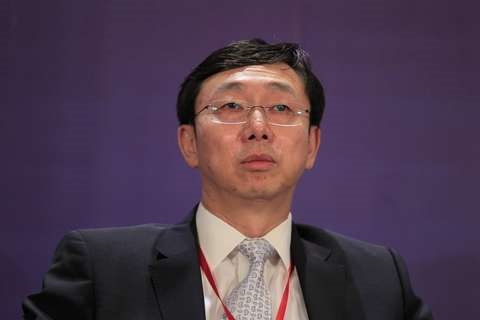
Following the Executive Board discussion on Jamaica, Mr. Tao Zhang, Deputy Managing Director and Acting Chair, said:
“Jamaica has established a commendable track record of program ownership and implementation under the Extended Fund Facility (EFF). Macroeconomic stability has been entrenched, evidenced by low inflation, the build up of foreign currency reserves, and a decline in the current account deficit. Fiscal discipline and proactive debt management have helped place public debt on a downward trajectory. Still, growth is low, poverty and unemployment are high, and crime and security challenges impose a serious drag on growth.
“The authorities’ request for a Stand-By Arrangement (SBA), which they intend to treat as precautionary, will provide insurance against unforeseen adverse external economic shocks, while focusing reform efforts to deliver better growth and job outcomes, as well as reduce poverty, while sustaining macroeconomic stability.
“Fiscal discipline and public debt reduction will continue to anchor Jamaica’s reform program. Public sector transformation, another key pillar of the program, will seek to re-orient public resource allocation toward infrastructure, social protection, and security-related spending, while delivering more efficient public services. The ongoing growth-friendly shift from direct to indirect taxes will continue to broaden the tax base and improve the efficiency of the tax system. The program will continue to protect social spending, while also instituting reforms to strengthen the social safety net.
“The Jamaican authorities recognize that enhancing monetary policy credibility and operations for an eventual move to inflation targeting is critical. Key reforms include strengthening the operational autonomy of the Bank of Jamaica, refining the monetary policy signaling and liquidity provision framework, and improving macroeconomic modeling and forecasting. Toward this end, the authorities are committed to maintaining exchange rate flexibility and continuing to build international reserves through market-based purchases of foreign exchange. Furthermore, concrete steps will be taken to further enhance financial sector resilience and promote greater access to credit and financial inclusion.
“Supply side reforms are critical to unlock Jamaica’s growth potential and create more private sector jobs. In this context, every effort is needed, in collaboration with development partners, to execute the structural growth reforms recommended by the authorities’ Economic Growth Council. Resources will have to be redirected to combat crime and ensure national security. Easing of growth bottlenecks will facilitate a stronger private sector job creation, as the government refocuses and streamlines its role.
“The authorities’ commitment and commendable track record, together with continued broad-based support for the reform agenda, should help foster its successful implementation.” ANNEX Background
Jamaica has made commendable progress in its economic adjustment program over the past three and a half years under the existing IMF-supported program (see Press Release No. 13/150). Fiscal discipline and proactive debt management have helped reduce public debt by more than 25 percent of GDP since the start of the extended arrangement under the Extended Fund Facility (EFF). Macroeconomic stability is becoming entrenched as evidenced by low inflation, the buildup of foreign currency reserves, and a decline in the current account deficit. And important reforms are being undertaken to unlock Jamaica’s growth potential.
Still, real GDP growth and employment dividends from the reforms have been slow to materialize. Growth has averaged 0.8 percent during the program period, albeit improving more recently to 1.4 percent in Q1 of FY16/17, supported by gains in agriculture, manufacturing, electricity generation, and tourism. Growth in FY2016/17 is expected to reach 1.7 percent in FY16/17. Business confidence is strong and Jamaica’s international bonds are trading close to the average rate of other emerging markets. Unemployment is still high at 13.7 percent in April 2016, which partly reflects an increase in labor force participation. Program objectives
A renewed focus on growth and job creation is needed, and the new precautionary Stand-By Arrangement (SBA) aims to sustain the macroeconomic stability, while boosting employment, raising the living standards of the Jamaican people, and progressively reducing a poverty level that remains too high. The main pillars of the program are to:
(i) better support growth, jobs, and social protection, including by improving public sector efficiency, rebalancing from direct to indirect taxes, strengthening the social safety net, and reallocating public resources to growth-enhancing capital spending;
(ii) reduce public debt to 60 percent of GDP by 2025/26 by maintaining primary surplus at 7 percent of GDP for the duration of the new arrangement;
(iii) modernize the monetary policy framework and build the foundation for an eventual move to inflation targeting, while maintaining exchange rate flexibility and continuing to build precautionary reserves; and
(iv) bolster the resilience of the financial system.
Members of Parliament referred extensively to the CDB report at the Nov. 8 House sitting.
The Caribbean Development Bank’s report “Fiscal and Structural Reforms in Saint Lucia: Towards a Comprehensive Agenda” is available for reading by the public.
Members of Parliament referred extensively to the report at the Nov. 8 House sitting, as they discussed amendments to the Value Added Tax legislation.
A draft version of the report was also the basis for a press conference in September by Minister in the Ministry of Finance Hon. Dr. Ubaldus Raymond and the CDB’s Director of Economics Dr. Justin Ram, where some of the findings were discussed. At that time it was announced that once received, the final version of the report would be made available to the public.
The Eastern Caribbean Central Bank also contributed to the report, along with the staff of the Ministry of Finance.
The report is available below and can also be accessed via: http://www.govt.lc/publications/
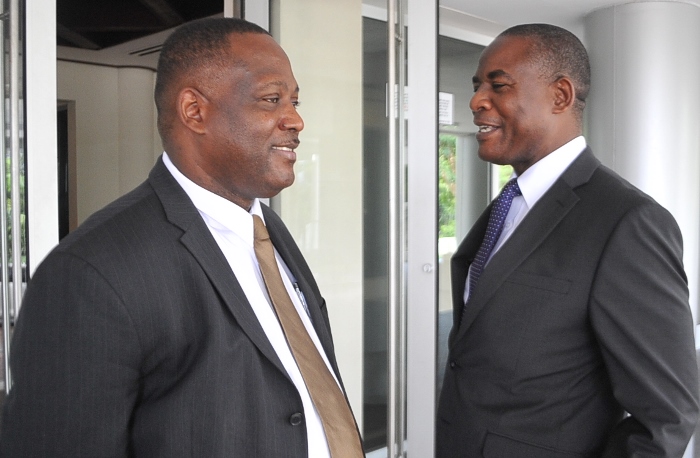
International Business Minister, Donville Inniss chatting with ICAB Executive Director, Reginald Farley, at ICAB’s 23rd Annual Conference at the Lloyd Erskine Sandiford Centre today. (A.Miller/BGIS)
Barbados’ overall rating on implementing the standard on transparency and exchange of information has been upgraded from partially compliant to largely compliant.
International Business Minister, Donville Inniss, made this disclosure today, as he addressed the Institute of Chartered Accountants of Barbados’ 23rd Annual Conference at the Lloyd Erskine Sandiford Centre.
Mr. Inniss stated that as a result of the upgrade, entities that were previously unable to access financing from some international financing institutions because of their policy concerning countries with partially compliant ratings, could now do so.
The Minister, who recently returned from Tbilisi in Georgia, Russia, where he led a delegation to the Global Forum Plenary, told attendees that despite this victory, “there was still much work to be done”.
“…work is ongoing to implement the Common Reporting Standard for automatic exchange of information in 2017 as an early adopter, while we also prepare for our next Peer Review in the latter half of 2018,” he shared.
Noting that the new rounds of Peer Reviews were currently under way, Mr. Inniss explained that countries would be assessed based on the Global Forum’s 2016 Peer Review methodology, which now includes a focus on beneficial ownership and the quality of exchange of information.
He further added that Barbados was preparing for a mutual evaluation by the Caribbean Financial Action Task Force, and an assessment team was scheduled to conduct a site visit in December.
“This review will assess our effectiveness in implementing the recommendations concerning knowing your customer and anti-money laundering and counter-terrorist financing.
In this regard, a delegation is in the Turks and Caicos attending a plenary of the Caribbean Financial Action Task Force as part of our preparation for our mutual evaluation,” he stated.
The theme for this year’s conference is: Barbados at 50 reaching beyond this horizon.
Minister of Culture, Sports and Youth, Stephen Lashley. (FP)
The Ministry of Culture, Sports and Youth is partnering with several organisations to provide aid for Haiti.
During a press conference on Thursday at the Ministry in Sky Mall, Minister Stephen Lashley said that his department was collaborating with the Pan-African Coalition Organisation (PACO) in order to bring relief to Haiti after it was severely hit by Hurricane Matthew.
“We really are extremely sad to see the devastation; we feel that there is need for response that will bring a measure of relief for our sisters and brothers in Haiti…It is going to be very important for Barbados and the rest of the Caribbean to provide a response,” he stated.
Emphasising that the relief effort must be an “ongoing” one, Mr. Lashley told members of the media that there were plans to collect food, water and medical supplies at various locations across the island, including schools, businesses and churches.
Additionally, with deforestation proving to be a challenge in Haiti, the Minister stated that a decision was made to donate trees in order to assist with reforestation efforts.
According to him, some trees would be instrumental in the prevention of land slippage, while others could help to supplement the diets of Haitians or be used for medicinal purposes.
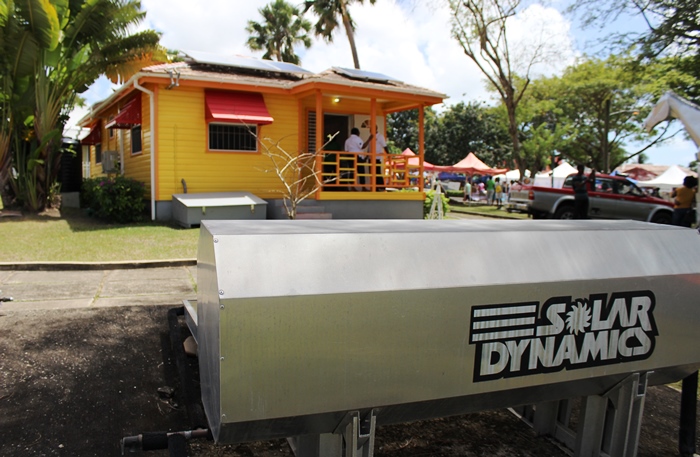
Mr. Lashley also disclosed that his Ministry and PACO were seeking to provide relief in the form of locally-crafted solar cookers. The cookers, fashioned out of easily sourced materials, will initially be created by Adhim Muhammad, a concerned citizen wishing to assist in the efforts.
The Minister added that a concert, entitled: One Love, would be held in February to coincide with Black History Month. He said the event would feature some of Barbados’ best artistic talents and would be an annual event.
Barbados’ Caricom Youth Ambassador, Zwena Perry, stated that her office had engaged various organisations in assisting in a donation drive entitled: The50 for Haiti Project.
Ms. Perry explained that barrels placed in strategic areas such as A1 Supermarkets and all Massy stores, would be used to collect donations from the public. She added that the CARICOM Youth Ambassadors’ (CYA) office would arrange to transport the donations to Haiti.
Ms. Perry further noted that her office would be hosting a panel discussion on Barbados’ participation in CARICOM, and, in lieu of a monetary contribution, persons would be asked to donate non-perishable food items and personal care items, all of which would go towards relief efforts in Haiti.
The panel discussion, entitled: To Leff or Nah, will take place at The University of the West Indies Cave Hill Campus, on Tuesday, November 22, at 6:30 p.m.
Persons interested in donating a barrel or box may contact the CYA Office via email at cya@barbados.gov.bb, or call the Ministry of Culture, Youth and Sports at 621-2700.
Community groups in the northeastern region of Grenada benefitted from a community-based five-day tourism workshop aimed at developing and strengthening the tourism product in that part of the island.
The northeast region of Grenada comprises the town and villages of Grenville, Marquis, Post Royal, Soubise, Telescope, Mt. Carmel, Munich and Paradise. This area is well known for its rich natural, historical and cultural heritage. The communities are richly endowed with valuable assets including the 200 year old Paradise Bridge, one of the oldest in the entire Caribbean, hot springs, Amerindian historical sites, forts and waterfalls. The Royal Mt. Carmel Waterfall is one of the main attractions in the area because it is the highest waterfall on the entire island.
In addition to these resources, the communities in the North-East are also seeking to unlock the promising potential for activities such as bird watching, given that this area accommodates some extraordinary indigenous birds; and hiking trails owing to the breathtaking landscapes in that region.
The following areas were addressed during the workshop:
Site visits to undertake an Inventory of community assets
SWOT (Strength, Weaknesses, Opportunities, Threats) analysis of the tourism product
An assessment of the potential for community residents to offer home stays and potential eating establishments within the community
The importance of authenticity, community economic and social linkages and marketing strategies
Review of potential target markets, competitor analysis and product potential
Small group training on “How to Establish, Maintain and Respond to a Visitor Satisfaction Feedback System”
One-on-one business development advice to individual community stakeholders
Review of logistics with stakeholders for engaging with tour operators e.g. public liability insurance, health and safety certification etc.
The workshop ran from November 7-11, 2016 and was facilitated by Responsible Tourism Consultant, Mr. James Crockett.
A study will be commissioned shortly to analyse the state of the Solar Water Heating Sector, in an effort to determine what further assistance Government can provide to increase the penetration rate.
Prime Minister Freundel Stuart made the disclosure today while delivering the feature address at the Sustainable Energy Independence in the Caribbean: Making It Happen Conference, at the Lloyd Erskine Sandiford Centre.
Mr. Stuart said the success of the sector had shown what local entrepreneurial spirit, generous fiscal concessions and the support of the community could achieve to make the island a model in the world.
However, he expressed the view that there was a need to increase the penetration rate of the systems in the island, especially in the lower income sector.
He said Government had undertaken a number of initiatives in its quest to make Barbados a 100 per cent renewable energy island within the next 50 years, and it currently has many projects in the pipeline.
The Prime Minister disclosed that by the end of 2017, Government would have started to retrofit the 25,000 streetlights in the island with LED lights; and an additional 50 public buildings would be outfitted with solar photovoltaic systems.
“Thousands of energy inefficient lights in the public and private sector and in households will be changed out as part of the Government’s Phase Out Plan for energy inefficient lighting….,” he explained.
He added that a study would have been completed on the potential of the island for ocean energy, particularly ocean thermal energy conversion; and work would have started on the first wind energy utility scale plant in Barbados.
Mr. Stuart added that some of the tangible results were the distribution of approximately 45,000 free LED lights to householders; and another 12,000 would be issued within the next two months.
He noted that public buildings, including the Queen Elizabeth Hospital, schools, polyclinics and fire stations, had been retrofitted with 25,000 LED lights.
“Rebates have been provided for over 3,000 residences for energy efficient appliances under the Energy Smart Fund, and the Government has provided in excess of $12 million in low interest loans to businesses for the erection of solar photovoltaic systems…,” he pointed out.
The two-day workshop is sponsored by the Barbados Renewable Energy Association and the Central Bank of Barbados.
SLTB looks towards future advancements while managing the transitionary period.
Following the resignations of the Director and Deputy Director of the Saint Lucia Tourist Board, Minister of Tourism, Dominic Fedee, has announced that the current Chairperson of the Board, Agnes Francis, will assume the role of Executive Chairperson while the organization transitions to the Saint Lucia Tourism Authority and recruits new leadership. Thus far, the Executive Chair is being ably assisted by the remaining staff who have given their fullest support and are able to maintain normal operations. With the interest of Saint Lucia’s tourism industry as a top priority, this appointment is intended to allow for a smooth transition and continuity in the operations of the SLTB including the committed marketing programs, relationships with stakeholders and the execution of ongoing events such as the Atlantic Rally for Cruisers (ARC). The Government of Saint Lucia recognizes that for progress to occur, difficult choice must be made. However, the underlying intent is to go about the transition in a humane and transparent way, with the greatest respect for and fairness to staff. Above all, the Government of Saint Lucia stands steadfast in ensuring that the business of the industry will go on during this transition and that this process will strengthen and grow our destination and by extension our country whose future is inextricably tied to the tourism industry.
The Basic Needs Trust Fund (BNTF), in conjunction with the Ministry of Education, will hold an Opening Ceremony for the newly established Greggs Early Childhood Development Centre on Monday 14th November.
The ceremony takes place at the Greggs Primary School and will begin at 1:30 p.m.
The Opening Ceremony would feature the main address by Hon. Saboto Caesar, Area Representative for South Central Windward, and Minister of Agriculture, Forestry, Fisheries and Rural Transformation, who is also the line Minister of the BNTF; and other addresses by the Minister of Education, National Reconciliation, and Ecclesiastical Affairs; and a Representative from the CDB.
The Government of Dominica has signed a 8.9m Euro financing agreement with the European Union to further support efforts by the Roosevelt Skerrit administration to rehabilitate the country after the damage caused by Tropical Storm Erika.
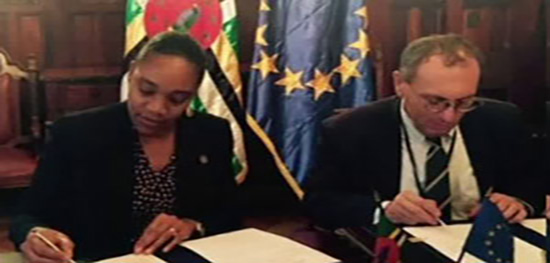
The agreement was signed by the Honorable Minister for Foreign Affairs, Francine Baron and Stefano Manservisi, European Commission Director for International Co-Operation and Development at the recent EU-CELAC summit held in the Dominican Republic.
The overall post-Erika rehabilitation project, which will be carried out through the Ministry of Finance is part of efforts by government to source concessionary or grant funding that will mitigate the effects of tropical weather phenomena.
The project is being financed under the 11th European Development Fund and will be administered via the general support programme.
In the margins of the presentation of credentials on November 2nd by the new European Ambassador to Dominica, Her Excellency Daniela Tramacere, to the President of the Commonwealth of Dominica, His Excellency Charles Savarin, Ambassador Tramacere also held a meeting with the Honorable Prime Minster, Dr Roosevelt Skerrit, where details of the financing agreement were discussed.
Immediately following the damage caused by Erika, the EU’s Humanitarian Aid and Civil Protection Department provided EC$913,000 in emergency humanitarian funding to assist those most affected.
Meanwhile, Ambassador Tramacere also discussed other aspects of Dominica’s cooperation with the European Union, such as the programme of the Banana Accompanying Measures (BAM). Dominica was allocated 15.27 million Euros for the BAM and to date 95 percent or 14.5 million Euros of all BAM funds have been contracted.