At a recent press conference on Tuesday 21st June, Minister of Agriculture, Forestry, Fisheries and Rural Transformation, Hon. Saboto Caesar, disclosed that the Banana Services Unit (BSU), is continuing efforts to reduce the Black Sigatoka disease to Cronshaw levels to a minimum of one or two.
Minister Caesar said that his aim is to “keep Black Sigatoka out of the headlines”. In this regard, he stated “for the year, we have been able to keep it out of the headlines, meaning it is not one that has aroused so much discussion in the public as a problem”.
Despite efforts to eradicate the Black Sigatoka disease, the Minister of Agriculture stated, “it is a disease that we would have to live with and we would have to adjust the technology that we use in terms of farming”. He called on farmers to prune and fertilise banana plants regularly.
From the Ministry of Agriculture’s perspective, Minister Caesar said that his Ministry will ensure that the fertiliser program that is in place is properly managed, and the fertiliser is applied on time so that the plants are healthier.
Minister Caesar is mindful that the increased application of fertiliser will be an added cost that farmers will have to bear. This, he remarked, is a sad thing because it is not reflected in an increase in price of bananas. Furthermore, he stated that “farmers in St. Vincent and the Grenadines have done a great job so far”. However, he added that there are still abandoned banana fields, and that these are a potential source for new outbreaks of the Black Sigatoka disease.
The honourable Minister further stated the aerial spraying will continue, and that he met with Head of the BSU, Mr. Karomo Browne, to discuss the purchase of more mist blowers. He admitted that this is something for which further technical advice must be sought regarding the dispensation of these chemicals by individuals in the Ministry, if it is something that is desired to be intensified.
He highlighted that certain chemicals pose health risks to citizens so that this has to be taken into consideration. “All of these issues are being worked on, but I am satisfied, so far, with the work of the BSU in controlling Black Sigatoka disease here”, said Minister Caesar.
The Minister reminded farmers to co-operate with the BSU and that, “it is not only the BSU’s work, but there is a careful partnership, because the BSU cannot do its work if the farmer does not employ the proper farming practices, which can result in flaring ups”.
“We are in the rainy season and it is usually far easier to control Black Sigatoka in the dry season”, Caesar cautioned farmers. He said that the responsibility now lay on Mr. Karomo Browne, who took over from Mr. Sylvester Vanloo. Mr. Browne, said Minister Caesar, will be tested for his mettle over the next six months, and wished the team all the very best and asked the farmers to continue to do their practices in terms of the fertiliser application, de-leafing practices, and to work with their Extension Officers to control the Black Sigatoka disease here.
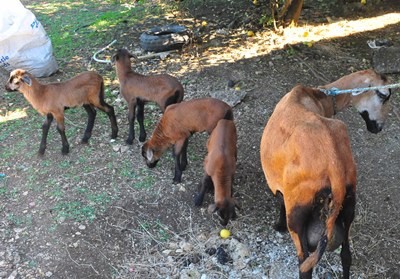
We often see them frolicking around in green pastures and open spaces. Ranging in colour from light tan to dark mahogany red, with black facial stripes and legs, the Barbados Black Belly sheep is a breed of domestic sheep indigenous to the island.
Known for its ability to shed its wool, its capacity to adapt to a wide variety of climates and terrain, high resistance to parasites, and docile nature, the black belly sheep is often a talking point among local agriculturalists, as the general feeling is that not enough attention is being paid to this ovine breed.
Among those to hold this view is Chief Agricultural Officer in the Ministry of Agriculture, Food, Fisheries and Water Resource Management, Lennox Chandler, who, during a recent interview with the Barbados Government Information Service, was quick to point out that in the case of the Black Belly sheep, “too much talk”, was taking place and not enough action.
“Just like cotton, we have not paid enough attention to the Barbados Black Belly sheep. People all over the world want it. As a matter of fact, there are more Black Belly sheep outside of Barbados than in Barbados. I remember years ago at the Sugar Cane Field Centre in Trinidad there were 1,000 Barbados Black Belly sheep and at the time we only had 100. Again, we have to start thinking about how we want to develop this and we have to start harping on the linkages,” he underscored.
Stating that the local sheep was considered an expensive, gourmet meat, Mr. Chandler noted that it was nice in flavor and carried little fat.
“First off, you have an animal that produces four or five in one litter, but again I want to state that we have not paid enough attention to branding and marketing. You have New Zealand lamb which is 15 years in the fridge and doesn’t have the flavour like Black Belly sheep. So, again, we have to revisit and refocus on that little sheep which has a lot to offer.”
The leather from the sheep, which according to the Agricultural Officer is superior to any leather that one could get in any part of the world, is also supple, smooth and soft in texture. He further stated that the leather, hooves and all the parts of the sheep could also be utilised to produce quality products.
“One of the things that we have ignored in this country is the development of so-called cottage industries. We have not paid enough attention to these small or micro cottage industry people, who, all over the world, add to their respective economies. We have not paid attention to bringing people into these cottage industries and working with them. These are cottage industries that people could be working on,” Mr. Chandler stressed.
He pointed out that in large industrial societies, 85 per cent of the economy was driven by micro and small businesses, while in Barbados, the last report indicated that small businesses were down to between 50 and 55 per cent.
“Our economy is not going to grow if we just sit down and wait on a big Pine Hill Dairy to come, or another big Intel…You develop your micro, small and medium-sized industries. We have lapsed on that tremendously and as a result, we don’t have the infrastructure in place for it at the level of financing, other incentives and other relations, whether it is merchant banking, etc.,” he lamented.
The agricultural official said that another area that needed development with regard to the Black Belly sheep was identifying new sources of feed for livestock, especially during times of drought. Mr. Chandler explained that this was essential as a means of providing an alternative source to concentrates from Pinnacle Feeds and other places.
He continued: “We plan on investigating shrubs such as mulberry. We have to see everything that we do as having the potential to create an industry, and a simple thing like mulberry as livestock feed goes beyond that. As mulberry is also wine; it’s cosmetics; it’s all these things that you can create just out of a simple plan.”
Governor General confers award on Sir Kennedy (Order of National Hero)
First living national hero among three awarded for stellar contribution to nation-building.
St. Kitts and Nevis’ first Prime Minister, Dr. the Right Excellent and the Right Honourable Sir Kennedy Alphonse Simmonds, made history as the first living national hero
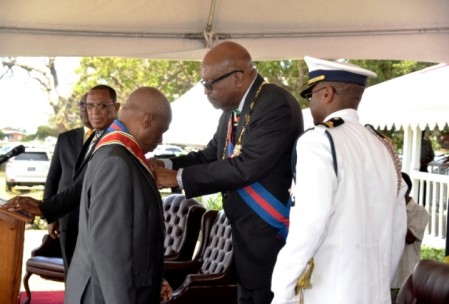
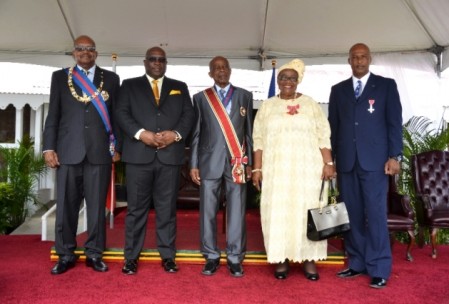
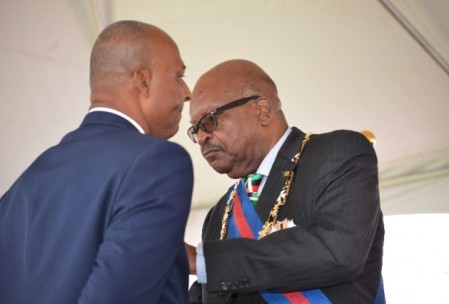
when he was conferred today with the highest award of the country, the Order of National Hero. He was among two other distinguished nationals of the Federation of St. Kitts and Nevis who were awarded for their sterling contribution to nation-building at an investiture ceremony held by His Excellency the Governor-General Sir S.W. Tapley Seaton at Government House on Tuesday June 28, 2016.
One of the awardees, Mr. Keith Ian Scarborough, was formally conferred with the award of Member of the Most Excellent Order of the British Empire (MBE) for his outstanding contribution to the Arts. Mr. Scarborough is a cultural icon in Nevis. Known in the Calypso arena as King “Dis N Dat”, Mr. Scarborough won the coveted Culturama Calypso title for ten years. He has represented Nevis in several regional and international calypso forums. He has also ran for representational politics for the St. Thomas constituency in Nevis on the Concerned Citizen’s Movement (CCM) ticket and also served as Cricket Chief in Nevis.
Another awardee, Ms. Clarita Violetta Richards, was bestowed with the award of Officer of the Most Excellent Order of the British Empire (OBE). Ms. Richards has served as a long-standing public servant. She has worked in Foreign affairs in the diplomatic service at the High Commission in London; she has been the organist and choir director at the Zion Moravian Church for many years; she also taught Modern Languages. She retired as a Permanent Secretary in the Office of the Prime Minister in the People’s Action Movement (PAM) Administration.
In paying tribute to Mr. Scarborough and Ms. Richards, two of Her Majesty Queen Elizabeth, The Second’s New Year 2016 awardees, and Sir Kennedy, Prime Minister Harris described the moment as a proud one.
“Today is indeed a remarkable occasion and in some ways it is about us as a people redeeming the times, and equally it is about us as a people making our own history and coming of course to reconcile our duty as citizens and nationals of St. Kitts and Nevis.
“We are here acknowledging that we are proud of our history and we are proud of the contributions of our sons and daughters to the development of St. Kitts and Nevis. Today then, is a blessed day and we really ought to rejoice and make glad…today we pause to say congratulations and thank you to Mr. Keith Scarborough MBE and Ms. Clarita Richards OBE for meritorious service on behalf of our country. Today, equally our heartiest congratulations and loudest thank you are extended to Dr. the Right Excellent and the Right Honourable Sir Kennedy Alphonse Simmonds, our first Prime Minister and only surviving National Hero,” Prime Minister Harris said.
“Such a momentous occasion is being witnessed by so many today. Many appreciate that had it not been for the Lord and the transformation of the landscape from its divisive politics and ad hominem attacks, this day would not have come. I give God honour and glory for bringing our people into the marvelous light and the opportunity it has provided for a fresh start, a fresh start in national healing, a fresh start in reconciliation, a fresh start in national honour, and a fresh start in national unity,” he further added.
In commending the only surviving Nation Hero Sir Kennedy, Prime Minister Harris mentioned that he has been “ given his flowers while he is still alive” instead of posthumously.
Several achievements of Sir Kennedy were outlined by the Prime Minister, which include taking the country into Independence on September 19, 1983, from Great Britain.
“Sir Kennedy is a towering standard bearer for the period that historians label as the beginning of contemporary Caribbean politics, which is that watershed moment in time when several Caribbean countries attained their Independence from Great Britain,” Prime Minister Harris said.
Other achievements of Sir Kennedy, then Premier, include signing of the Treaty of Basseterre along with several Organization of Eastern Caribbean States (OECS) Heads of Government on 18th June, 1981.
“The formation of the OECS in 1981 edged St. Kitts and Nevis in the forefront of sub-regional integration. Everyone in the region and further afield took notice of the halcyon prosperous days that Kittitians and Nevisians would enjoy well into the next decade under the visionary leadership of Sir Kennedy,” said Prime Minister Harris, while highlighting that as the country’s first prime minister, “his government’s main development objectives between 1980 and 1995 focused upon improving on the country’s infrastructure, creating specially designated areas for tourism, and fostering a macro-economic and regulating environment that would aid private sector development.”
Prime Minister Harris described the 1980’s under Sir Kennedy’s leadership as one of a “booming economy”, rising wages and salaries, one of the lowest unemployment rates in the Caribbean, and labour productivity among the highest in the OECS, being the largest exporter of clothing to the United States.
The Sir Kennedy Simmonds Highway that leads to the South-East Peninsula was dubbed the brainchild of Sir Kennedy.
“The South-East Peninsula is now home to many beach bars and restaurants, the Sea Bridge Ferry Terminal, Christophe Harbour, the first tunnel in the country and the soon-to-be-opened Park Hyatt, which is the premium brand of the Hyatt Hotels Corporation,” Prime Minister Harris said.
Other snapshots of Sir Kennedy’s achievements include the construction of Port Zante with facilities, his contribution to making the country’s education and banking sector more egalitarian, support for the equality of children irrespective of the circumstances of their birth, efforts to enhance student learning through school feeding programme and the self programme.
In singling out the banking sector, Prime Minister Harris said that the Development Bank, called the People’s Bank, opened its doors on May 22nd, 1981 and has had a successful 35 year history. In 35 years, the Development Bank has offered financial and technical assistance to thousands. Prime Minister Harris declared that within the last ten years (2006-2016), the Bank has approved 2, 143 student loans valued at a whopping 143.million dollars.
“Sir Kennedy’s legacy is composed of tens of thousands of pixels, each one represents every single citizen and resident of St. Kitts and Nevis, whose life has been impacted by his leadership. Today, we say thank you,” Prime Minister Harris said.
His Excellency the Governor General Sir Tapley Seaton also paid tribute to Sir Kennedy in whose Cabinet he served as attorney general, the youngest attorney general serving in the Commonwealth at the time. Sir Tapley served for 15 years as attorney general under the Sir Kennedy-led People’s Action Movement (PAM) Administration.
The decorated investiture ceremony was attended by members of the diplomatic corps, senior government officials, members of Cabinet, Premier of Nevis, Honourable Vance Amory, former Governor General, Sir Cuthbert Sebastian, and friends and family of the awardees. The National Anthem was done by the St. Kitts and Nevis Defence Force Band and the invocation by the Ven. Archdeacon Dr. Alson Percival.
1 of 6
Governor General confers award on Sir Kennedy (Order of National Hero)
ST. GEORGE’S, GRENADA, Tuesday, June 28, 2016: The Inland Revenue Division (IRD) of the Ministry of Finance and Energy is reminding all taxpayers and the general public that the deadline to obtain the five percent (5%) rebate on Property Tax for 2016 is Thursday June 30th 2016.
The general public is also reminded that Thursday 30th June 2016 is the deadline to license vehicles within the following range:
· Plural letters – 751 to 999
· Single letters – 7501 to 9999
In order to better facilitate taxpayers’ payments for these deadlines, the IRD will make the following operating adjustments:
· Extended opening hours at IRD’s cash office, at the Ministry of Finance on the Carenage, from 7:00am to 4:30pm on Wednesday June 29th and Thursday June 30th 2016.
· Cashiers will be available at the Ministry of Finance’s car park on Thursday 30th June 2016, from 9:00 am – 4:00 pm to accommodate taxpayers who have their demand notices in hand, for the payment of Property Tax only.
· Cashiers will be stationed at the Government Printery at the Botanical Gardens in Tanteen, to receive payments for Property Taxes, Drivers Licences and Vehicle Licences between the hours of 8:00am to 12:00pm and 1:00pm to 3:00pm, on Wednesday, June 29th and Thursday, June 30th, 2016.
Payments can also be made at any District Revenue Office throughout the island and through the Ministry’s online portal: www.eservices.gov.gd. (Please use Chrome or Firefox platform).
The Inland Revenue Division will like to take this opportunity to thank all those who assisted and supported the Tax Caravan on Saturday, June 25th, 2016, on its journey around the island.
The IRD appreciates your assistance and support in its efforts towards taxpayers’ compliance and enhanced service delivery.
The House of Parliament met on Monday, June 27th to give consideration to five main agenda items.
By press time on Monday, two Bills had been debated and passed. The Money Laundering Prevention Act was successfully amended to broaden the definition of the crime as well as the scope of law enforcement. That Bill was unanimously approved.
Much more debate took place on a Bill to establish a legal framework to continue addressing the financial fallout which follows the collapse of regional insurance giants, Colonial Life Insurance Company (CLICO) and British American Insurance Company (BAICO) in 2009.
This framework will serve the countries of the Eastern Caribbean Currency Union and The Bahamas where BAICO is registered.
The Hon Prime Minister and Minister for Finance, Dr. Roosevelt Skerrit outlined, “The Monetary Council appointed a core committee to deal with the day-to-day operational matters of the resolution of the insurance concerns while a council continues to oversee the activities.
“Among the actions which had to be taken was the appointment of judicial managers who have provided the technical guidance on the solutions which have been approved by the Monetary Council and adopted and implemented by the ECCU member states.
“Thus far, a resolution strategy for dealing with BAICO policyholders has been approved. In that regard with funds provided by the Government of Trinidad and Tobago, a number of small policyholders were paid amounts that fell due from BAICO.
“The remaining BAICO business was transferred to Sagicor Insurance but those people and institutions who invested in annuities have not recovered their investments.”
He says CLICO still remains largely unresolved.
A uniformed law was therefore determined necessary for the eight ECCU states and The Bahamas.
The Plan of Arrangement BAICO/CLICO Act of 2016 was endorsed by both sides but not before some stimulating discussion.
Both sides support the OECS Governments marked efforts to rescue as many policyholders as possible.
The Opposition voiced some dissatisfaction with what it considered inaction by regional Governments including Dominica’s.
The Hon Finance Minister advised that that is not case.
He referenced a financial commitment from the Government of Trinidad since Trinidad has taken over the assets of BAICO.
Here’s an excerpt from his statement.
“Based on our negotiations with Trinidad, the Trinidad Government agreed to give us in the OECS US $100m as part of their contribution to the resolution involving British American Insurance Company…We in the OECS paid millions of dollars to persons who had invested in British American Insurance Company and every person who invested $30,000 or less got paid in full [thanks] to our efforts as the OECS. The records will show that these persons who invested $30,000 were in the majority.
“There were public announcements; every Minister of Finance in the OECS gave an update as to [our progress] including the Minister of Finance of Dominica. We have to understand the complexity of this arrangement. It is not the Government who can say to [them] to pay out. It is the courts. The decision to pay out resides solely with the courts of those separate jurisdictions. That’s why they appointed a Judicial Manager who is not answerable to me as the Minister for Finance or Prime Minister Ralph Gonsalves in St. Vincent. They were not appointed by us. So it is the courts that will determine what happens with the assets of BAICO and CLICO.
“As Governments, recognising the impact that this has had on citizens of our countries, we have gotten involved in an extraordinary manner because it is not the first time that people have invested and lost money. It happens every day.”
He added that the OECS Governments have threatened to sue Barbados and Trinidad who hold the assets CLICO and BAICO respectively. The Monetary Council ultimately determined that it would be better to first use resources to give policyholders some ease.
As a matter of fact, he says, regional Governments ought to be commended for getting involved in this way.
On the subject of the devastating losses suffered by Dominicans through the crash of these insurance companies, Hon Dr. Skerrit advised, “Any investment scheme which offers you more than the banks, 6% or up, stay away from these.”
He says however regional Governments are leaving no stone unturned to recoup as much of the loss as possible.
Meantime, according to the Hon Minister for Tourism and Urban Renewal, Senator Robert Tonge, new legislation in 2012 now provides some level of protection to policyholders.
“Over 40% of the premiums that [the insurance companies] collect on an annual basis are put in [a fund]. The insurance regulators go a step further: during the period of insurance, you may have outstanding claims which are also placed in the insurance fund so that if the insurance company goes broke… the regulators can use those funds to pay out to another company which can take over your unearned premiums and outstanding claims.
“I am aware that on an annual basis, the insurance regulators of Dominica got to all the insurance companies to ensure that the outstanding claims and unearned premiums are placed and are available,” he reported.
He went on to say that those funds are kept in Dominica.
Newcomer, Hon Member of Parliament for the Soufriere Constituency, Denise Charles, was also sworn in on Monday.
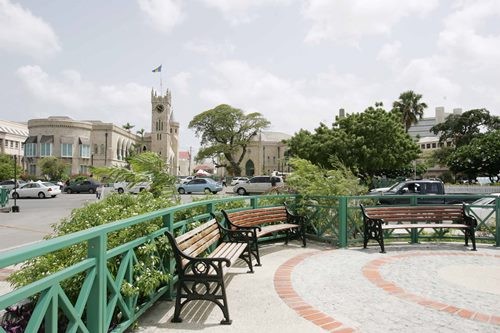
The Government of Barbados remains committed to the cultural revitalisation of Bridgetown.
Minister of Culture, Sports and Youth, Stephen Lashley, gave this assurance during his address at the First Citizens Crop Over City Fest and Ceremonial Delivery of the Last Canes last Saturday in the capital.
Mr. Lashley stated that as Historic Bridgetown and its Garrison marked the fifth anniversary of its inscription on the UNESCO World Heritage List, Government, along with its stakeholders, would do all that was necessary to ensure its cultural revival.
“The Ministry and the team at the National Cultural Foundation have been working tirelessly to raise people’s level of appreciation for the heritage of this city through the many initiatives on offer, such as free public and interpretative tours, lectures and cultural related programmes,” he noted.
The Minister reflected on bygone years when Bridgetown was a cultural hub with strolling minstrels, festivals, dances, travelling theatres and hawkers, and lamented that this cultural activity from the past had declined over the years.
However, he pointed out that through events such as City Fest, and initiatives such as the recently-launched Bridgetown Urban Renaissance Project, Government was reviving the image of the City “from just a place to work or a busy thoroughfare, to a vibrant cultural space with a wealth of history”.
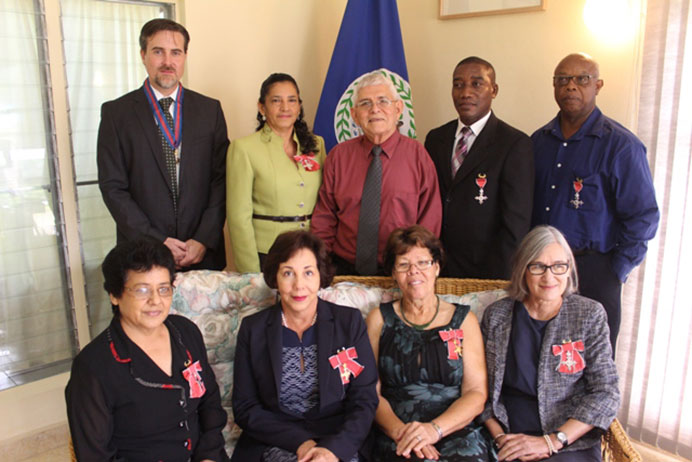
Belmopan. June 28, 2016. Eight distinguished Belizeans were honoured for their dedicated and outstanding services to their community at a ceremony held today at the Belize House in the City of Belmopan.
The insignias were presented by the Acting Governor General of Belize H.E. Mr. Carlos Perdomo on behalf of Her Majesty the Queen. Receiving the insignia of a Companion of the Order of Saint Michael and Saint George was Mr. Michael Bowen for services to business and industry. Mrs. Eleanor Hulse and Mrs. Dilicia Feinstein received the insignia of an Officer of the Most Excellent Order of the British Empire; Mrs. Hulse for services to education and Mrs. Feinstein for services to business and the community. The insignia of a Member of the Most Excellent Order of the British Empire was given to Ms. Emelda August for services to nursing; Mrs. Sarita Westby for services to education and the community; Mr. Juan Nunez for services to education and sport; Dr. Aaron Lewis for services to science; and Mrs. Janet Gibson for services to environmental protection.
(left) Dr. Francis Morey - Ministry of Health (right) Dr. Alexandrine Martinez - Karl Heusner Memorial Hospital
Two medical officers from Ministry of Health and Karl Heusner Memorial Hospital will attend the “2016 workshop on chronic disease control” in Taiwan.
June 28th, 2016, BELIZE CITY, BELIZE The Embassy of the Republic of China (Taiwan) is pleased to announce that two medical officers from Ministry of Health and Karl Heusner Memorial Hospital are invited through the Embassy of the Republic of China (Taiwan) to attend the “2016 Workshop on Chronic Disease Control”, which will take place in Taiwan ICDF in Taipei City, during July 20th– August 2nd, 2016. The prevalence rates of overweight and obesity in Belize are quite high, which mainly contribute to the development of chronic disease, ex: diabetes, hypertension, hyperlipidemia, cardiovascular disease, etc. Also the hypertension and diabetes patients are the high risk group of kidney disease. And the “Renal Failure Prevention Project” between Belize and Taiwan has been implemented from February 10, 2016. The purpose of Renal Failure Prevention Project is to treat the patients at the early stage to prevent the exacerbation and lead to effectively reduce the socio-economic cost of the whole society. The “2016 Workshop of Chronic Disease Control” aims to share Taiwan’s experience on policy planning, practices, system and framework of chronic disease control (mainly focusing on obesity-related disease), also focuses primarily on policy making issues in order to assist attendants from partner countries in dealing with the chronic disease control. Not only the indoor lectures will be performed, but the attendants will visit government agencies and medical institutions in charge of obesity prevention, chronic disease prevention and chronic disease screening. To facilitate the mutual cooperation in the health field and enhance the welfare of people between Belize and Taiwan is always the priority concern for both countries. Through this workshop and the mentioned project, both parties deeply believe that the prevention and control system on chronic disease in Belize will be well developed.
Following the launch of the PROCOM Challenge in mid-April, there has been a significant interest from a number of private sector organizations across commercial sectors.
Businesses are jumping at this opportunity to improve on their productivity and competitiveness and by extension maximize on their operational efficiency.
Micro, small and medium enterprises (MSMEs) in Saint Lucia are set to receive co-financing of up to XCD$100,000 for the implementation of projects which seek to enhance productivity and competitiveness through the PROCOM Challenge. In addition to the financial investment, winning businesses will receive the technical assistance to ensure that their ideas/solutions thrive and are impactful. The purpose of the Challenge is to encourage businesses in finding innovative solutions which will help improve the overall climate as it relates to productivity and competitiveness.
Executive Director of the NCPC, Mrs. Fiona Hinkson is very positive about the level of interest generated in the PROCOM Challenge and is looking forward to seeing the types of projects which will emerge. Speaking on the Challenge she said, “When the PROCOM Challenge was initially conceptualized, we had identified micro, small and medium enterprises as the sole recipients. We have received significant feedback post-launch and after internal discussion, we went back to the drawing board and further improved on the Challenge. We recognize that great ideas can come from anywhere and we want to ensure that we give equal opportunities to organizations that may have winning ideas but encounter greater challenges in accessing funding. We have therefore included a small-window for start-ups (i.e. businesses that are registered but have only been in existence for 1 to 3 years). We are hoping that the diversified solution stemming from the PROCOM Challenge will transform the business environment.”
The application process for the challenge is very simple. Businesses applying to the PROCOM Challenge are asked to follow these steps:
STEP 1: Before you start an application, carefully review the eligibility criteria and selection guidelines to ensure that you are the right fit for the Challenge. This information can be found in the PROCOM Challenge Brochure and Manual which may be downloaded from the NCPC Website; www.stluciancpc.org or blog; www.ncpcstlucia.wordpress.com. You may also call 468-5576/468-5571 with any questions/queries on the Challenge.
STEP 2: If you think your idea/solution meets the necessary requirements, submit your application using the prescribed forms and supporting documents to the NCPC; stluciancpc@gmail.com no later than 11:59pm on Thursday, June 30th, 2016.
STEP 3: Wait for confirmation from the NCPC. If your initial application has been shortlisted, you will be invited to a Business Plan Training Session where you will receive guidance on the preparation of your business plan for submission to the investment panel. (N.B Only successfully shortlisted applicants will be contacted by the NCPC)
STEP 4: Completed Business Plans must be submitted to the NCPC no later than four (4) weeks after the Business Plan Training Session.
STEP 5: The Business Plans will be reviewed by the Investment Panel and short-listed applicants will be required to pitch their idea to the panel for final judging. Once approval has been given, the funds will be disbursed after signing of the grant agreement and project work will commence.
The PROCOM Challenge comes to an end this week. Interested businesses are asked to apply by sending their application forms to the NCPC no later than June 30th, 2016.







 The Monetary Council ultimately determined that it would be better to first use resources to give policyholders some ease.