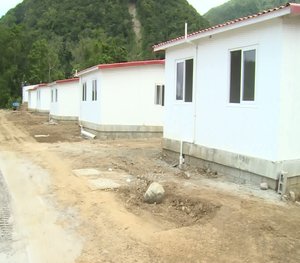
Government to buy 1000 Petro Casas from Venezuela, this was revealed by the Honourable Minister for Housing, Reginald Austrie on Thursday 16th June, 2016.
Honourable Austrie revealed that the two governments are finalising discussions for this agreement.
The 1000 petro casas will complement government’s housing revolution programme.
“The 300 hundred we got was a gift, but the government has taken a deliberate position to purchase 1000 petro casas from the government of Venezuela for distribution across the country. Although this may seem to be a very small token based on Venezuelan standards, it should go out there to demonstrate government’s understanding and government’s attempt to assist in the reconstruction of the Venezuelan economy. “the minister noted
The Honourable Minister stated that the Venezuelan government, despite challenges, never wavered on their assistance to Dominica and based on principle the government of Dominica decided to purchase these petro casas.
The Housing Minister also disclosed further development in addition to 10 houses being provided by the Adventist Development and Relief Agency, (ADRA), at Plat Mapier in Colihaut.
Construction of the houses at Plat Mapier began in January this year.
“That will be complemented by six petro casa units, which is part of the donation received from Venezuela. I must on behalf of the government and people of Dominica thank the Adventist Development and Relief Agency, (ADRA), and the government of Venezuela for being the first to offer assistance in the field of housing…”
The Honourable Minister for Housing also announced that contracts have been signed for an additional 50 petro casas to be installed at the site in Centre, Grand Bay.
Currently, people from the Dubique community are being housed at the Grand Bay Community Centre and Grand Bay Youth Centre.
New Ambassador-Designate To Geneva, Bentley Gibbs. (B.Hinds/BGIS)
Retired Permanent Secretary, Bentley Gibbs, has been appointed Permanent Representative to the United Nations Office and other international organizations in Geneva.
According to a statement from the Ministry of Foreign Affairs and Foreign Trade, the Ambassador-designate is expected to assume his duties later this month, and will replace Dr. Marion Williams who served from 2010 to 2015.
Minister of Foreign Affairs and Foreign Trade, Senator Maxine McClean, has expressed confidence that the work which will be undertaken by the new envoy will be instrumental in advancing Barbados’ interests in Geneva and in the wider international community.
Mr. Gibbs has had a long and distinguished career in the public service, most notably as Permanent Secretary (Foreign Trade) in the Ministry of Foreign Affairs and Foreign Trade. He has played a central role in CARICOM, ACP/EU and World Trade Organization matters.
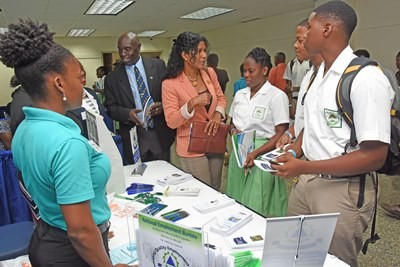
Labour Minister, Senator Dr. Esther Byer Suckoo and Managing Director of Regional Management Services, Dennis de Peiza chatting with students at the launch the inaugural World of Work Showcase today. (C.Pitt/BGIS)
Employers have been urged to continue supporting existing internship and apprenticeship schemes or develop their own job placement programmes.
This appeal came today from Minister of Labour, Senator Dr. Esther Byer Suckoo, as she addressed the opening ceremony to launch the inaugural World of Work Showcase at the Lloyd Erskine Sandiford Centre.
Dr. Byer Suckoo said such training programmes could be seen as a means of investing in and developing potential employees for the workplace. In addition, she pointed out that employers could develop a database of interns and refer to it as vacancies arose in the company.
She expressed the view that there was a need to develop a formalised world of work training programme within all secondary schools, so that students would be equipped with the necessary soft and life skills before entering the working environment.
“Such a programme should also expose students to the working environment, through job shadowing, internships or apprenticeships. This is an area which I have spoken about on a number of occasions because these are meaningful ways of building competencies, and transferring the correct work attitudes and behaviours,” she emphasised.
Dr. Byer Suckoo said that as Minister responsible for Labour and Human Resource Development, she had heard the concerns expressed by employers in both the private and public sectors regarding the lack of readiness of new entrants into the working environment.
“It has been reported frequently that our young people lack what most persons refer to as “soft” skills – those very important employability skills. Members of the Social Partnership have all alluded to this in different fora, and are committed to dealing with it individually and collaboratively,” she added.
She told her audience that her Ministry had recently completed the compilation of its “Job Seekers Manual” and copies had been disseminated to all stakeholders. It has also been posted on the Ministry’s website to allow for easy access by a wider cross-section of persons.
Dr. Byer Suckoo added that the Ministry was strengthening its Labour Market Information System to ensure that data on the current and future trends in the labour market was timely, relevant and easily accessible to key stakeholders.
“We recognise that that information is vital in determining the skills which are required to drive economic development. And so, we are now in the final stages of completing an updated Barbados Standard Occupational Classification, which will be another key tool through which young persons, HR professionals and guidance counsellors, in particular, can gain valuable information to assist in career development.
“We are also making changes to ensure that our employment services meet the needs of Barbadians today, as we realise that we have not been meeting these demands, especially with high unemployment. Very shortly we will be launching the new and improved employment services,” she disclosed.
The one-day World of Work Showcase was hosted by Regional Management Services Inc., and Dr. Byer Suckoo commended its Managing Director, Dennis de Peiza, for his willingness to share his experience and expertise in management and industrial relations.
The young people who participated in the showcase received a copy of Mr. de Peiza’s book Introduction to the World of Work, which covers a number of topics, including Unionisation: Labour Laws, Practices and Workplace Standards; Workplace Requirements and Expectations; and Things Workers Should Know.
The Ministry of Health is spearheading efforts to find more placements for medical graduates of the Faculty of Medical Sciences, University of the West Indies, to pursue internships.
Speaking at the annual welcome ceremony and banquet for new doctors at the Barbados Concorde Experience last Saturday, Minister of Health, John Boyce, acknowledged that the current demand outstripped available placements for the interns.
He told his audience: “Let me assure you that the Ministry is working assiduously to have a transparent system in place for the selection of interns, and will continue to work with our partners to increase the total component of persons eligible for internship.”
The Health Minister said that he would be meeting with the chairman of the Medical Council and other stakeholders to look at the issue and discuss solutions to the problem, which has seen some graduates without internships “over the last couple of years”.
Mr. Boyce disclosed that Barbados had been approached by at least five offshore medical schools within the last five years, seeking to relocate to the island to provide training for undergraduates in the field of medicine.
While stating that Barbados was honoured to be considered to have both the stable economic climate and the infrastructure necessary to support offshore medical schools, he however made it clear that any system developed must be based on collaboration with the Ministry of Education; a respect for the laws of the country; and provision for both nationals and non-nationals to have the opportunity to fulfil their internships.
Mr. Boyce advised the graduates to always remember that learning never stopped. “The dynamic nature of health care makes continuing education and training imperative for workers in order to continue to provide the best health care possible. The need to stay ahead of the curve on new tools and techniques is a must in the healthcare field,” he stated.
He also urged them to look for opportunities not only in the clinical area but also in public health, epidemiology and research, noting “the functions of a dynamic Ministry are based on the integration of these disciplines in our decision-making processes”.
The retail prices of petroleum products have changed. The next price adjustment is on Monday, July 4.
The public is hereby notified that in keeping with changes in international oil prices, the retail prices of the following petroleum products have increased.
GASOLINE – from $2.36 to $2.44 per litre or from $10.71 to $11.11 per gallon DIESEL – from $2.07 to $2.22 per litre or from $9.39 to $10.08 per gallon Kerosene – from $1.19 to $1.41 per litre or $5.40 to $6.39 per gallon 20 Pound Cylinder (9.07 kg) from $24.64 to $25.41 per cylinder 22 Pound Cylinder (9.98 kg) from $27.38 to $28.23 per cylinder 100 Pound Cylinder (45.36kg) from $163.61 to $169.44 per cylinder
All prices take effect on Monday, June 20. The retail prices of fuel products will be next adjusted on Monday, July 4.
Prioritising the Caribbean Creative Industries through the CCIMU.
The process of cultivating a buoyant and sustainable cultural and creative economy within the Caribbean is a step closer with the development of a business plan to establish the Caribbean Creative Industries Management Unit (CCIMU).
At the 26th Intercessional meeting of the Caribbean Community (CARICOM) Heads of Government held in February 2015, a recommendation was made for a dedicated body to address the needs of the Region’s cultural and creative industries in the form of a Caribbean Creative Industries Management Unit (CCIMU). Whilst addressing the needs of the regional creative and cultural industries, the Unit is proposed to: foster creativity, support the development of businesses, create opportunities and improve trade. Central to the success of the unit will be the legal framework, ensuring the rights and obligations of stakeholders are respected and legally protected. “We still face the challenge of the lack of strategic and focused management in the development of the region’s creative and cultural industries. This lack of a coordinated regional approach has hindered the sector’s ability to contribute to sustainable development in the region. The biggest gap has been the absence of structure that addresses the monetization of the creative industries in the region” saidPamela Coke-Hamilton, Executive Director, the Caribbean Export Development Agency (Caribbean Export). Caribbean Export has been assigned the lead role in the development of the CCIMU.
It is the vision of the CCIMU to be the premier provider of evidence based services to enhance the performance and competitiveness of the Creative Industries across the Caribbean. This can only be achieved through taking a leadership role, facilitating an enabling environment through the enhancement of value chains, strengthening of regional networks and building capacity of the Caribbean creative industries to grow and be more competitive internationally.
Speaking on behalf of the Caribbean Development Bank Edward Greene, Division Chief, Technical Cooperation Division,expressed gratitude to Caribbean Export for the collaboration and taking the lead on this initiative. “CDB is pleased to be a partner in the creation of the CCIMU. We know that the CCIMU can play a critical role in addressing the needs of the regional creative industries—by fostering creativity; developing businesses; creating opportunities and improving trade; and ensuring that the rights and obligations of stakeholders are respected and legally protected,” he said. CDB is providing funding for technical assistance to support the establishment of the CCIMU, through the staging of stakeholder consultations and the development of a business plan for the Unit.
Central to the discussion at the meeting of key industry stakeholders in Trinidad and Tobago on June 16, 2016, were the priority sectors within the region’s creative industries. These were identified to be music, animation, fashion and festivals in view of their potential to deliver the most growth and value-add across the creative industries wider economy. “We must measure the economic value of our cultural capital and then leverage that value into commercial viability. This is what will strengthen the sector, enhance market access, drive growth and expand exports for sustainable development in the short and long term,”said The Honourable Olivia Grange, Minister of Culture, Gender, Entertainment and Sport, Jamaica
The consultation focussed on defining the vision and mission of the proposed entity, it also addressed the priority areas of focus and the resulting work streams which generated considerable discussions amongst the stakeholders. The issue of governance and structure of the entity was addressed in the context of existing National frameworks in each Member State; focus was directed at funding arrangements and the sustainability of the proposed entity. “The CCIMU will bring to the forefront the business perspective of the talent which comes naturally from the region. With this convergence, it can be expected that this Unit will improve the competitive advantage of each country with their distinct flavor, as well as achieve a competitive advantage for the Caribbean Region as a whole,” expressed Angela Edwards, Permanent Secretary, Ministry of Community Development, Culture and the Arts.
A final report is to be prepared by the end of June 2016, taking into consideration the views and recommendations from the stakeholders present at the consultation. It is anticipated that this report on the proposed entity will be addressed at the upcoming Heads of Government conference in Guyana in July 2016.
Presentation of Credentials to the Governor General of Belize.
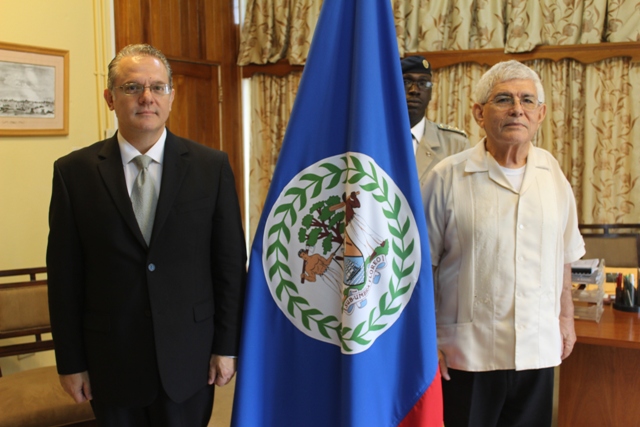
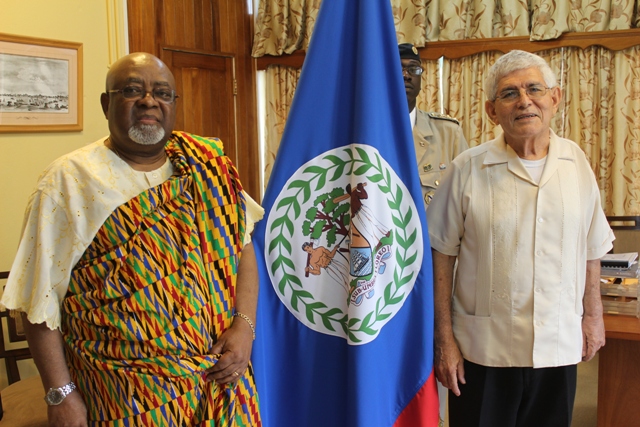
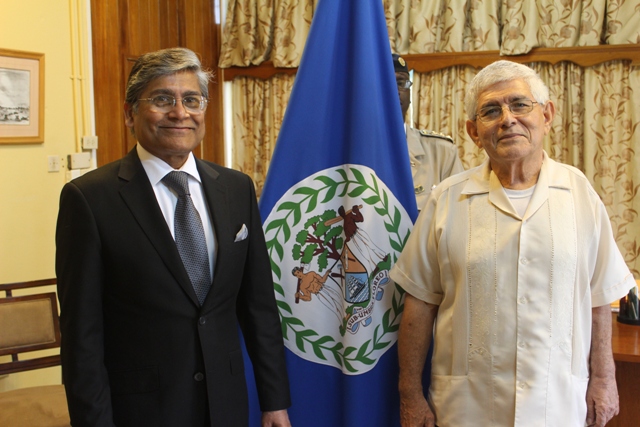
Belmopan. June 20, 2016. Three ambassadors presented their credentials to the Acting Governor General of Belize H.E. Carlos Perdomo today, June 20, 2016 at the Belize House in the City of Belmopan.
The credentials of H.E. Mohammad Ziauddin, Ambassador of Bangladesh; H.E. Evagoras Vryonides, Ambassador of Cyprus; and H.E. Lt. Gen. (Retd.) Joseph Smith, Ambassador of Ghana; were graciously received and welcomed by H.E. Carlos Perdomo.
The ambassadors expressed their pleasure in being in Belize and extended warm greetings to Belize from their respective governments. Each ambassador conveyed their country’s intention to continue to develop their relations with Belize. H.E. Joseph Smith H.E. Mohammad Ziauddin
Castries, Saint Lucia. June 20, 2016: Within a week of being appointed as Minister for Equity, Social Justice, Empowerment, Youth Development, Sports, Culture & Local Government, the Honourable Lenard “Spider” Montoute is moving full steam ahead.
Minister Montoute, who previously served as Minister for Social Transformation during his last ministerial appointment, is no stranger to the impact and importance of social services to the country.
As expected, the first order of business for himself and colleagues the Honourable Edmund Estephane and Senator Fortuna Belrose was an assessment of the status quo.
Minister Montoute asserted that “one of the issues we have to look into immediately is the set-up of the various boards, because traditionally when new administration is sworn in, board members tender their resignations so as to provide the Minister with a free hand going forward. I am in the process now of ensuring that we appoint our various boards as speedily and seamlessly as possible. By and large we want to have a smooth transition without causing any disruptions.”
The three Ministers assigned to the Ministry of Equity, Social Justice, Empowerment, Youth Development, Sports, Culture & Local Government met with heads of departments across the Ministry and also the statutory agencies that fall under the Ministry’s purview.
Honourable Montoute shared his optimism for the future of his Ministry, citing plans to improve existing initiatives to complement new plans. He said that he has every confidence that the three Ministers who share the portfolios are prepared to deliver. “We have Honourable Estephane who is the point person for Youth & Sports, Senator Belrose who is the point person for Human Services and Local Government and I am taking responsibility for Equity, Social Justice, and Culture which is a new portfolio that has been added to the social services,” Minister Montoute said.
The Minister also hinted at his excitement about the Culture portfolio which will soon see Carnival becoming a premiere National Festival deserving of the input of more resources and recognition.
Ministry of Health Continues to Caution Public as new Zika Cases Emerge.
Belmopan. June 20th, 2016. The Ministry of Health is investigating and closely monitoring a situation on the island of Caye Caulker, Belize District where three additional Zika cases have been confirmed.
These cases stem from an investigation of fever and rash cases reported earlier in June. While we continue to aggressively scale up efforts to reduce the mosquito population in the area along with local authorities, we once again ask for cooperation from the community to assist the Ministry and our local partners to clean up areas that may be breeding sites for the mosquitoes. This effort will continue especially with the onset in the increase of rains.
We continue to engage with the local authorities in Caye Caulker along with the investigative team from the Central Region offices in Belize City. Samples will now only be sent for reporting purposes as we have now confirmed the presence of the Zika virus in Belize.
The focus is now on the educational campaign to reduce mosquito breeding sites and also in protecting women who are considering getting pregnant or may already be pregnant from the risk associated with contracting the Zika virus.
IMF Executive Board Concludes 2016 Article IV Consultation with Trinidad and Tobago.
On May 20, 2016, the Executive Board of the International Monetary Fund (IMF) concluded the Article IV Consultation1 with Trinidad and Tobago.
Trinidad and Tobago’s output has continued to shrink while declines in global energy prices are leading to surging fiscal deficits and are pushing the external current account into deficit. Energy output is sharply lower due to supply-side constraints. Combined with weak non-energy growth, real GDP is estimated to have declined 2.1 percent in 2015 and is expected to fall another 2.7 percent in 2016. The lower energy prices and weaker growth have contributed to a steep fall in fiscal revenues, raising the FY 2014/15 (October to September) deficit to 4.7 percent of GDP, and once the full-year impact is felt, to a projected 10.9 percent of GDP in FY 2015/16.2 In addition, lower energy prices reversed Trinidad and Tobago’s usual current account surplus, with the current account estimated at a deficit of 5.4 percent in 2015, while gross official reserves fell from US$11.3 billion to US$9.8 billion during 2015. Core inflation remained anchored at 2.0 percent yoy in 2015, while headline inflation fell to 1.5 percent (yoy). Unemployment remained low (3.6 percent in September 2015), in part as make-work programs continue to facilitate employment, though layoffs are picking up.
The new government has undertaken fiscal adjustments intended to bring the economy back into balance. It introduced new revenue measures with the FY 2015/16 budget, and made further adjustment measures mid-year when it became clear that even the seemingly conservative energy price assumptions in the budget were overoptimistic, due to the subsequent continued decline in energy prices. The Central Bank began tightening monetary policy to mitigate capital outflows beginning in late 2014, before pausing in January 2016. Although the currency has been allowed to depreciate modestly against the U.S. dollar, external balance models suggest the currency remains substantially overvalued (although the degree of overvaluation is subject to uncertainty due to historical shortcomings in domestic data), while foreign exchange shortages persist. Banks remain strong, while there has been some progress on structural reforms, notably with respect to a significant start on efforts to remedy statistical shortcomings.
Executive Board Assessment3
Executive Directors noted that the recent sharp decline in energy prices is posing major challenges to Trinidad and Tobago’s economy. Directors welcomed the efforts taken by the new government and encouraged further policy actions, including additional fiscal consolidation and structural reforms, to preserve macroeconomic stability, diversify the economy, and enhance medium-term growth prospects.
Directors concurred that a strong medium-term fiscal plan is needed to re-establish a sustainable fiscal path and ensure debt sustainability. They commended the authorities for the important steps taken thus far and encouraged them to put in place a comprehensive fiscal framework to guide their multi-year adjustment efforts. Directors agreed that priority should be given to broadening the revenue base with a comprehensive VAT reform, improving tax administration, phasing out fuel subsidies, while improving targeted social protection. In this context, they also welcomed the authorities’ intention to pursue a comprehensive expenditure review.
Directors supported the current pause in monetary policy tightening given the challenges to growth. They noted that while the immediate policy priority is to focus on maintaining external balance, addressing foreign exchange shortages on current transactions would be important. Directors noted that a well-communicated move to greater exchange rate flexibility, as part of a comprehensive demand-management package, would help strengthen the foreign exchange market and support the needed macroeconomic adjustment. Some Directors highlighted the importance of mitigating volatility in the foreign exchange market, and recommended a careful adjustment strategy.
Directors noted that strong comprehensive structural reforms are needed to achieve sustained and inclusive growth over the medium term. They emphasized the importance of pushing ahead with energy sector taxation reforms, addressing inefficiencies in the public service, and strengthening financial sector supervision and regulation, particularly the non-bank financial regulatory framework. They also welcomed ongoing efforts to further strengthen the AML/CFT framework.
Directors encouraged continued efforts to reform the labor market, improve the business climate, and make further progress on the establishment of a tax policy unit and the National Statistical Institute to address the remaining shortcomings.
Read More: http://www.imf.org/external/np/sec/pr/2016/pr16298.htm