


DOMONICA: Patrons of the much anticipated Jazz and Creole Festival now know the full line up of this year’s event.
At a press conference on Wednesday April 13th, Marketing Executive at the Discover Dominica Authority, Monique Jacob, announced Cadence All Stars as the final main stage act for Jazz and Creole 2016.
According to the DDA, the Cadence All Stars brings together some of Dominica’s best musicians to perform Dominican music.
This band features Fitzroy Williams, Cornell Phillip, Jerry Moullon, Jason Joseph, Freddy Nicholas, Carlene Xavier-Phillip and Joy Stoute.
At a previous press conference, the artistes launched were Andy Narell, Cameron Pierre, Soft and Élan Parlé.
Jazz and Creole 2016 is carded for May 15th 2016.
Le Pélican Magazine out of French St. Martin, Courts Dominica and Rainbow Rentals are partnering with the Discover Dominica Authority for the first time this year.
Final artistes revealed for Jazz and Creole

Minister McClean Welcomes Officials
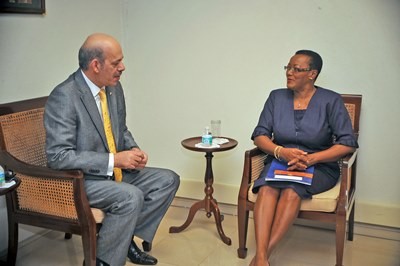

BARBADOS: Minister of Foreign Affairs and Foreign Trade, Senator Maxine McClean, held talks recently with the Ambassador of Qatar to Barbados, Battal M. Al-Dosari; and Honorary Consul of Barbados in Turkey, Tolga Eken, at her Culloden Road Ministry.
In her meeting with Qatari Ambassador, Battal M. Al-Dosari, Senator McClean and the envoy discussed trade opportunities for both countries; preparations in Qatar for the 2022 FIFA World Cup; and the possibility of increased airlift between the two countries.
Barbados and Qatar established diplomatic relations on December 4, 2007.
During the meeting with Mr. Eken, the two officials discussed matters of mutual interest, including the development of trade links, and the possibility of having Turkish Airlines using Barbados as a hub to connect to other countries. Mr. Eken was officially appointed as Honorary Consul on September 22, 2015.
kim.ramsay-moore@barbados.gov.bb
New dialysis units for VH
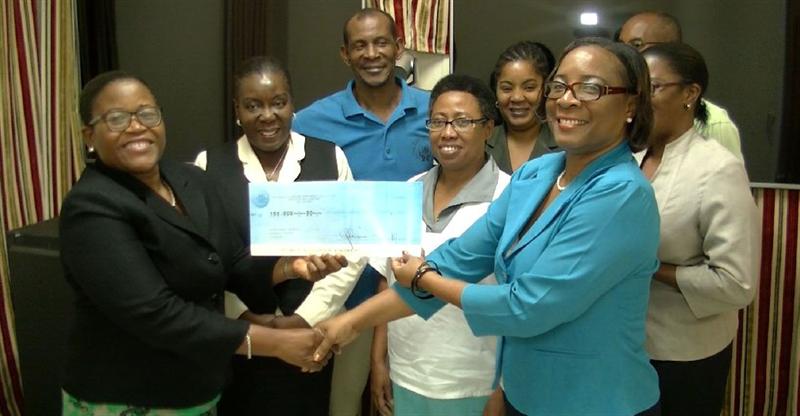

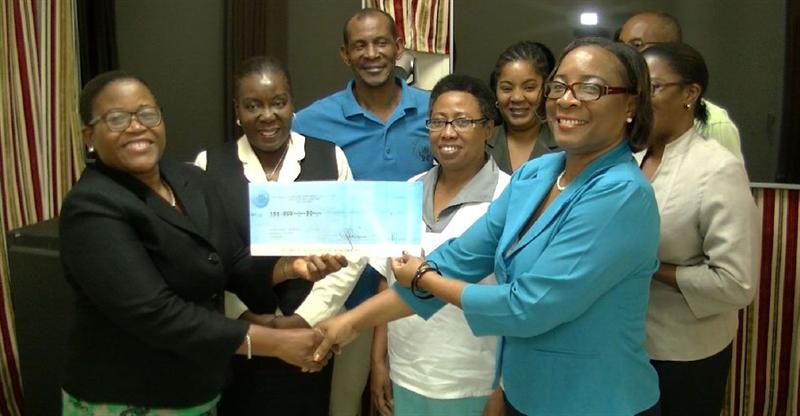 The Civil Service Cooperative Credit Union made a donation of EC$150,000 to Victoria Hospital towards the purchase of two fully equipped dialysis units.
The two units will increase the number of clients who can access dialysis treatment at the medical facility.
Victoria Hospital Executive Director Jeanette Hughes expressed gratitude to the credit union for its contribution.
“It is important to us that you have made a contribution towards a service which is very costly for the hospital; and for the clients it is a lifelong service. We welcome any resources that will help improve the lives of our clients.”
Consultant Nephrologist Dr. Merle Clarke, thanked the Civil Service Cooperative Credit Union for its support over the years, and explained that chronic kidney disease – one of the main complications of diabetes and hypertension – is the most common non-communicable disease on island.
“The treatment is extremely expensive especially for patients with stage five kidney disease who require renal replacement therapy, dialysis or hemodialysis. It is out of the reach of the average patient particularly without heavy government subsidies, and that cost does not include the cost of the medication patients require.”
President of the Civil Service Cooperative Credit Union, Adria Rose Sonson presented the cheque, and explained that during World Kidney Day, the credit union was informed of the long waiting list of persons to be dialyzed, the shortage of machines and the high cost of providing dialysis services. consequently, the union felt that the best contribution would be to donate towards the purchase of additional machines.
“This donation is dear to our hearts because among us are a few who are afflicted with kidney disease. If our society is affected, we are affected and so we hope to continue this partnership.”
The renal unit currently functions at maximum capacity with 66 patients per week.
CSEC Oral Examinations Next Week


BARBADOS: The Ministry of Education, Science, Technology and Innovation has advised that CSEC Spanish and French Oral Examinations for private candidates will be held next week. The Spanish Orals will take place on April 18 and 19.
Candidates whose surnames begin with letters A-G are requested to take their Spanish Orals on Monday, April 18, beginning at 9:00 a.m.
These will be held at the Ministry’s headquarters, Elsie Payne Complex, Constitution Road, St. Michael.
Candidates whose surnames begin with letters M-Z will take their Spanish Oral examinations at the same venue on Tuesday April 19, also at 9:00 a.m.
However, candidates whose surnames begin with letters H-L are required to take their Spanish Oral examinations at The St. Michael School, Martindales Road, St. Michael, on Tuesday April 19. These commence at 9:00 a.m.
Meanwhile, the French Oral Examinations for all private candidates will take place at Springer Memorial Secondary School, Government Hill, St. Michael, on Friday, April 22, at 9:00 a.m. All candidates taking these examinations are required to walk with picture identification.
joy-ann.gill@barbados.gov.bb
Instructors in disaster risk reduction undergo training

 DOMINICA: The OECS Commission, through the Ocean Governance Unit and the reducing the Risk To Human And Natural Assets Resulting From Climate Change (RRACC) project in partnership with the ACP-Brussels, have developed a Train the Trainer Instructor programme in the Caribbean region on disaster risk reduction in small island developing states.
The five-day training which began on Monday, 11th April, targets representatives from key regional agencies from disaster management, water resources management, tourism, fisheries, agriculture, NGO and health.
Lester Arnold is Project Coordinator of the RRACC at the OECS commission.
“As part of the project’s mandate we are to build the enabling environment in support of policies and laws to reduce vulnerability, address information gaps that can strain addressing vulnerabilities, making interventions in fresh water and coastal management to build resilience in the tourism and agriculture sector, raise awareness on issues related to climate change and improve capacities for climate change adaptation.
Over the years, the OECS member countries have created pivotal institutions that are providing, through regional stability, socio-economic advancement. However climate change impacts and climate variability are shown to have serious environmental, social and economic consequences on member states.”
Arnold says in order to combat the effects of climate change, there is a need to develop policies, strategies and plans to mitigate its impacts. He says the roles and responsibilities of member states should also be outlined to help build capacity, and enhance resilience through disaster risk reduction measures.
“In view of building resilience and creating the enabling environment to deal with disaster risk reduction using ecosystems, the OECS Commission, through the RRACC project, in collaboration with the Ocean Governance Unit and the ACP has engaged the services of these facilitators to develop and deliver this training workshop that has been tailor-made for the region, and which will enable member states to develop their own ecosystem-based disaster risk reduction measure.”
Five years ago, the OECS Commission started its first climate change project with funding by the USAID to the tune of us$9.5 million.
This was in response to the amount of money spent on restoration efforts after natural disasters.
Between 1990 and 2008 the Caribbean experienced 165 natural disasters with the total impact in damage and losses estimated to be us$136 billion with economic impact at it’s highest at us$63 billion.
The training hopes to provide exposure which will allow for better articulation, establishing synergies and mainstreaming of eco disaster risk reduction climate change adaptation into policy and programme management.
Barbados And U.S. Discuss Education
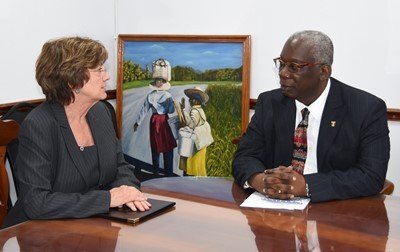
BARBADOS: There is mutual interest in the education systems of Barbados and the United States (US).
This was made clear recently when US Ambassador to Barbados, Linda Taglialatela, paid a courtesy call on Minister of Education, Science, Technology and Innovation, Ronald Jones, at the Elsie Payne Complex, Constitution Road, St. Michael.
Stating that she looked forward to partnering with the Ministry, Ambassador Taglialatela expressed interest in the island’s A Ganar program, with its role in addressing at-risk students.
“I think that is a very admirable program and one of the things that I would like to do is go out to some of the schools and spend some time with the little ones … Some of the Embassy team would like very much to be able to engage with the schools, to talk and work with them and where we can help, we certainly want to,” she said.
Emphasising that education was very dear to her, Ms. Taglialatela said it was sometimes disheartening because of the tendency to put less money into this discipline than other areas.
“The older I get the more I realise how important education is in developing and training the next generation of leaders. And, I think in some ways we are falling short across the globe, trying to find ways to build those young people and the skills they need, not only to succeed in life, but just the basic skills of how to take care of yourself when you graduate from high school,” she stressed.
Mr. Jones welcomed the Ambassador’s interest in schools under the A Ganar program, and praised the US Embassy for its “effective” public relations and communications. He also expressed appreciation to the Embassy for its donation of books and other items over the years, adding that he looked forward to the continuation of that outreach.
The Education Minister noted that the island’s public sector had, over time, been the beneficiary of training through Harvard Business School; that there were ongoing nursery education initiatives with Wheelock College in Boston; and an impending Memorandum of Understanding with Georgia State University.
He also informed the Ambassador that Science, Technology, Engineering and Mathematics (STEM) education, Early Childhood Education and Autism Education were priority areas in which the US Embassy could further lend assistance.
Barbados and the United States of America established diplomatic ties in 1966.
joy-ann.gill@barbados.gov.bb
DSC benefits from crowd funding training
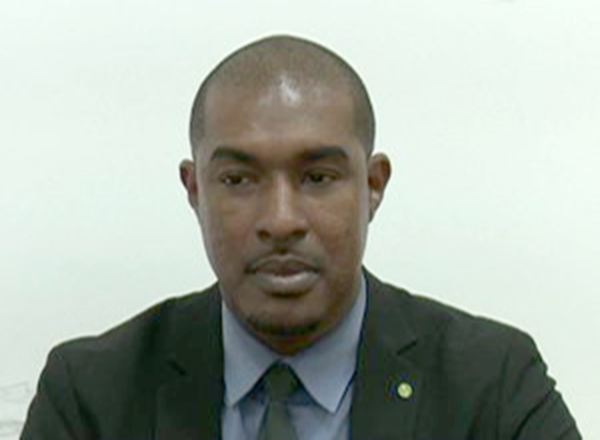
DOMINICA: The OECS Competitive Business Unit held a one-day E-Business (crowd funding) training at the Dominica State College on Monday, 11th April.
Crowd funding is the practice of funding a project or venture by raising monetary contributions from a large number of people.
The primary focus of the OECS Business Unit is on competitiveness and innovation in the small and medium size enterprise in the OECS.
The training targeted lecturers and students of the Dominica State College.
Marlon Marie is officer in charge of the Organization of the Eastern Caribbean States Competitive Business Unit.
“The training session is geared towards opening minds into technologies that are available and tools that are available out there for access to finance. We are not only working on crowd funding, we are also teaching social media skills and marketing skills. Students use social media for various things and it is important for them to realize that there is a business aspect to social media. We are trying to get them to think more positively in terms of the use of these tools.”
Marie said that when an individual is involved in crowd funding it is important to always look at their actions on social media.
In detailing some of the topics for discussion at the training he said, “We are trying to show persons that it is not a new phenomenon, also we are going to show the students and the lecturers what crowd funding is like presently by using the internet. We are going to be teaching about pitching your idea because it is very important to pitch your idea. One of the main activities is the utilization of videos, because when you launch a crowd funding campaign you need to have an effective video. There is going to be group activity to prepare a pitch for crowd funding and social media marketing as well.”
Marie said he would like young people to know that social media is here to stay and it can be used positively. He is also hoping that young persons can recognize and take advantage of the business opportunities social media presents.
The OECS Commission is working collaboratively with the Vision Funder, one of the first crowd funding platforms in the Caribbean. Vision Funder is a subsidiary of legacy global, a Barbados based company which provides access and services globally.
Consultant for Vision Funder, Eldonna Lendor, told participants of the training that the primary focus of Vision Funder is the economic development of the region.
She says the company has recognized that sometimes the services available are not always contextualized to the Caribbean and is aspiring to provide the type of support that the Caribbean is geared towards.
“So we take pleasure to introduce you to our very own Caribbean crowd funding platform, a platform that is geared towards providing this type of service not only to the Caribbean but globally,” she said.
Last year the OECS Competiveness Business Unit trained 43 small and medium sized enterprises and has now placed sole focus on the youth by preparing potential entrepreneurs for the market.
ECTEL council improves legislation

ST. LUCIA: Telecommunications ministers meet to discuss new legislation that will facilitate investment and strengthen regulations.
 Ministers with responsibility for telecommunications in the region of the Organization of Eastern Caribbean States (OECS) will meet in Saint Lucia today, to discuss new legislation designed to strengthen consumer rights and ensure that the climate for investment remains competitive.
The main agenda item for the Eastern Caribbean Telecommunications Authority (ECTEL) Council of Ministers’ 33rd meeting is the new draft Electronic Communications (EC) Bill. The EC Bill contains changes to the licensing process that will facilitate investment in all ECTEL member states; new rules that address competition issues facing the sector; and recommendations for strengthening the National Telecommunications Regulatory Commissions (NTRCS) to make it more effective. The bill also contains improved rules for resolving quality of service issues faced by consumers.
At the meeting, the ECTEL Council of Ministers will, additionally, discuss new quality of service regulations, consumer protection regulations, retail pricing, wholesale pricing, and the sharing of infrastructure; and consider a recommendation on measures to address the impact of the merger of Cable & Wireless Communications and Columbus International in light of the impasse in negotiations between ECTEL and the companies.
Managing Director of ECTEL, Embert Charles, said the meeting is an important one that will advance the policy objectives of member states.
“These submissions to the ministers are in response to the directives of the ECTEL Council of Ministers late last year for the Directorate to advance the process of regulatory reform, in order to address the wide range of emerging issues in the electronic communicationssector in ECTEL member states.”
Following deliberations, the approved new regulatory instruments including the EC Bill and an amended ECTEL Treaty will be submitted to the member states for promulgation.
The ECTEL Council of Ministers is made up of ministers responsible for telecommunications in the Commonwealth of Dominica, Grenada, Saint Lucia, Saint Kitts and Nevis and Saint Vincent and the Grenadines. The governments of Antigua and Barbuda and Montserrat have been participating, as observers, in the deliberations of the ECTEL Council of Ministers since 2012.
Foreign Minister Meets With Netherlands Delegation
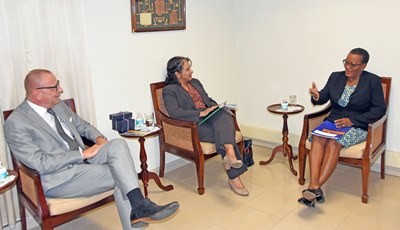
BARBADOS: Ways in which Barbados and countries in the Netherland Antilles could work together on key issues were discussed recently, when a delegation from the Kingdom of the Netherlands met with Minister of Foreign Affairs and Foreign Trade, Senator Maxine McClean.
Ambassador of the Kingdom of the Netherlands to Barbados, Jules Bijl; Acting Director of the Western Hemisphere Department of the Ministry of Foreign Affairs and Foreign Trade of the Kingdom of the Netherlands, Joost Reintjes; and Ambassador for CARICOM Affairs of the Kingdom of the Netherlands, Lucita Moeniralam, held talks with the Minister at her Culloden Road office.
The officials spoke about the possibility of creating linkages in the agricultural sector, particularly in the areas of horticulture and green house technology. Senator McClean noted that Holland was a “powerhouse” in green house technology, and Barbados could benefit from its expertise in this area.
She added that a group of young persons in Barbados was working on the development of cooling systems and pest control in greenhouses which would enable them to grow a wide variety of crops.
With regard to horticulture, the Minister expressed the belief that this industry was one that could be further developed. According to her, Barbados produced beautiful flowers every year which usually won prizes at the Chelsea Flower Show in London. She identified tissue culture development as an area that could be developed to service local consumers.
Other issues discussed included educational opportunities, air lift into the region, security, opportunities for trade, renewable energy and the economic situation in Barbados.
kim.ramsay-moore@barbados.gov.bb
First Calf Born Under Artificial Insemination Program
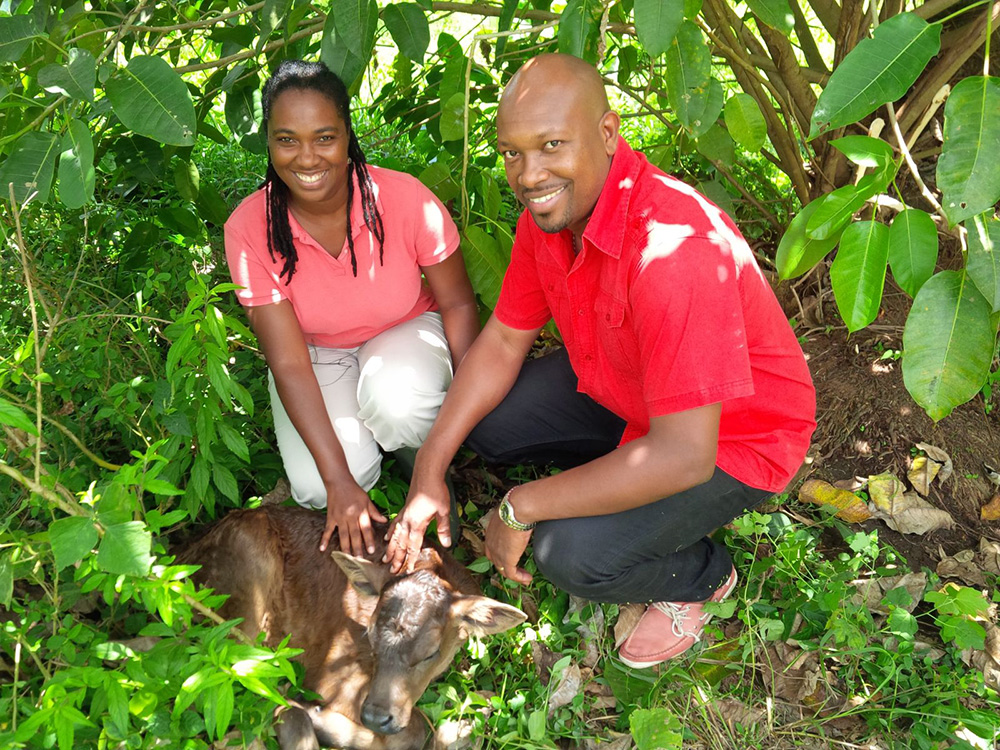


ST. VINCENT: Tuesday, 12th April was “a very exciting day” for farmer, Mr. Wayne Daniel and the Ministry of Agriculture, Forestry, Fisheries and Rural Transformation, following the birth of a 72 pound calf, conceived through artificial insemination.
Mr. Daniel’s cow was the first of 30 cattle artificially inseminated under the Ministry’s Artificial Insemination Program, which was initiated in 2015 and is aimed at developing and expanding the livestock sector here.
One hundred straws of cattle semen were donated compliments the Government and people of Jamaica. Among the breeds of cattle expected to be bred from the project are Jamaican Hope, Red Pol and Black Pol, all indigenous to Jamaica.
“I want to congratulate my brother Wade for being the first famer to receive a calf. He was approached by the Ministry of Agriculture, just like other cattle farmers. He took the initiative very seriously and today we are witnessing the birth of the first artificially inseminated calf,” said Minister of Agriculture, Hon Saboto Caesar.

Caesar also encouraged all cattle farmers in St. Vincent and the Grenadines to look at the opportunities and possibilities created by exporting cattle to Grenada and other countries. “We are going to embark on a very robust program throughout 2016 so that we can have as many cows go through the process of artificial insemination. We are in the process of looking for different breeds of cattle,” the Minister added. Meanwhile, Mr. Daniel, a farmer in Guava, Orange Hill, for over 35 years, said that he was “very excited and happy”. This is a very good initiative the Ministry has undertaken and I am very proud to be the first farmer whose cow was the first to give birth under this Artificial Insemination program,” Daniel said, smiling.
The female calf was given the name, Ja-C. A symbol of the co-operation between Jamaica and Cuba on the artificial insemination initiative.
Source: Ministry of Agriculture Communication Unit