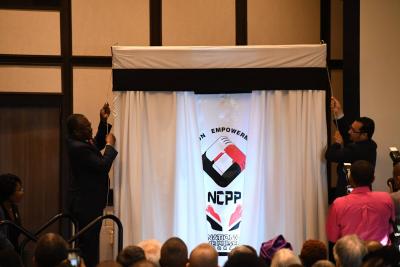
Change of venue for NCPP San Fernando public outreach engagement.
The Ministry of National Security wishes to advise that the National Crime Prevention Programme (NCPP) Public Outreach Engagement venue has been changed from the San Fernando City Corporation City Hall to the Southern Academy for the Performing Arts (SAPA).
The Public Outreach is carded to take place on Thursday 13th September, 2018 from 5:30 p.m. to 7:30 p.m.
The Ministry apologizes for any inconvenience that may be caused by this change of venue for this Public Outreach Engagement.
The NCPP looks forward to the support and participation of each citizen, across every sector of Trinidad and Tobago.
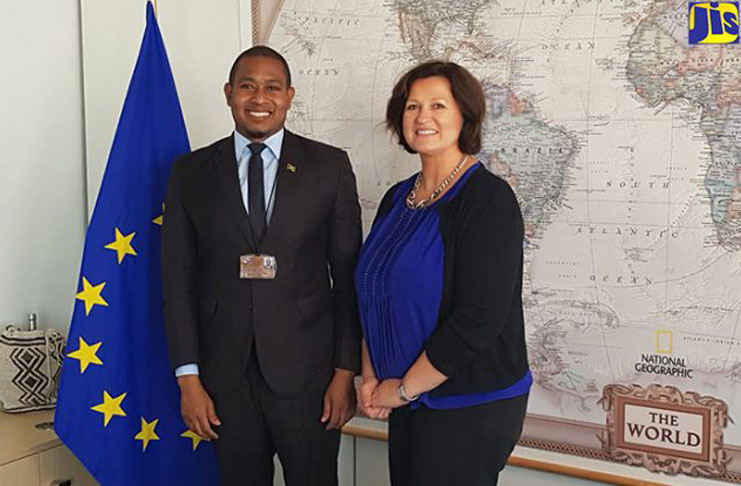
Minister Floyd Green Participates in European Union Visitors Programme – EUVP.
Minister of State in Jamaica’s Ministry of Education, Youth and Information, Floyd Green, is visiting Belgium and France this week to participate in the European Union Visitors Programme (EUVP) September 10 – 14, 2018.
The EUVP is an individual study programme of the European Parliament and the European Commission that invites promising young leaders and opinion shapers from countries outside the European Union to visit EU institutions to gain a first-hand appreciation of the EU and how it works.
Minister Green’s agenda includes meetings with European parliamentarians, directors and heads of unit of EU Institutions, including those who work on issues relating to the Caribbean, fisheries, blue economy, ocean governance, education, youth, the environment, agriculture and rural development. He will also visit the European Parliament in Strasbourg, France.
“Being in Brussels, the centre of EU activities, has really given me a significant appreciation of the diversity of the EU and how much of a noble project the European Union is in trying to bring together diverse people from different countries around common values. The fact that they have been able to do so and even with their challenges, for me, is a positive signal of what is possible when we come together,” the minister shared.
“I’m sure that at the end of the day it will be quite a fulfilling and rewarding programme,” he said.
Each year, the EU Delegation in Jamaica proposes candidates for consideration to participate in the programme. The final selections are made through a committee of the European Parliament.
Head of Delegation of the European Union in Jamaica, Ambassador Malgorzata Wasilewska, said the EUVP and other such exchange programmes, help to improve understanding among professionals from different backgrounds, and build bridges between partner countries and the EU.
“Jamaica and the EU share such a strong partnership, and what better way to strengthen that relationship than by bringing the people involved closer together so that they can share ideas and learn from each other?” she mused.
The Jamaica and European Union partnership commenced in 1975 when Jamaica became a member of the African, Caribbean and Pacific (ACP) group of countries. Current EU development support to Jamaica is governed by the 20-year Cotonou Partnership Agreement which expires in 2020.
“The EUVP presents an important opportunity for Minister Green to influence understanding of the realities of the Caribbean and Jamaica among his counterparts in Europe. In addition, it has great networking value and can help to identify opportunities within the EU to advance Jamaica’s development agenda, especially at this crucial time in the relationship between the EU and the Caribbean,” said Ambassador Wasilewska.
Some past participants in the programme are Minister of Foreign Affairs and Foreign Trade Kamina Johnson Smith; former Senator Imani Duncan- Price and General Secretary of the People’s National Party, Julian Robinson.
BULLETIN
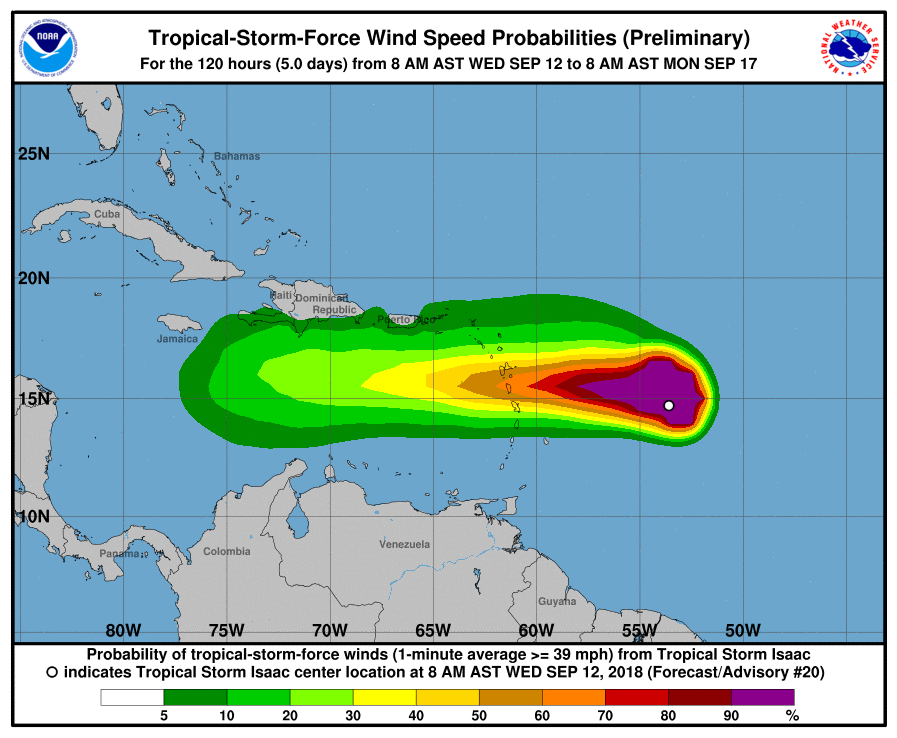
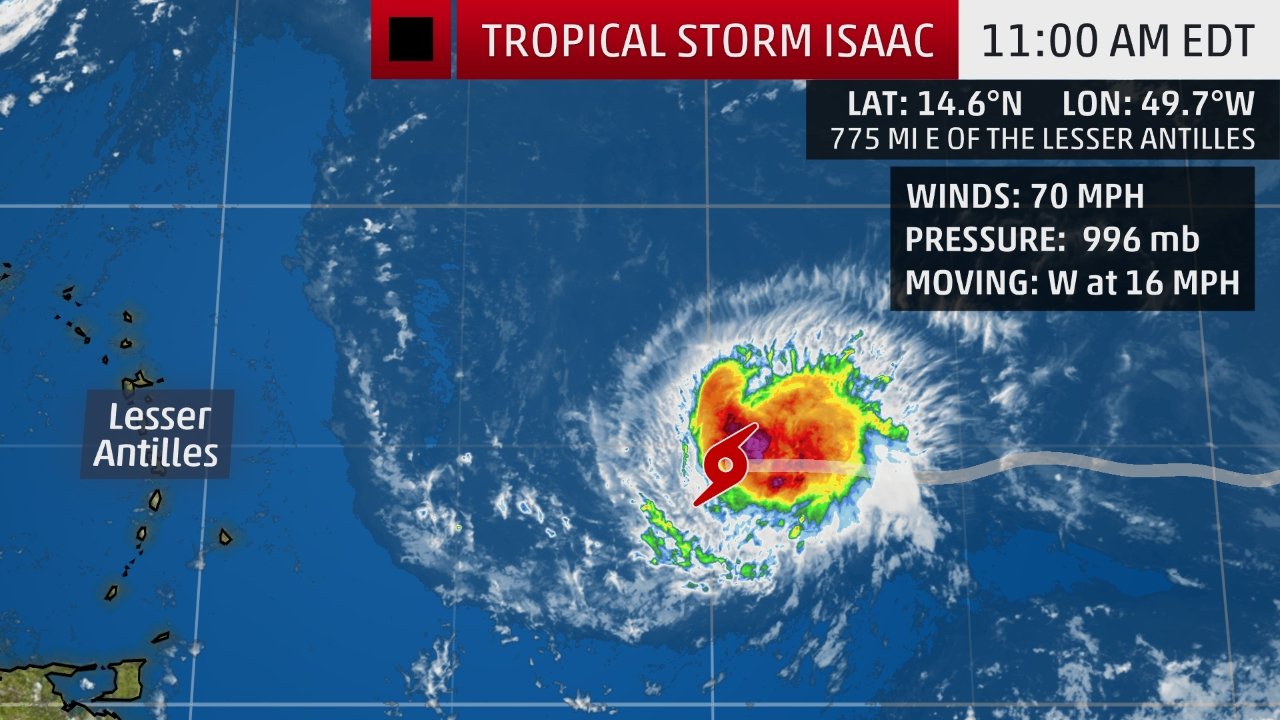
Tropical Storm Isaac Advisory Number 20
NWS National Hurricane Center Miami FL AL092018
1100 AM AST Wed Sep 12 2018
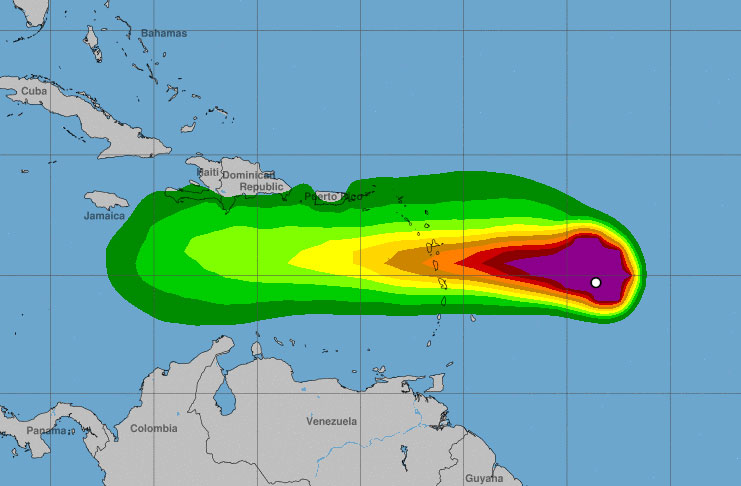
…ISAAC SHOULD REACH THE LESSER ANTILLES EARLY THURSDAY…
SUMMARY OF 1100 AM AST…1500 UTC…INFORMATION
———————————————–
LOCATION…15.0N 54.7W
ABOUT 420 MI…675 KM E OF MARTINIQUE
ABOUT 455 MI…730 KM E OF GUADELOUPE
MAXIMUM SUSTAINED WINDS…60 MPH…95 KM/H
PRESENT MOVEMENT…W OR 275 DEGREES AT 17 MPH…28 KM/H
MINIMUM CENTRAL PRESSURE…1000 MB…29.53 INCHES
WATCHES AND WARNINGS
——————–
CHANGES WITH THIS ADVISORY:
None.
SUMMARY OF WATCHES AND WARNINGS IN EFFECT:
A Tropical Storm Warning is in effect for…
* Martinique
* Dominica
* Guadeloupe
A Tropical Storm Watch is in effect for…
* Antigua
* Montserrat
* St. Kitts and Nevis
* Saba and St. Eustatius
A Tropical Storm Warning means that tropical storm conditions are
expected somewhere within the warning area within 24 to 36 hours.
A Tropical Storm Watch means that tropical storm conditions are
possible within the watch area, in this case within 24 to 36 hours.
Interests elsewhere in the Leeward Islands should monitor the
progress of Isaac.
For storm information specific to your area, please monitor products
issued by your national meteorological service.
DISCUSSION AND OUTLOOK
———————-
At 1100 AM AST (1500 UTC), the center of Tropical Storm Isaac was
located by a NOAA Hurricane Hunter aircraft near latitude 15.0
North, longitude 54.7 West. Isaac is moving toward the west near 17
mph (28 km/h), and this general motion with some decrease in forward
is expected to continue through the weekend. On the forecast track,
Isaac is forecast to move across the central Lesser Antilles and
into the eastern Caribbean Sea on Thursday, and then move across the
eastern and central Caribbean Sea through Saturday.
Aircraft data indicate that maximum sustained winds remain near 60
mph (95 km/h) with higher gusts. Gradual weakening is forecast
during the next 72 hours.
Tropical-storm-force winds extend outward up to 175 miles (280 km),
primarily to the north of the center.
The estimated minimum central pressure is 1000 mb (29.53 inches).
HAZARDS AFFECTING LAND
———————-
RAINFALL: Isaac is expected to produce total rainfall accumulations
of 2 to 4 inches with isolated amounts up 8 inches across
Martinique, Dominica, and Guadeloupe, 1 to 2 inches with isolated
amounts to 4 inches across Puerto Rico and the southern United
States Virgin Islands, with up to an inch anticipated across the
remaining Windward and Leeward Islands. This rainfall may cause
life-threatening flash flooding.
WIND: Tropical storm conditions are expected on Martinique,
Dominica, and Guadeloupe early Thursday. Tropical storm conditions
are possible within the tropical storm watch area on Thursday.
STORM SURGE: Some coastal flooding is possible in areas of onshore
winds. Near the coast, the surge will be accompanied by large
waves.
SURF: Swells generated by Isaac will begin to affect portions
of the Lesser Antilles this afternoon. These swells are likely to
cause life-threatening surf and rip current conditions. Please
consult products from your local weather office.
NEXT ADVISORY
————-
Next intermediate advisory at 200 PM AST.
Next complete advisory at 500 PM AST.
All schools remain closed and DOWASCO to shut off water in preparation for Tropical Storm Isaac.
As the Dominica prepares for the arrival of tropical storm Isaac, the Hon Prime Minister, Roosevelt Skerrit has announced that all schools on the island will be closed on Wednesday and Thursday September 12th and 13.
Dominica was placed under a Hurricane Watch on Tuesday morning however by Tuesday night at 11:00pm the watch was discontinued, and the island was placed under a Tropical Storm Warning.
Hon Skerrit said the closing of schools is as “precautionary measures” as up to 10 inches rain is expected between Wednesday and Friday.
“We do not want to have a situation where we allow our students to come in for two hours [or] an hour and have to rush them back to their homes,” Hon Skerrit said.
He explained this decision is significant particularly for students who attend schools out of their communities.
Hon Skerrit asked citizens not to be complacent but to take all precautionary measures and to be vigilante. He said NEPO is sparing no effort and taking the impending storm “seriously”.
“Our position at NEPO is to take all the necessary precautionary measures to ensure that we can place all ourselves and our property in safer situations …Do not take this thing for granted, do not be complacent, do not dismiss what NEPO, ODM and the Met office are saying to us,” he warned the public.
General Manager of DOWASCO, Bernard Etinoffe also announced at Tuesday’s press briefing that the company will shut down its water supply system at 2:00pm on Wednesday.
At Tuesday’s meeting officials from the Ministry of Health as well as from the Ministry of Public Works also updated the public on their state of readiness.
Another briefing is expected at 11:30am today Wednesday and officials from the NEPO’s shelter committee, the Ministry of Public Works and the Office of Disaster Management will address the public.
At 5am, Tropical Storm Isaac was located near latitude 14.6 degrees north and longitude 53.5 degrees west or about 530 miles east of Dominica. Isaac is moving westward at 15 mph with maximum sustained winds now decreased to near 60 mph with higher gusts. Some further weakening is expected but Isaac should remain a tropical storm as it moves across the area on Thursday.
The President of Cuba Miguel Díaz-Canel Bermúdez, accompanied by Cuba’s First Lady, Lis Cuesta, and Cuba’s Foreign Minister Bruno Rodríguez Parilla, met with Prime Minister Rt. Hon. Dean Barrow, his wife Mrs. Kim Simplis Barrow, and Ambassador of Belize H.E. Annie Burns, in a frank and friendly exchange on areas of common interest. The group discussed challenges, achievements and cooperation between the countries.
In particular, President Díaz-Canel described the granular process of public consultation across Cuba over the Proposed Constitution. He confirmed that public consultations were taking place in factories, schools, and other central meeting places in order to ensure broad participation. Members of the public are able to propose new points for consideration, as well as suggest amendments. This process is also open to Cubans abroad. The President, Foreign Minister, and other members of the National Assembly of Cuba have regular participation in robust town-hall-style debates.
Prime Minister Barrow congratulated the President, Government and people of Cuba on this most important exercise, and the comprehensive, inclusive and fully democratic way in which it is being conducted.
The two leaders expressed a desire to strengthen the already close ties between their two countries. They agreed that greater cooperation would be especially useful in the political arena, tourism and trade. They discussed, in particular, the upcoming United Nations General Assembly. Prime Minister Barrow reiterated Belize’s continuing support in calling for an end to the unilateral, unjust commercial, economic, and financial blockade against Cuba and its people.
The meeting ended with the Prime Minister thanking the Cubans for their long-standing generosity in relation to the scholarships extended to deserving, young Belizeans.
On a personal note, Prime Minister Barrow also expressed profound appreciation to President Díaz-Canel for the hospitality of the Cuban Government and the expert medical care he is receiving in Cuba; and for the warmth and friendliness extended to him by all Cubans with whom he had come in contact.
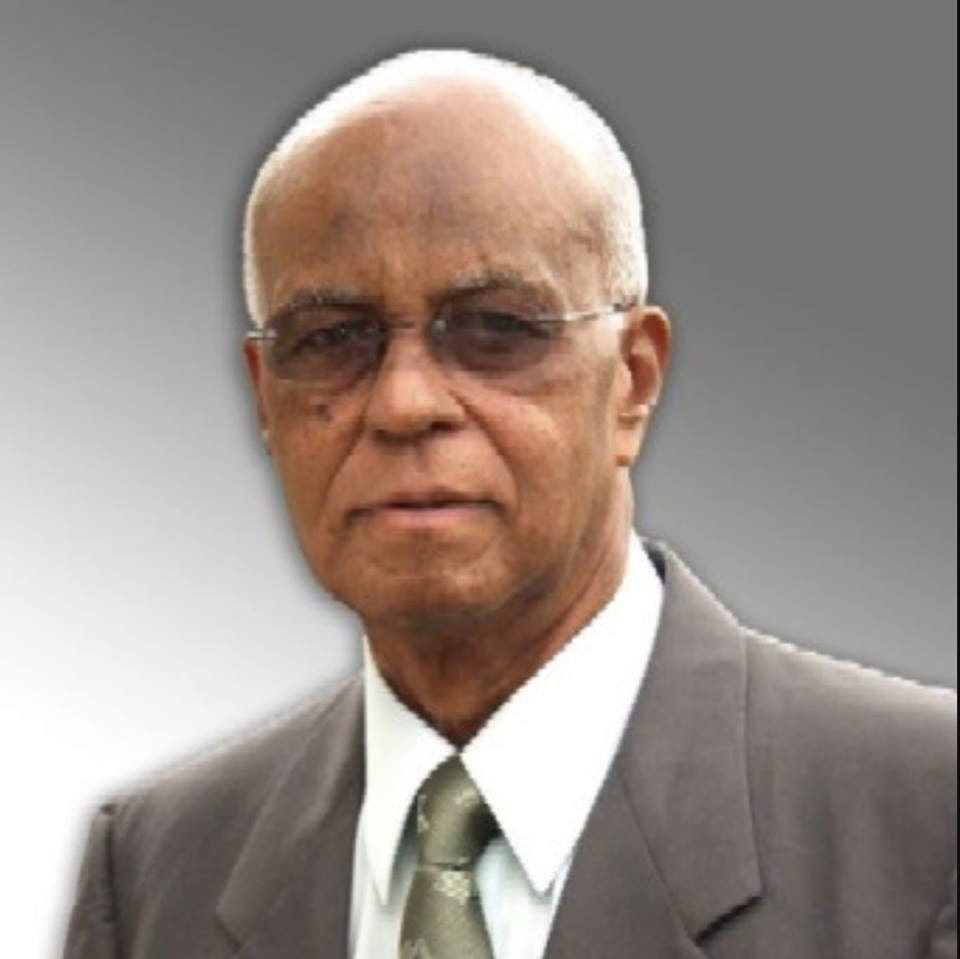
CARICOM extends condolences on passing of former Montserrat Chief Minister.
CARICOM Secretary-General Ambassador Irwin LaRocque has expressed the Community’s condolences to the family of Montserrat’s former Chief Minister Mr Bertrand Osborne and to the Government and people, on his passing.
Mr Osborne, who died last Wednesday, served as Chief Minister of Montserrat from November 13th 1996 to August 27th 1997, a particularly difficult time in the island’s history during the height of the volcanic crisis.
Ambassador LaRocque, in his Message of Condolence to Montserrat’s Premier Mr. Donaldson Romeo, lauded Mr. Osborne’s dedication to politics and the private sector, noting that his “heightened sense of social responsibility will long be remembered in his native land.”
“He will be remembered for his integrity, honesty and trustworthiness which has been acknowledged by all regardless of political affiliation. The Community extends its condolences to his wife Lystra, his children and the entire Osborne family and the Government and people of Montserrat,” the Message stated.
Barbados Economic Recovery Programme Team’s responses to the questions posed by Professor Michael Howard on page 26A in the Nation’s Sunday Sun for Sunday, September 9, 2018.
Ques:What are the projected dollar cuts for current expenditure over the loan period?
Ans: The loan period is for 4 years, with the last disbursement in May 2022. Projected expenditure cuts over this period amount to $571 million.
Ques:Has fiscal revenue been overestimated, given the fact that the economy is in recession, and large job cuts will occur which will further reduce tax revenue yield?
Ans: The fiscal revenues have not been overestimated. They take into account the economic business cycle and all factors impacting it, including any possible job losses.
Ques:How many workers in the public service and the SOEs are estimated to be sent home?
Ans: The program does not take the draconian and outdated approach by targeting some number for sending home workers. The objective of reform to the SOEs and to Central Government is to make the public sector fit for the challenges of the twenty first century through modernising and improving the efficiency, quality and cost effectiveness of the public sector. This will mean adjustment and rationalisation of SOEs and some Government Departments. It will also mean retooling and empowering, retraining and enfranchising some of the public sector workers to improve effectiveness. There will be job losses in some areas but there will also be employment gains in other areas where deficiencies have long set in. The net effect is likely to be a reduction in public sector employment but the number is also likely to be far smaller than the numbers bandied around and all will be offered some alternative, be it in the modernizing and digitizing program, an extensive training program, early retirement or a job in the private sector.
Ques:Is there any estimated money value of severance payments in relation to job retrenchments?
Ans: This is still being worked out at the level of the Social Partnership.
Ques:Are there any preliminary estimates to show how many SOEs will be merged, shut down or privatised, or the savings to be derived from these actions? Will user fees be charged for certain services, and if so, which ones?
Ans: The SOEs reform process began with what can be considered the most comprehensive consultation in our modern history from the Social Partnership to the leadership to the wider public, to identify potential for efficiency gains, cost recoveries, and enfranchisement through divestment of entities and/or activities. Indeed, almost 5000 persons participated in answering 93 questions in an online survey. There is consensus from the consultation process that 29 entities must be transformed with a savings of about $115m by end of 2019/20. It is hoped that around one-third of these reductions will be felt by the end of 2018/19 with the balance in the following fiscal year. Additionally, all Government entities will benefit from stronger timelier financial accounting and oversight.
On the issue of user fees, there are currently four entities which provide an essential public service that the private beneficiaries have a capacity to pay for and where they do so in many other countries. These entities are the Vital Statistics of the Supreme Court Registry, the Land Registry, the Corporate Affairs and Intellectual Property Office, and the Financial Services Commission. The process of moving to full cost recovery of these activities through user fees will also involve an initial and ongoing independent review of the potential for greater efficiencies, for example, through the use of new technologies and approaches, to keep these fees to international norms or lower. The Transport Board and Sanitation Services are also entities where increasing user fees are being considered as part of cost-recovery process (the Sanitation Service fees have already been increased) but these two entities also present opportunities to empower and enfranchise Barbadians, e.g. helping drivers and their teams own their buses and sanitation trucks, bid for work from the Government and commit to minimum standards of public service. As such, any further increase in user fees for these two entities be a small part of a larger restructuring effort within these entities.
Ques:Is there an estimated target for the new bus fare?
Ans: No, as any increase will be part of a comprehensive transformation process involving improving efficiencies and reducing cost.
Ques:What are the “conditionalities” or requirements for the IMF loan?
Ans: The conditionalities of the IMF loan are the targets set by Barbados itself under the Barbados Economic Recovery and Transformation program (BERT). These are: i) achieving a 6 percent primary balance by fiscal year 2019/20 and maintaining it for the next four year; ii) no further accumulation of arrears; iii) reducing transfers to SOEs by no less than the amount identified under the BERT program; iv) any increase in public debt must be consistent with keeping the debt-to-GDP ratio on the downward trajectory to reach 60 percent by 2033; and v) maintain social spending at a level consistent with protecting the most vulnerable in society.
Ques: What will be the nature and perceived impact of debt restructuring?
Ans: The public debt was deemed unsustainable by every possible measure and every international institution (as reflected in the numerous downgrades to the very bottom of the rank of rated countries), including the IMF. Not only the stock of debt but the servicing of the debt was also choking the life out of the economy. Indeed, the gross financing needs of Government reached 41 percent of GDP in 2017 as highlighted in the IMF 2017 Article IV Report on Barbados. As such, the Government announced a comprehensive debt restructuring, including external debt to commercial creditors and treasury bills, on June 1, 2018. Significant progress has been made in discussions with both domestic and external creditors and an exchange offer for Barbados dollar-denominated debt was issued on September 7, and the plan is to table an exchange offer external (US dollar-denominated) debt to commercial creditors shortly. Government debt held by the Central Bank of Barbados and by the NIS will also be restructured. The successful restructuring of the debt will put the debt on a sustainable path to reach 60 percent by 2033 and free up much needed fiscal space for infrastructural and development spending.
Ques:Was an increase in public sector salaries and pensions, as well as removal of UWI fees an appropriate economic policy, given that the stated goal of annual IMF briefings, as well as the present programme, is to reduce current expenditure?
Ans: This was absolutely an appropriate policy and one which received zero push back from the IMF. The design of economic policy must not only consider the current circumstances but also what has gone before. In doing so, it is clear that the appropriate policy is an increase in salaries and pension, given that the public workers in Barbados have not had a salary increase in over a decade and because of inflation the cost of living has increased considerably. This (the increase in salaries) then becomes the baseline on which the forwarding looking policies can be designed. Similarly, the imposition of UWI fees had created hardship for many Barbadian students, even more so in an environment of a prolonged economic recession. The removal of fees had to be dealt with immediately and be incorporated in the baseline. The same can be said of the additional expenditures to address the sewage and sanitation problem, which required immediate attention.
Ques:Is the flat tax (a modified poll tax) printed on the water bill an unfair or inequitable levy, which will impact proportionately heavier on the poor than on higher income groups?
Ans: We have protected the poorest and most vulnerable with higher pensions and welfare payments. The adjustment is skewed to the most fortunate in our society by raising the top tax rate and corporate tax rates, but we also believe that we are all in this together and everyone should make a contribution even if it is as small as $1.50 per household per day or 30 cents for everyone in the average-sized household.
Ques:Is the IMF loan of US$290 million too small for an extended Fund programme, given our very low level of reserves, and our extremely high level of debt?
Ans: No it is not too small for an Extended Fund Facility (EFF) as it represents 220 percent of quota and any amount above 100 percent of quota is considered ‘high access’. Yes, Barbados could have benefited from even higher access to build reserves buffers, given our vulnerability to external shocks and natural disasters. However, we must also be mindful that the greatest benefit of the endorsement by the IMF of our economic recovery and transformation program is the catalytic role such an endorsement plays. Our development partners, the Inter-American Development Bank and the Caribbean Development Bank have both pledged significant amounts of financing, approaching BDS$300m for Barbados once our program is approved by the IMF Executive Board, which is likely to be in a few weeks. Together we are likely to receive BDS$1bn of support to our reserve from our multilateral partners as a result of the IMF supporting Barbados Economic Recovery Programme (BERT).
Ques:Is a previous detailed report by the IMF on the SOEs available, which would offer some guidance in our monetary and financial situation, rather than having to depend on a qualitative consumer survey?
Ans: While a report by the IMF on the SOEs is available and can be sourced from the Ministry of Economic Affairs, we opted to rely on the comprehensive survey of the Barbadian public which reflects the wishes and views of Barbadians. Not only is this consistent with the principle of us – Barbadians – developing the Barbados Economic and Transformation program, but all the research show that where the public has a say in the design of economic policy, the implementation of said policy is more likely to be successful.
Ques:Are loans from financial institutions like the Inter-American Development Bank, where we can tap funds, also not subject to conditionalities?
Ans: No and this is because many institutions and institutional investors rely on the IMF endorsement, which is taken to imply that the country’s program is based on a coherent and consistent set of policies that are highly likely to be successfully implemented and with the desired outcome. This is the catalytic role of IMF support we referred to above.
Targets in Barbados Economic Recovery and Transformation Program (BERT) are the ‘Conditionalities.
The “conditionalities” of the International Monetary Fund’s loan are the targets set by this country in the Barbados Economic Recovery and Transformation Program (BERT).
That is the word from the Barbados Economic Recovery Team, in response to questions recently posed by retired senior lecturer in economics at the University of the West Indies, Cave Hill Campus, Professor Michael Howard, in a newspaper article.
According to the team, these conditionalities are: achieving a six per cent primary balance by fiscal year 2019/20 and maintaining it for the next four years; no further accumulation of arrears; and reducing transfers to state-owned enterprises (SOEs) by no less than the amount identified under the BERT Program.
In addition, the group said “any increase in public debt must be consistent with keeping the debt-to-GDP ratio on the downward trajectory to reach 60 per cent by 2033; and maintain social spending at a level consistent with protecting the most vulnerable in society”.
The team further pointed out that loans from financial institutions, such as the Inter-American Development Bank, would not be subject to conditionalities. The group explained that “many institutions and institutional investors rely on the IMF endorsement, which is taken to imply that the country’s program is based on a coherent and consistent set of policies that are highly likely to be successfully implemented and with the desired outcome”. According to the economic recovery team, this is the catalytic role of the IMF support.
The team noted that the IMF loan of US$ 290 million was not too small for an Extended Fund Facility (EFF), as it represented 220 per cent of quota. The group added that any amount above 100 per cent of quota was considered ‘high access’.
“Yes, Barbados could have benefited from even higher access to build reserves buffers, given our vulnerability to external shocks and natural disasters. However, we must also be mindful that the greatest benefit of the endorsement by the IMF of our economic recovery and transformation program is the catalytic role such an endorsement plays.
“Our development partners, the Inter-American Development Bank and the Caribbean Development Bank, have both pledged significant amounts of financing, approaching BDS$ 300 million for Barbados, once our program is approved by the IMF Executive Board, which is likely to be in a few weeks. Together we are likely to receive BDS$ 1billion of support to our reserve from our multilateral partners, as a result of the IMF supporting BERT,” the team disclosed.
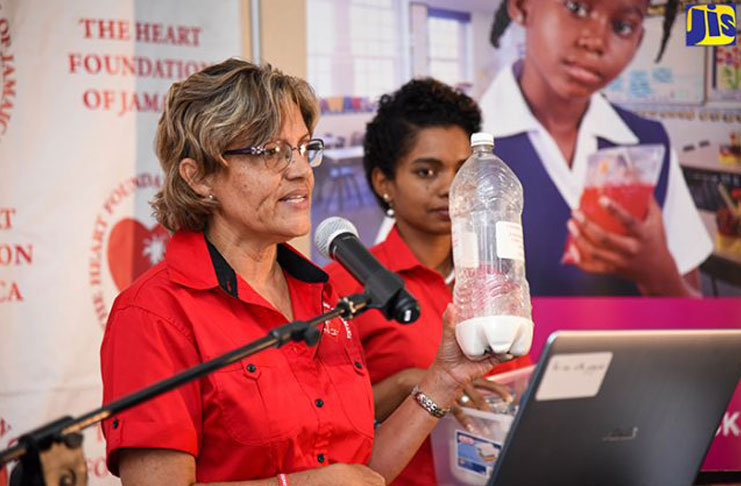
Executive Director of The Heart Foundation of Jamaica, Deborah Chen, holds a soda bottle with the estimated amount of sugar that is used in beverages to fill them.
Discussions Begin with Manufacturers to Reduce Sugar in Drinks.
Minister of Health, Dr. the Hon. Christopher Tufton, says discussions have started with manufacturers who distribute sugary drinks to schools about the steps they will be taking to reduce the sugar content, before the Government implements its new policy on these drinks in January 2019.
Speaking at the release of the ‘Are You Drinking Yourself Sick?’ post-obesity-prevention campaign survey results, which took place at the Spanish Court Hotel in New Kingston on September 10, Dr. Tufton said manufacturers are key stakeholders that the Government wants to see producing juices that are more fruit-based and healthy for the nation’s children.
“There are three months to go [before the policy is implemented in January]. In the meantime, we have been having discussions with a number of the critical stakeholders, including manufacturers,” Dr. Tufton said.
“I think it’s important that the dialogue continue. I think it’s key for the behavioural change that we seek to include all concerned, because this campaign, this public advocacy, is not just about behavioural change for our children, our teachers, our vendors and our policymakers; it’s also about behavioural change for those who supply the goods that we would like to consume,” he added.
Dr. Tufton said he is encouraging school-beverage manufacturers to embrace the approach the Ministry of Health has been taking, as the goal is to reduce obesity and non-communicable diseases (NCDs) among our nation’s children.
“It’s good business to say to your consuming public that we have a product that’s good for you, and frankly speaking, a drink that contains four times the daily recommended amount of sugar cannot be good for you,” the Minister argued.
According to the ‘Key Findings in the Obesity Prevention Public Opinion Survey, Jamaica’, which were presented at the event, seven out of 10 Jamaicans attributed negative health impact to sugary-drink consumption; approximately eight out of 10 respondents were concerned about the effects of sugary drinks on their children’s health, and there was evidence to show that children had easier access to sugary drinks at school, when compared to their homes or other places outside of their homes.
The survey also stated that approximately 54 per cent of respondents agreed that children had most sugary drinks at school; approximately 83 per cent of them strongly supported policies on the provision of healthy food and beverages in schools; approximately 71 per cent of Jamaicans interviewed support the imposition of a tax on sugary drinks; eight out of 10 persons agreed that the tax revenue should be spent on programmes that reduce obesity, especially among children; and 91 per cent of respondents agreed that there should be clear warning labels on the front of food and beverage packages to alert consumers when products are high in sugar, salt or fats.
CDEMA and MapAction partner to enhance speed and effectiveness of disaster response in Caribbean.
The Caribbean Disaster Emergency Management Agency (CDEMA) and humanitarian mapping charity MapAction yesterday signed a Memorandum of Understanding (MoU) to formalise their new joint working relationship. MapAction will work alongside CDEMA teams and support National Disaster Management Agencies within the Caribbean region as needed.
MapAction is supporting the teams that make up the Regional Response Mechanism (RRM),
CDEMA’s Participating States as well as the CDEMA Coordinating Unit, to improve their use of data gathering, mapping and analysis for the effective planning and delivery of humanitarian aid in response to disasters. The partnership is expected to help RRM teams provide disaster response support quickly and in the right places.
In the event of an emergency in the Caribbean region, MapAction will work with all responders to obtain the most complete, accurate and detailed data available. Dependent on the scale of the disaster, MapAction may deploy one team to support several RRM teams or several MapAction teams may be allocated to different RRM or member state teams. In certain situations, for example ahead of hurricanes, they may preposition to ensure the most rapid response possible. There are currently six CDEMA RRM teams, as well as the Regional Coordinating Centre in Barbados. The teams cover different aspects of disaster response, including rapid needs assessment, search and rescue, coordination and various technical specialists.
Ronald Jackson, Executive Director of CDEMA, commented, “[Suggestion:] We had the
opportunity to work closely with members of the MapAction team during the response to
Hurricanes Matthew in 2016 and again during Irma and Maria in September 2017, and from this collaboration, we understood the benefits that their mapping and information management expertise could bring to our own operations. This partnership will enable us to build our teams’ own capacities for mapping and analysing data to enhance our response to any future disasters, as well as calling on MapAction personnel to help us directly when emergencies happen.”
MapAction’s Chief Executive Liz Hughes said, “Collaboration and partnership are fundamental to MapAction’s approach, and we are delighted to have the opportunity to deepen and formalise our working relationship with CDEMA. We are keen to support them and their partners in whatever way we can.”