Home Blog Page 148

Social Partners provide feedback on the way forward

Review-HGP

Social Partners provide feedback on the way forward after the Homegrown Programme.

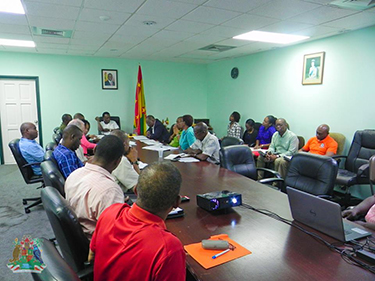
Following from a meeting on September 29th, 2016, The Committee of Social Partners, led by Prime Minister Mitchell, held its 2nd joint review of the Homegrown Structural Adjustment Programme, on Friday, October 14th, 2016.
Friday’s meet sought to continue the discussions on the Homegrown Programme, scheduled to come to an end in December 2016, and to receive feedback from the partners on the areas that should be maintained, tweaked or removed altogether.
The suggestions received have been very comprehensive and of high quality.
Generally, the partners have called on Government to provide some form of tax relief; maintain or increase spending on the social safety net programmes and housing; continuation of the social partnership and broadening of same to include youth representation and broadening of the scope of the monitoring committee to beyond the review of monthly reports among others.
Prime Minister Mitchell was very satisfied with the level of the discussions and expressed willingness to take a number of a number of the suggestions on board.
As he stated, “this engagement demonstrates Government’s willingness to strengthen national unity on matters of national importance.”

Statement from the Government on the Referendum

Referendum

The march to constitutional reform has been ongoing for many years, with a well-documented history of academic research and consultations that have informed this current process.

With the seven Bills finally settled on, and with the announced date approaching, the Government, as well as the leadership of Constitutional Review Advisory Committee (CRAC), have noticed that the entire nation has begun to pay attention to the issues, in a way that has been unprecedented.
We have sensed a genuine increase in national interest – and at the same time, people are asking for more time to become more familiar with what is being proposed.
While we appreciate that we cannot have an open-ended process, we understand the magnitude and historic significance of the Bills being presented to Grenadians for their approval.
In particular, one clause in the Rights and Freedoms Bill has caused growing concerns in some circles. After extensive general discussion, including with the chairman and other members of (CRAC), the Government believes that this, and any other lingering issues of clarity, must be addressed.
All the contributions of the various stakeholders on this matter have been considered and against this background, the cabinet has decided that it would serve the public good if approximately another month be given for the education process to be completed.
In this regard, the Governor General has been advised that a new date should be set for the holding of a referendum.
The Office of the Governor General will issue the relevant writs to give effect to this new decision, and the Electoral Office will take charge of the process.
We believe that this decision is in the broader national interest, and is consistent with the consultative posture of the Government, as well the Constitutional Review Commission from the very onset.
We invite all Grenadians to remain engaged in this dynamic process as we continue this long march to improving our constitutional arrangements – and in building a brighter future for not only this generation – but those to come.

Services Sector critical to Region’s survival

Chet Green
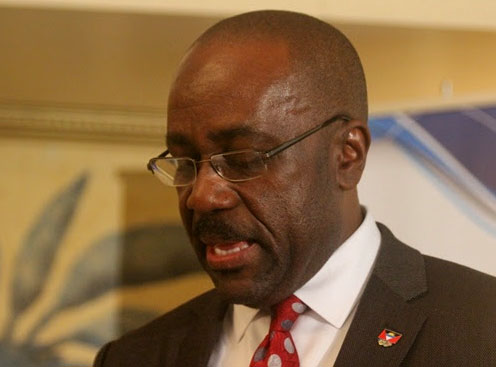
Antigua and Barbuda’s Minister of Trade, Industry, Sports and Culture Chet Green addressing the Opening of the Symposium.

Services Sector critical to Region’s survival – Antigua/Barbuda’s Trade, Industry Minister.

Stakeholders in the Region’s Services Sector who have gathered in Antigua and Barbuda for a development symposium have been warned that the Region’s very survival was linked to the performance of the sector and their efforts to make it succeed.
Antigua and Barbuda’s Minister of Trade, Industry, Sports and Culture Chet Green told the Symposium’s Opening Ceremony, Monday, that Services continues to be the economic engine for the CARICOM/CARIFORUM region, impacting  ‘our standard of living and indeed our very survival’
‘The Services Sector continues to be the largest sector of the regional CARIFORUM (CARICOM and the Dominican Republic) economy. It accounts for more than 75 percent employment and 60 percent of output.  It also accounts for the highest levels of foreign direct investment and has created a consistent trade surplus,’ the Minister reminded.
More than 150 regional public and private sector representatives are attending the three-day symposium which will seek to develop Regional Strategies and Action Plans to boost investment, output, employment and trade in the sector.  The event will focus on increasing business in several priority areas including:
o    Professional Services
o    Information and Communication technologies (ICT)
o    Financial Services
o    Health and Wellness Services
o    Cultural, Entertainment and Sporting Services
o    Tourism Services, and
o    Education Services
Minister Green told the gathering today’s reality makes the symposium all the more important.  He said new global informal centres of influence have emerged whose pronouncements have been significantly impacting the Region’s attractiveness and investment opportunities.  He pointed to  the blacklisting of Member States as tax havens, the delisting of financial institutions, and numerous downgrades by entities such as Standards and Poor’s.
CARICOM Secretariat’s Assistant Secretary-General , Directorate of Trade and Economic Integration, Mr. Joseph Cox urged the Symposium’s participants to be proactive and practical in their  recommendations.
He said the implementation plans must take account of the current financial situation in Member States, many of whom are in the process of executing structural adjustment programmes.  He cautioned that proposed solutions should also be practical and timely, given the rapid changes in technology.
Monday’s Opening ceremony was also addressed by the Dean of the CARICOM Youth Ambassadors Charde Desir, Antigua and Barbuda’s Ambassador to CARICOM Dr. Clarence Henry and Services Specialist at the Caribbean Export Development Agency, Allison Francis.
A summary of the recommended strategies and implementation plans will be presented at the close of the meeting on Wednesday to Hon. Gaston Browne, Prime Minister of Antigua and Barbuda and Lead Head of Government for Services in CARICOM.

Changes in petroleum prices – October 2016

The General public is hereby informed that, effective, Tuesday October 18, 2016, the retail prices of petroleum products (Gasoline, Diesel, Kerosene and LPG {Cooking Gas}) in the State of Grenada will be as follows:

Grenada:

Products Old Price New Price
Gasoline $13.74/IG  $13.72/IG
Diesel $12.52/IG $12.67/IG
Kerosene $7.01/IG $7.10/IG
L.P.G (Cooking Gas):
20 lbs Cylinder  $42.00  $42.00
20lbs Cylinder (Petrocaribe)* $37.00 $37.00
100 lbs Cylinder $$183.20  $184.70
Bulk $1.90/lb $1.95/lb

Carriacou

Products Old Price New Price
Gasoline $13.92/IG  $13.90/IG
Diesel $12.70/IG  $12.85/IG
Kerosene $7.20/IG $7.29/IG
L.P.G (Cooking Gas):
20 lbs Cylinder $51.00 $51.00
20lbs Cylinder (Petrocaribe)* $46.00 $46.00
100 lbs Cylinder $206.20 $207.70
Bulk $1.90/lb $1.95/lb

Petite Martinique:

Products Old Price New Price
Gasoline $$8.42/IG  $8.40/IG
Diesel $7.20/IG $7.35/IG
Kerosene $7.20/IG $7.29/IG

The new Retail Prices are computed based on the average FOB costs: that is; (Ex-refinery prices), for the period, 14th September, 2016 to 13th October, 2016.
Consumers are encouraged to immediately notify the Price control/Consumer Affairs Unit in the Ministry of Finance of any instance of overpricing at telephone number 440-1369.

Observance of Caribbean Statistics Day, October 15th, 2016

Dr. Didacus Jules
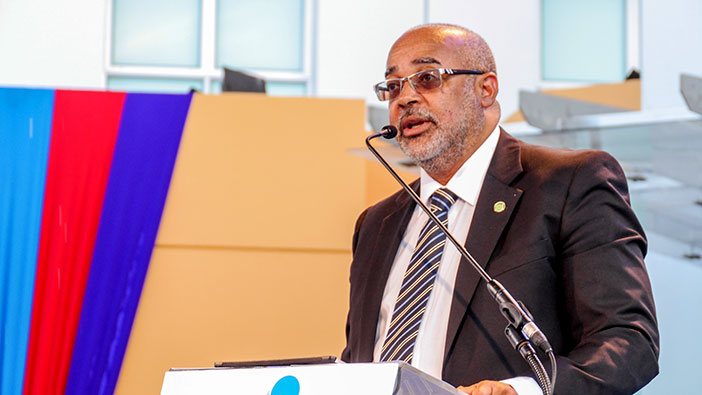
Dr. Didacus Jules, Director General, Organisation of Eastern Caribbean States

Remarks by Dr. Didacus Jules, Director General, Organisation of Eastern Caribbean States

” It gives me unbounded pleasure to deliver these remarks for the observance of Caribbean Statistics Day.

Since 2010, this Day is celebrated each year to heighten awareness about the important role official statistics play in all aspects of social and economic development of the OECS Economic Union. This awareness imposes an obligation to advocate for increased investment and for systematic and deliberate use of statistics for evidence-based, or at minimum, evidence-influenced actions.

The expectation is, this practice of using objective information, would eventually mainstream official statistics into national and regional development plans, policies and programmes and in our everyday casual debates, conversations and critique of government operations.
The facts are the facts.  Evidence should inform everything we do; every recommendation that we make; every programme that we design; every policy we develop; and every strategy that we craft. Because behind each indicator, each percentage, each ratio, each graph – is an indisputable narrative about a family, a community, a business, a nation, a region!
Though statistics underpin the OECS Commission’s work, it is not only a consumer of statistics. The Commission also advocates for and facilitates increased investment in their production, dissemination and use.
So it is enormously gratifying to announce that the OECS Regional Strategy for the Development of Statistics (RSDS) is at a stage to be endorsed by the OECS Economic Affairs Council and which perfectly coincides with Caribbean Statistics Day.
The OECS RSDS details, charts and schedules a 14-year master plan to transform our approaches to, processes for and perspectives about official statistics.
Our theme Revolutionising Our Statistics | Developing Our Societies succinctly captures exactly what we intend to achieve; how we intend to do it; why we need to do it and for whom we need to do it.
I wish to place on record my sincere and deepest appreciation for the collaborative work that culminated in this forwarding thinking master plan for official statistics.
I acknowledge all those involved for their very important contributions that can redound to the success of our One Community, Working Together: the key players in the national statistical system in each Member State; development partners; staff at the Commission; and certainly the heads of the national statistical offices who are expected to be at the fore-front of this transformative agenda.
The observance of Caribbean Statistics Day, through the lens of the OECS Economic Union, singles out six essential issues:
First, it gives us an opportunity to acknowledge, give due acclaim to and to celebrate our achievements. In that regard, observance of this Day allows us to thank our partners and contributors for their efforts to produce the data we need for prudent decision-making, policy development and evaluation, and debates and everyday life choices.
This occasion sensitizes stakeholders, non-governmental organisations, research institutions, the media and all data providers – households and businesses – about why official statistics are indispensable to national planning, and the significance of their role in their production and responsible use.
Second, Caribbean Statistics Day offers a platform to emphasise the role of the OECS Commission as the leader of the OECS regional statistical system with the principal responsibility to preserve data comparability across the Member States.
Data comparability is an important characteristic of regional data as it allows us to implement the provisions of the Revised Treaty of Basseterre for a single economic and financial space. In that regard, the Commission supports the Member States to use harmonised methods and standardised systems to ensure that the product of the statistical process looks the same from country to country.
Third, Caribbean Statistics Day forces us to reflect on what we have achieved and what still needs to be done. Among the achievements to deliver comparative data are:

  • 2010 OECS Population and Housing Census;
  • OECS Labour Force Survey;
  • OECS Multi-Poverty Measurement Framework;
  • OECS Labour Administration Application;
  • OECS Info;
  • OECS Education Statistics Digest.

I thank the development partners who have helped in this regard – CDB, UNECLAC, World Bank, EU, UNDP, ILO, UNICEF to name a few.
The OECS Member States have also standardised the use of computer-aided devices for e-collection of data from households and businesses. This change from paper to tablets promises to reduce the time from data collection to data dissemination; and to significantly enhance the quality of the statistical product. This innovation is very promising.
Much more, however, remains to be done. We need to tap into new sources of data – big data; social media data and open data; widen the scope, such as collecting disability, youth and gender disaggregated data; deepen the details so that we get to micro issues; and increase the frequency so that we address current and emerging development issues and other social and environmental phenomena when and where it is occurring; and whom and what it is affecting.
Fourth, it is an occasion to broadcast our plans to address the data gaps, capacity weaknesses; user satisfaction; and to dispel myths about the intention of the statistical business process that frustrate efforts to collect the raw data.
The urgency for bringing about needed change justifies why the Commission is uniquely well-placed to help the Member States overcome perennial statistical development challenges.
Official statistics are organic as their characteristics respond to external triggers and environmental conditions. Political ideologies inscribed in manifestos; regional regimes such as free movement of people; and global initiatives such as 2030 Agenda influence which statistics are produced.
The importance of investing in statistical capacity can no longer be procrastinated by policy-makers.
In that regard, our collective resources and capacity to make available and accessible the relevant quality statistics has to be continuously measured, updated and modernised.
Fifth, observance of Caribbean Statistics Day sends a clear message to all partners in statistics – national, regional and global, about our resolve and commitment to rollout a bold and broad transformative agenda for official statistics – our pledge to produce and disseminate objective evidence that comes from us, about us and for us – to develop our societies in a single economic and financial space.
Finally, and above all else, we must ensure that official statistics are used by policy-makers and politicians, and also by entrepreneurs and investors, by national development workers, and by citizens themselves – constantly, proudly and responsibly. Once they are available and accessible, then there is no excuse for not using them.
New technologies are offering easy and fast ways to disseminate, mine and interrogate these data. We now have tools and techniques that can support fascinating exposition of trends, patterns; and phenomena; geographically locating them at the community, district/parish, national or electoral constituency level – where it is happening, vividly and tangibly.
Geo-visualisation integrates geospatial data and official statistics to make them “alive” and almost immediately actionable using images such as infographics and maps.
By making use of these and other new information and communication technologies in a networked single financial and economic space – where no one dominates and everyone can and should play a part – we can multiply the power of our knowledge; intensify our efforts to deepen integration; and the share the benefits of our success.
In so doing, we can realise an accelerated pace at arriving at the day we can have truly achieve a data-smart society.
Join me now in celebrating Caribbean Statistics Day as we trumpet our achievements despite severe resource constraints, and commit to pushing through to produce the statistics that are indispensable for our economic and social well-being; and for a sustainable environmental.
Thank you.”

Symposium 2016 to Examine Issues Affecting Public Broadcasting

Gladstone Wilson
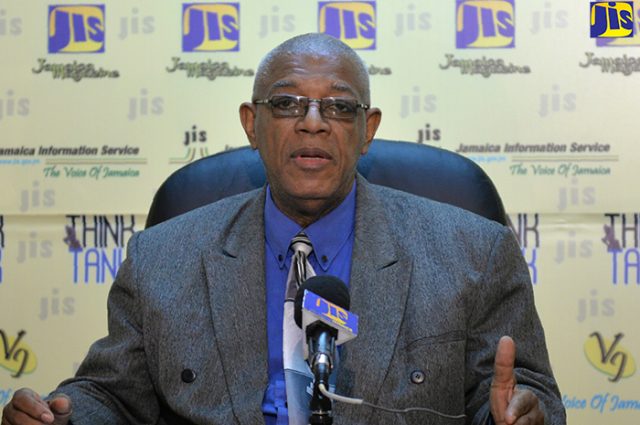
Chairman of the Board of Directors, Public Broadcasting Corporation of Jamaica (PBCJ), Gladstone Wilson (Photo: Yhomo Hutchinson)

Several issues affecting public broadcasting in Jamaica will be discussed at Symposium 2016, scheduled to take place from October 18-20 at the Jamaica Conference Centre, downtown Kingston.

The event, organised by the Public Broadcasting Corporation of Jamaica (PBCJ) will be held under the theme ‘Public Broadcasting: Agenda for the Future’.
Among the topics to be discussed are ‘Defining Public Broadcasting: What is it?’, ‘Applicable programme content for viewers or listeners’, ‘Investing in Public Broadcasting’ and ‘Technology: Pushing the Boundaries’.
Speaking at a Jamaica Information Service (JIS) ‘Think Tank’, yesterday (October 12), Chairman of the PBCJ Board of Directors, Gladstone Wilson, said the symposium will be officially opened on October 19, at 9:00 a.m. by the Minister of Education, Youth and Information, Senator the Hon. Ruel Reid.
He said the event will consist of a mix of keynote speakers, short talk presentations and five moderated panel discussions over the two-day period. Youth participation will also be at the forefront with the inclusion of tertiary-level youth presentations on a discussion panel.
Additionally, he said that international presenters have been invited from the Caribbean Broadcasting Union, Public Media Alliance International, National Association of Broadcasters, Public Broadcasters International and other leading media organisations.
Mr. Wilson, who is also Chairman of the Symposium 2016 Organising Committee, said that the event will not be a “talk shop” but will provide an opportunity “to sift through policy issues and exchange ideas that will assist our internal planning for what we want to do”.
“We also want to assist the process, because we are the practitioners, and so we have to help the policymakers to say, yes, because they are going to help us in certain areas when it comes to funding and a certain direction,” he added.
Mr. Wilson said the PBCJ is eagerly looking forward to hearing the various perspectives, especially the discussion that will focus on investing in public broadcasting.
“We have been grappling with how you fund public broadcasting so that it can do what it is supposed to do,” he said, noting that the PBCJ is funded by the Government, and not permitted to seek income through the traditional method of sale of airtime and commercial sponsorship.
Persons interested in attending the symposium should register at: http://symposium.pbcjamaica.org/

JIS Kicks off Heritage Month School Tour

JIS

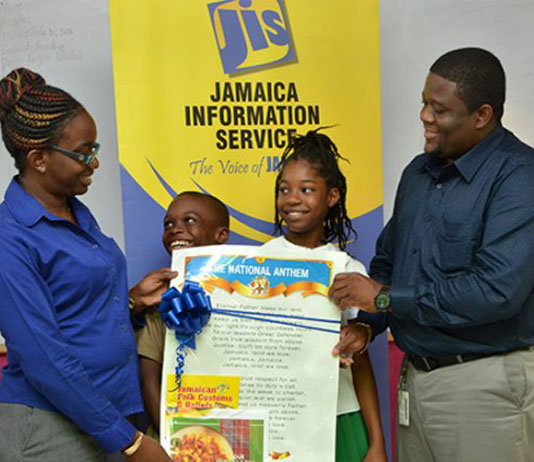
The Jamaica Information Service (JIS) on Tuesday (October 11) kicked off its annual Heritage Month school tours with stops at Half-Way Tree and Mona Heights Primary schools in the Corporate Area.

The institutions were the first of the more than 20 to be presented with heritage packages comprising books and posters produced by the agency.
Expressing gratitude for the publications, Principal of Half-Way Tree Primary, Carol O’Connor Clarke, pointed to the impact of the JIS and its programming on the students.
“JIS, the voice of Jamaica, you are the voice of our nation’s students and we want to say a big thank you, and we are proud to know that our school was chosen to be the first (on the tour),” the Principal said.
The annual school tours form part of the agency’s activities to mark Heritage Month in October, which is this year being observed under the theme ‘Our Heritage… our Legacy… our Strength.’
Chief Executive Officer of the JIS, Donna-Marie Rowe, explained that every year at this time, the JIS selects a number of early-childhood, primary and high schools to visit.
She noted that the agency places great value on this kind of engagement “as it allows us to interface with our young viewers and listeners as we work to engender nationalism”.
“We donate packages of our publications with information on national heroes, symbols, emblems and other aspects of our nation’s heritage and culture, which we know will be useful in reinforcing lessons in heritage studies and civics taught in the classroom,” she said.
“We also use this opportunity to capture cultural performances for radio, television and social media. Students and teachers are always very enthusiastic to showcase their talent and understanding of our history through very creative original items,” she continued.
The school tours are also used to promote the annual JIS Heritage Competition which is now open for entries. Eligible persons can enter one of three competitions – Essay, Poster and the inaugural Photo contest.
For the Heritage Essay Competition, now in its sixth year, primary-level students from nine to 12 years old, are being asked to write an original essay on the topic ‘Who is Your Favourite Jamaican Sportsman or Sportswoman and Why?’
Eligible students should submit a 400-500-word piece through the JIS website, which will be judged on relevance to the topic, originality, accuracy and analysis of research data, writing style and language skills.
The Heritage Poster Competition invites submission in one of two categories – graphic designs and illustrations, to be judged on interpretation of the topic, originality, creativity, artistry and presentation.
The topic for the poster competition is ‘Jamaica’s Rich Sporting Heritage’ and entries should be 11 inches by 17 inches in dimension, in landscape or portrait orientation. Importantly, graphic posters should include no other image but those provided by JIS, and entries must also be submitted through the website: www.jis.gov.jm.
The Photo Competition is open to tertiary-level students, and entries will be judged on interpretation of the topic, originality, composition, technique and impact.
This year’s theme is ‘I Am a Sports Champion’. Photos should be submitted using a cloud storage service, such as Dropbox, OneDrive (SkyDrive) or Google Drive.

Building an Energy Efficient Private Sector

Pamela Coke-Hamilton
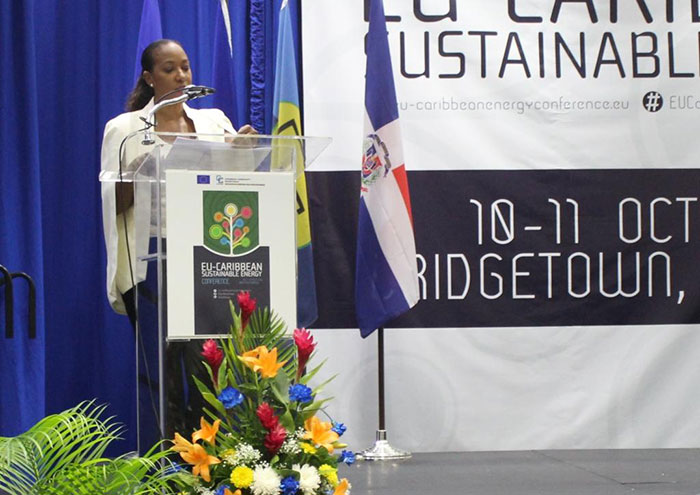
Executive Director of the Caribbean Export Development Agency (Caribbean Export) Pamela Coke-Hamilton

The Executive Director of the Caribbean Export Development Agency (Caribbean Export) Pamela Coke-Hamilton called on the Region’s private sector to drive forward with the adoption of renewable energy solutions at the EU-Caribbean Sustainable Energy Conference currently taking place in Barbados.

“What we have found at Caribbean Export is that companies are increasingly eager to take corrective measures because it affects their bottom line”, Coke-Hamilton shared.  The implementation of energy efficient practices within business operations enables firms to be more competitive in the global market.
To assist these organisations, the Agency has developed an Energy Management Training module for their Productivity Network (ProNET) programme, which helps SMEs address the role of energy in business, increase their understanding of the energy service supply chains. In addition, following participation in the course, businesses should be more equipped to make the choices necessary as it relates to different energy systems and their technologies to make them more efficient.
Coke-Hamilton urged that as a region, the transition towards renewable energy solutions becomes an increasing priority and that “we [should] move beyond simply writing energy policies and work towards having these translated into actual legislation that would benefit the private sector”.
Initiatives such as the removal of VAT on energy efficient and renewable energy equipment, the support for the use of electric vehicles, and an introduction to rebates for energy reduction are a few of the recommendations that the Agency has previously made to regional Governments.
Further, in recognition of the costs burdened by SMEs to make the necessary changes, the Agency is providing grants to firms so as to enable them to have energy audits conducted.  This energy audit would be the first stage to understanding the energy cost savings that could be seen as a result of implements various energy efficient measures.

STOP THINK CONNECT Project gets underway in Antigua-Barbuda

Cyber Security

The Ministry of Information, Broadcasting, Telecommunications & Information Technology as part of Cyber Security month – October, is partnering with the National Cyber Security Alliance (NCSA) and the Anti-Phishing Working Group (APWG) to develop and deploy a universal online safety and security messaging scheme to alerting and instruct users and consumers on the importance of online security.
A website relevant to Antigua and Barbuda’s campaign and geared towards the specifications of the STOP THINK CONNECT initiative has been instituted to sensitize the public on the importance of cyber security awareness and the importance of best practices when using the Internet.
The local STOP THINK CONNECT website at www.stopthinkconnect.org.ag provides tips on how to keep a clean machine from malware and other online threats, protect your personal information when using Wi-Fi hotspot or an open internet connections, customizing privacy and security setting on social media and other website for information sharing, etc
The campaign’s three easy actionable steps: STOP THINK CONNECT are easy to understand and apply and advises all Internet users to take security measures, understand the consequences of their behavior and actions and enjoy the benefits of the Internet.
The STOP THINK CONNECT Project is one of 28 eGovernment projects that a team at The Ministry of Information, Broadcasting, Telecommunications and Information Technology under the guidance of the Hon. Melford Nicholas are working towards fulfilling by year end 2016.
The campaign’s Partner Program aims to address the worldwide problems of online security and cybercrime by harmonizing messaging across the globe.
Antiguans have easier access through the Ministry’s hard work through the realization of the Online Driver’s License Renewal, the digitization of records for persons to conduct searches online at the Intellectual Property, access to search for title deeds online at the Land Registry, and the digitization of records at the Police for the certificate of character.
Barbuda was not left out as the Ministry’s team was also instrumental in getting the Council and Treasury computerized.
Other projects already completed include the e-visa through Immigration, and the provision of laptops to the National Public Library.

St. Kitts and Nevis to Host the 8th UWI Open Campus Ceremony

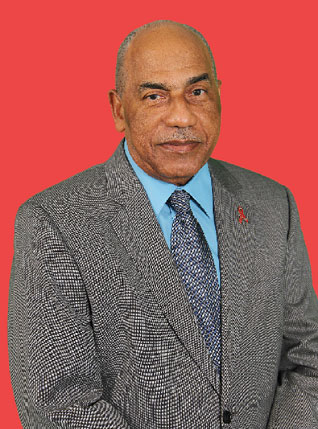
Dr. Sir Prince Ramsey

St. Kitts and Nevis to Host the 8th UWI Open Campus Ceremony.

St. Kitts and Nevis will once again celebrate the achievements of graduands of The University of the West Indies (UWI) Open Campus, in a grand Presentation of Graduates Ceremony to be held on Saturday, October 08, 2016 at 10:00 a.m. at the St. Kitts Marriott Resort, Frigate Bay, Basseterre.
This 8th Presentation of Graduates Ceremony of The UWI Open Campus will see six hundred and ninety eight (698) students (593 undergraduates and 105 postgraduates) officially graduate from the Open Campus with Master’s, Bachelor’s and Associate degrees, as well as Certificates and Diplomas in a wide range of subject areas. As in past years, graduands from across the Caribbean will gather together in the presence of Heads of State and Government, the Chancellor and Vice-Chancellor, members of the University’s Executive Management, other highly placed University and local government officials, as well as family and friends, to receive their formal academic qualifications.
The official ceremony will begin at precisely 10:00 a.m., preceded by the Graduands, Academic and Chancellor’s processions. The public is invited to share in the momentous occasion via live online streaming on the Open Campus’s website at www.open.uwi.edu.
This year, The UWI Open Campus will confer an Honorary Doctorate of Science on a citizen from Antigua and Barbuda, Dr. Sir Prince Ramsey. A Family Physician in private practice, Sir Prince received his formative education in Antigua & Barbuda and Oxford and London, England. His education culminated with a medical degree received from The University of the West Indies.
For the past twenty-five years, Sir Prince has lectured in over twenty Caribbean countries, the USA and Canada, mainly on the subjects: Family Planning, STDs, Sexual Disorders and HIV/AIDS. He has received many local, regional and international awards for his philanthropic contribution to health – especially in the field of HIV/AIDS. These include awards from the Caribbean Family Planning Affiliation 1993, the Ministry of Health in Antigua, 2002, and UNICEF in 2003.
The Valedictorian for this year is Ms. Rone Alexis, who will be graduating with First Class Honours from the Open Campus’s BEd Early Childhood Development and Family Studies programme. A graduate of the Leon Hess Comprehensive Secondary School and the Sir Arthur Lewis Community College (SALCC) in Saint. Lucia, Rone subsequently gained valuable work experience from attachments to various government ministries, including the Early Childhood Education Unit. In 2006, Rone joined the teaching profession at The Lady Gordon Opportunity Centre – a Special Education school in Saint Lucia. After two years of teaching, she pursued further studies at the Division of Teacher Education and Educational Administration of the Sir Arthur Lewis Community College, graduating two years later with a 4.0 grade point average.
In 2012, not satisfied with an Associate Degree, Rone enrolled with The UWI Open Campus to read for a Bachelor’s Degree in Early Childhood Development and Family Studies. True to form, Rone continued on her path of excellence, and will on October 08, 2016, graduate from The University of the West Indies, Open Campus with a 4.03 grade point average. As is customary, Rone will deliver the Valedictory Speech on behalf of her colleagues from across the region.
After the official Presentation Ceremony, the new graduates and their guests will celebrate their academic achievements at an official reception hosted by the Government and People of St. Kitts and Nevis.

Audio Theme