
Home Blog Page 163

Community involvement key in eliminating Zika-carrying mosquito

mosquito
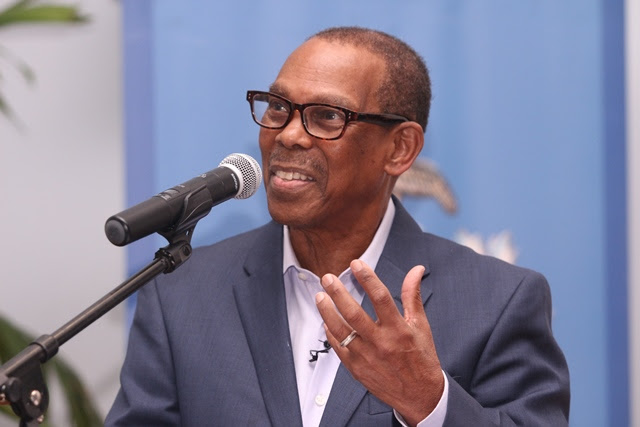
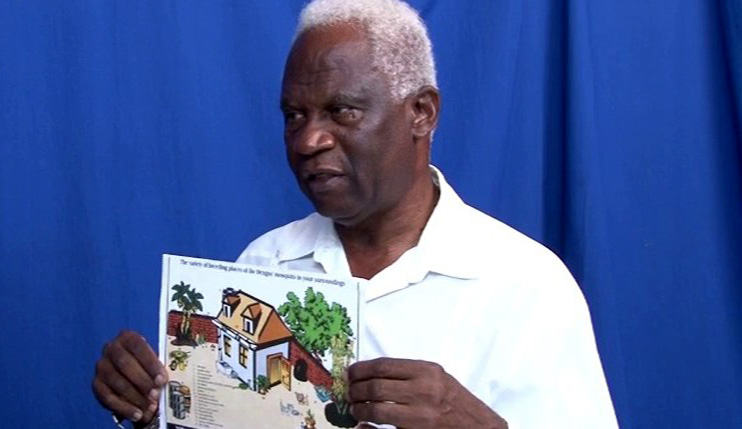
Dr. Sam Rawlins holds up the mosquito elimination poster that he created

Basseterre, St. Kitts, June 23, 2016 (SKNIS): Retired entomologist Dr. Sam Rawlins has emphasized that every individual has a key role to play in the elimination of the aedes aegypti mosquito, which is responsible for transmitting the zika virus from one individual to another.

“For effective control, there is need for mobilizing the community to participate in source reduction,” he said.  “All sectors need to become involved, the public and private.”
“It’s not just a government thing; all of us have a vested interest in this because if your children are going to become infected with dengue or chikungunya or zika, you would not be very happy,” Dr. Rawlins said.  “If everybody in our household becomes agents of search and destroy,… your duty now is to go and search around our environment for all these habitats.  Now if every householder did that, then the mosquitoes breeding next door, wouldn’t come over the wall and come into your yard, although you’re doing the right thing, and bite you.  You would be eliminating them over there, while you’re doing it over here.”
The call to action is depicted in a poster designed by Dr. Rawlins who worked at the Regional Virus Laboratory that later became the Caribbean Epidemiology Centre (CAREC) and then at the Centres for Disease Control in North Colorado, USA.  He said that the message on the poster is: “without habitats there is no aedes aegypti, without aedes aegypti there is no dengue fever – eliminate the habitats around your home.”  It was emphasized that while the poster had been created in response to a dengue outbreak, it can apply to the chikunguna and zika viruses as well because the same mosquito is involved.
The former entomologist identified three methods of mosquito control in general.  Removing, emptying or filling up all water receptacles within one’s environment, chemical control and personal protection.  He explained that water receptacles can range from flower pots and discarded shoes to water barrels and plants whose parts can hold water.
“Anything that holds water especially, in fact this mosquito prefers clean water,” Dr. Rawlins said, noting that gutters along the roof can become breeding sites. “It means that the water won’t run off and mosquitoes can breed right there in that, laundry tanks, uncovered tanks.  We found that in Trinidad and Tobago, most barrels and buckets and drums were the best habitats, home for mosquitoes.”
“So if you have these barrels around the home as in every Caribbean country, aedes aegypti (mosquitoes) would love to go and lay their eggs in there.  When the water rises enough, you have an explosion of hatching of eggs.”
The lifecycle of the mosquito would then continue with larvae (wrigglers), pupa and adult.  The cycle would begin again once the female received a blood meal that would provide the protein required for the development of the eggs.  He said the key to keeping mosquitoes out of containers that are used to collect water is to keep them covered.
Dr. Rawlins further noted that another less effective method of mosquito elimination is chemical control, which includes fogging as well as putting temephos which has the brand name of abate in water containers.
Personal protection was also identified as a third method of mosquito eradication.  This was said to include using mosquito repellant as well as wearing long sleeves and long pants.


WCMF 2016 launched with $1M more in funding

WCMF

This year’s edition of the World Creole Music Festival has been launched with the announcement that Government has increased its financial contribution to the show.

From October 28th to 30th, patrons can look forward to headline acts like the musical stylings of Timaya, the Midnight Groovers, Kreyol La, Morgan Heritage, Wyclef Jean, Ophelia Marie, Kes, Gentleman, Popcaan, Mr Killa, Grand Mechant Zouk, T-Mickey and Akon.
Several local artists and bands and other visiting performers are all set for the three nights of pulsating rhythms.
The Government of Dominica has increased its contribution for this year’s show according to the Hon Minister for Tourism, Senator Robert Tonge.
“Traditionally, the Discover Dominica Authority gets a subvention of $780,000 but we knew that this year, the show had to be bigger, better and a lot more exciting…so that when you heard the lineup you would no longer decide which night you would attend, you would be forced to buy a season ticket. So the Government of Dominica has approved an additional $1m to ensure that the vision of this event is brought to fruition.
“This is a significant improvement to the financing of the festival that will allow for better and timely organisation and provide more effective negotiation with the artistes.”

Barbados will monitor Britain’s withdrawal from EU

brexit

Barbados will monitor Britain’s withdrawal from EU.

Prime Minister Freundel Stuart, like most people around the world, has expressed surprise at the decision of the British to vote in favour of leaving the European Union.
And, Mr. Stuart says the Caribbean would have to wait and see whether the decision to withdraw would have any seismic effects in this region.
“In the short term I do not think so, but clearly, given the close relationship between Barbados and the United Kingdom, our heavy dependence on British tourism, and the fact that we have an international business sector that benefits from British investment as well, we have to wait to see what will happen over the medium to long- term. I do not think that in the very short-term that we should become too anxious because the dismantling process is going to take about two years,” he said.
The United Kingdom voted in a referendum on Thursday to leave the European Union, with those in favour of remaining being defeated by 52 per cent to 48 per cent.  The Prime Minister expressed the view that there would be some currency shocks, but stressed that once those initial shocks had passed, the pound would regain its place.
He continued: “I think we have to monitor the situation and if we are required as a result of reverberations felt here in Barbados to make any adjustments and to adapt to any new realities, we should stand ready to do so. But it is not an occurrence which we can afford to ignore. Britain is still a major power in the world and the bilateral relationship is a very strong one, and we therefore have to monitor any potential changes.”
Mr. Stuart noted that the United Kingdom had been a part of the European Union for 43 years, and therefore one would have thought that the British would have found it very difficult to make a decision to severe those ties. He stated, however, that the decision had been taken and one had to adjust to that new reality.
He said that with the presence of the United Kingdom in the European Union, Caribbean officials were certain that on critical issues they would have a voice on which this region could rely.
“To the extent that they are not going to be at the table in the European Union that voice will be missing, although I do not envisage that because the United Kingdom is disengaging from the European Union, that the disengagement will be such that they will have nothing to do with the European Union at all…,” he stated.
Mr. Stuart reminded that the Caribbean also had its own experiences with referenda and integration movements. He recalled 1962, when the 10-member Federation in the Caribbean was dismantled after a referendum held in Jamaica.

Financing Agreement with the European Union

European Union

CARICOM Deputy Secretary-General calls for increased implementation of a major Financing Agreement with the European Union.

(CARICOM Secretariat, Turkeyen, Greater Georgetown, Guyana)     Caribbean Community (CARICOM) Deputy Secretary General Dr. Manorma Soeknandan is reminding CARICOM Member States of their responsibility for the 10th European Development Fund (EDF) CARICOM Single Market and Economy (CSME) Economic Integration Programme (EIP). This is a financing agreement signed with the European Union for over 28 million Euros of which approximately 19 million Euros is for implementing the CSME. Dr. Soeknandan was speaking at the opening ceremony for the Regional Technical Meeting on the implementation of the Agreement. As of June this year, there was an implementation of 53% of the resources and the meeting was called to seek ways of increasing delivery.
The agreement was signed in 2012 and ends in March 2017. Permanent Secretaries, National Authorising Officers and National CSME Focal Points were today meeting in Barbados seeking ways to overcome project delivery hurdles.  The CARICOM Deputy Secretary General says that if funds are not used then they will be lost and the active input of Members States is crucial for success. She stated that as we look towards an 11th Economic Development Fund (EDF), CARICOM should ensure mistakes are not repeated and called for a preparatory phase before future projects are rolled out.
Giving the feature address at this morning’s opening ceremony was the Chairman of the CARICOM Commission, Senator, Darcy Boyce, Minister within the Prime Minister’s Office, Barbados. The Head of the European Delegation to the Eastern Caribbean Countries, OECS and CARICOM/CARIFORUM Ambassador Mikael Barfod also gave opening remarks.

Sea Cucumber season closed

Sea Cucumber
Sea Cucumbers ( Photo Credit: farawayfood.blogspot.com)

Sea Cucumber season closed – In accordance with Statutory Instrument No. 67 of 2009, under the Fisheries Act Chapter 210 of the laws of Belize Revised edition 2000-2003, the Belize Fisheries Department hereby reminds all fishers and the general public that:
No person shall fish for, or harvest, at any time in the waters of Belize, or buy, sell, have in possession, export or attempt to export any sea cucumber after June 30th , 2016. The season will remain closed from July 1 st to December 31st 2016
Any person found in possession of sea cucumber after this date will be charged and prosecuted in a Court of Law in accordance to the Fisheries Regulations. The assistance of the fishing community and the general public is greatly appreciated in the sustainable use and conservation of this important fishery resource. For additional information or to report any illegal activity please contact the Fisheries Department at telephone number: 224-4552/203-2623 or by email: fisheries_department@fisheries.gov.bz

Inaction on Climate Change could lead to enormous costs

Dr. Edward Greene

Inaction on Climate Change could lead to enormous costs for the Caribbean.

(CARICOM Secretariat, Turkeyen, Greater Georgetown, Guyana)     Unless bold steps are taken now to eliminate the risks from Climate Change “future generations are in big trouble and for the Caribbean the trouble is massive “.
This is the warning given by UWI Professor Emeritus and former Assistant Secretary General for Human and Social Development, CARICOM Secretariat,  Dr.  Edward Greene, to a large audience at the UWI Distinguished Open Lecture at the UWI, St Augustine on 21 June 2016.
In his presentation entitled, Climate Change: The Future of the Caribbean, Dr.  Greene referred to the Paris Agreement, ratified by 192 nations of the UN, as a landmark declaration aimed at keeping global warming below 2 degree Celsius. According to him, “for the first time there was a global commitment to pursue efforts to limit temperature increases to 1.5 degrees Celsius”.
Tracing the journey to Paris, Dr. Greene commended CARICOM and the leadership of the Caribbean Community Climate Change Centre (5Cs)  for the  campaign 1.5 to stay alive, initiated in 2009 ahead of the UN Conference on Climate Change in Copenhagen –   “the CARICOM Campaign is to be celebrated” he said.
Noting that the objectives of the Paris Agreement requires multi-sectoral action, he illustrated their  linkages  with many of the sustainable development goals, especially those related to: food, nutrition and sustainable agriculture; gender equality and empowerment of women and girls; access to affordable and clean energy; and ensuring healthy lives and promoting wellbeing for all ages.
Dr Greene who chaired the CARICOM Steering Committee on Climate Change during the period 2008-2010, pointed out that the implementation of the agreed CARICOM Plan for climate resilience is a step that could catalyze the Region’s integration movement; but that it required game changers. In this regard he identified the special role of the Universities and other institutions of higher education; making functional cooperation pivotal to the climate change enterprise; investing in the renewable energy sector; engaging schools and communities; and involving the people, civil society, in climate decisions and actions as priorities.
He also pointed to the need for overcoming the challenges and the gaps to be addressed by the Region, which he identified as including insufficient development of climate impact models, inadequate early warning systems, insufficient venerability studies and inadequate technical, institutional and financial capacity.  But Dr. Greene is worried “that rampant nationalism stands in the way of a viable Caribbean Community that is a prerequisite to deliver on the priorities of climate change “.
The sourcing of adequate financial resources to fund activities for climate adaption and mitigation and for risk reduction was deemed equally important by the former Assistant Secretary-General. Drawing on a series of studies, he concluded that by 2050, the overall cost of inaction will revolve around   losses and damages for the Caribbean, in absolute terms estimated to a total of US $22Billion annually or 10 percent of GDP.
He called on the University if the West Indies to seriously consider a Consortium Graduate School for Sustainable Development in the Caribbean and  on CARICOM to establish a Commission of Caribbean Community Climate Change Implementers.
“I believe that the Climate Change agenda and the bold actions we must take provide a golden opportunity for the revival and strengthening of the regional movement and for the sustainable future of the Caribbean” he concluded.
 

Women's Seminar 2016

Women's Seminar 2016

First Citizens & Neutrogena present “Make It Happen!” Women encouraged to sign up for holistic wellness seminar.

Make this the year you embark on a future filled with financial, professional success and achievement! On Saturday July 2nd “Make It Happen” as First Citizens and Neutrogena present the annual holistic Women’s Seminar at Sandals Halcyon Beach Resort.
Held under the theme “Make It Happen: Successful Women Make Life Altering Choices”, the event will feature a cadre of female speakers including First Citizens deputy CEO Sharon Christopher, First Citizens Investment Services regional manager Carole Eleuthere-Jn Marie, Business and Environmental Consultant Geraldine Lendor-Gabriel, CEO of BDO St. Lucia Brenda Duncan and Host of Lifestyles on Choice TV Candy Nicholas. The one-day only event will address topics such as Making Career Magic Happen: Outside of Your Comfort Zone, The Art of Making Lemonade From Life’s lemons, Make It Count: Claim Your Financial Independence and Miracles Can Happen In Your Body.
“This is a seminar for women of all ages and of all professional standing,” stated Carole Eleuthere Jn Marie. “This is an opportunity to really sit down and assess who you are and develop your mind body and soul. This seminar is not just about managing finances or your health, it looks at all aspects of your life. Living our best life should not be an option, it should be the reality.”
Partners include Neutrogena, The Wave, JP Chenet, Confidence, Shoe Rehab, Helen Television System and Connections for Life.
To sign up for this seminar email: seminars@firstcitizensslu.com or call 458 6375.

Standing Committee for Maritime Sector

Maritime meeting
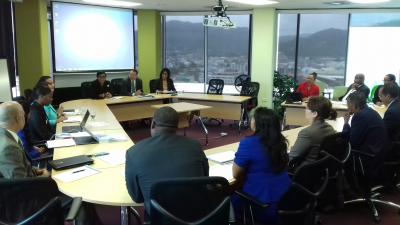
Maritime meeting in session being chaired by Minister Franklin Khan. (Photo courtesy Ministry of Trade)

Standing Committee for Maritime Sector holds first meeting.

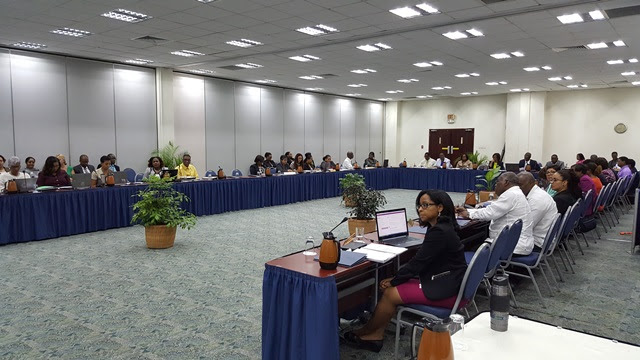
June 24, 2016: Ready to set strategic targets to ensure the development and growth of the Maritime Sector, the first meeting of the Standing Committee for the development of the Maritime Sector was held on Wednesday 22nd June, 2016 at the Ministry of Trade and Industry. The Committee which will report to Cabinet every three (3) months has been established to direct the development and implementation of initiatives for the expansion of the maritime sector under the chairmanship of the Honourable Franklin Khan, Minister of Rural Development and Local Government.

Addressing the members of the committee at the first meeting, Minister Khan said ‘if Maritime is one of the key sectors to manage the country’s budget deficit then we must start bringing projects on stream to have the impact that we want. We must begin to think about a post energy Trinidad and Tobago. The revenue stream from the energy sector can no longer support our country’s current trend of $50 and $60 billion budgetary expenditure plans. Our debt to GDP ratio still allows latitude for borrowing. However there is need for industries that can pick up the slack’.
The Standing Committee’s mandate involves the development and growth of the Maritime Sector; the facilitation of the sourcing of credit for the industry; the fast tracking of regulatory approvals; the identification of appropriate land for commercial maritime activity; the promotion of capacity building, training and apprenticeship arrangements and the provision of advice on incentives and investment opportunities.
This meeting follows the announcement made on Friday 10 June, 2016, by Senator the Honourable Paula Gopee-Scoon Minister of Trade and Industry of the Official Policy Framework of the Government of Trinidad and Tobago for the development of the Maritime Sector. Present at the meeting were Senator the Honourable Paula Gopee-Scoon, Minister of Tarde and Industry and the Honourable Shamfa Cudjoe, Minister of Tourism. Other representatives of this committee include the Minister of Planning and Development; the Minister of Works and Transport; the Secretary of Agriculture, Marine Affairs, Marketing and the Environment, Tobago House of Assembly;  the Ministry of Works and Transport (Maritime Services Division); the Chaguaramas  Development Authority (CDA); the Ministry of Finance (Customs and Excise Division); the Ministry of National Security (Immigration Division and the Trinidad and Tobago Defense Force (Coast Guard); the Environmental Management Authority (EMA); the Port Authority of Trinidad and Tobago; the University of Trinidad and Tobago (Maritime Programme); the Yachting Association of Trinidad and Tobago and the Caribbean Dockyard and Engineering Services Limited.

Grenada's PM on British exit from the EU

British Exit

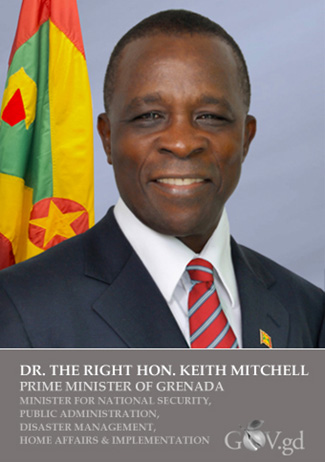
Statement from Prime Minister Mitchell on British exit from the European Union.

BrexitST. GEORGE’S, GRENADA, JUNE 24, 2016 – GIS: It is with great regret that Grenada notes the decision of the British people to leave the European Union.
While many of us would have preferred a different result, the world must accept and respect the democratic process and the will of the people.
There is no doubt that this decision will have a major effect on the European Union.
The Caribbean region must use this decision to examine our own Single Market and Economy, and the implications of this for trade and other relations, and adjust accordingly.
Grenada is forever grateful to Prime Minister David Cameron for his recent initiative to re-engage the Caribbean region and assist in our infrastructural and other development.
We also thank him for his historic and memorable visit to Grenada last September.
It is our hope that Britain’s new leadership will continue Prime Minister Cameron’s agenda for the Caribbean.

Local fruit fly under inspection

fruit fly

With the assistance of the United States Department of Agriculture, CARDI, the St. Lucia Ministry of Agriculture and the Technical Working Group of the Caribbean Plant Health Directors Forum, Plant Protection Specialist, Hannah Romaine, is assisting the Ministry of Agriculture’s Plant Protection Unit in finding out what is going on with the fruit fly in Dominica.
“We realize that the fruit fly is a major pest in the region but specifically in Dominica. The situation is totally different. We have seen that fruit flies are affecting mangoes in Dominica whereas in other countries, this is not so.

“So we are here to find out what really brings about this difference in infestation. We’ll be conducting studies to find out the morphological differences that exist with fruit flies in Dominica and St. Lucia and other countries where that situation is different.”
Romaine says the team will rear fruit flies to adult stage.
Molecular research on the flies is expected to produce results as to why the fruit flies in Dominica are so unique.
She says conditions may exist in Dominica that could account for the behaviour of local fruit flies. Romaine listed elevation and rainfall patterns.”
According to Romaine, control of these flies will lead to the improvement of the mango export industry.
“We know that the Julie [grafted] mango is an exported crop and the flies reduce the crop’s potential for export. We know that the adults lay the eggs in the fruit and the larvae feeds on the fruit making the fruit mushy and it cannot be consumed. It is not marketable. Because of this high unmarketable yield that we see in the mangoes, we realise that it is a problem which we need to address.”

Audio Theme