


TRINIDAD: April 25, 2016: The Government of the Republic of Trinidad and Tobago joined the global community in commemorating Earth Day on April 22nd, 2016.
Earth Day is celebrated on April 22nd annually, marking the anniversary of the birth of the modern environmental movement in the 1970s. The movement gave a voice to emerging environmental consciousness, and channelled human energy towards bringing prevailing environmental issues such as pollution, use of pesticides and biodiversity loss to the forefront.
Earth Day mobilises millions of people around the world to take action to support environmental protection. It has become the largest observance in the world, celebrated in an effort to encourage changes in human behaviour and provoke policy reforms. The theme for Earth Day 2016 is “Trees for the Earth!” With over 15 billion trees lost each year from deforestation, land development and poor forest management, Earth Day 2016 focuses on encouraging persons worldwide to plant trees.
Trees, and forests in general, are important because they help fight climate change and air pollution by providing climate regulation and sequestering (capturing) carbon dioxide emissions which are a major greenhouse gas. They also provide habitats for wildlife and provide essential ecosystem services such as flood control, watershed protection, and food and water provision, soil erosion protection to name a few essential for human survival. Additionally, trees support communities, their local economies and livelihoods.
The theme of Earth Day 2016 placed emphasis on regions of the world most affected by deforestation. This is particularly pertinent to Trinidad and Tobago considering that country is well-endowed with rich forest ecosystems covering approximately over 250,000 hectares of our land area. These consist of various types such as evergreen seasonal forest, semi-evergreen seasonal forest, deciduous seasonal forest, dry evergreen forest, montane forest, mangrove forest, herbaceous swamp, palm marsh and marsh forest.
Our forests provide habitats for a great variety of animal and plant species that enables our country to have one of the highest levels of biodiversity of all the Caribbean islands. Furthermore, this country’s forest resources are of paramount importance to all sectors of society. Nowhere is this more relevant, than in our rural communities where hunting, logging, craft, tour guiding and other nature-based recreational activities contribute significantly to local economies.
However, there are several causes of forest loss and degradation in Trinidad and Tobago such as forest fires, infrastructural development, unsustainable land use and illegal logging as well as overharvesting of forest products. In light of the importance of trees and forests towards the protection of the environment and to sustainable development, the Government of Trinidad and Tobago has pursued various policy and legislative measures as well as activities to ensure the conservation and protection of our forests.
Trinidad and Tobago has one of the earliest records of formal protection of forests with the establishment of the first Forest Reserve in the Western Hemisphere in Tobago’s Main Ridge in 1765. Under the Forests Act (Chap. 66:01 of 1915) a number of prohibited areas in Trinidad and Tobago are designated which restricts entry for set periods of time of the year (e.g. at certain nesting beaches during sea turtle nesting season from 01 March to 31 August), or throughout the year (e.g. Aripo Savannas) to ensure the protection of the nation’s forested areas that represent significant examples of the country’s natural heritage and for future generations. Some prohibited areas include areas that were also declared as Forest Reserves and Wildlife Sanctuaries.
Environmentally Sensitive Areas (ESAs) have been designated under the Environmental Management Act (Chap. 35:05) Environmentally Sensitive Areas Rules, for the conservation and management of biologically significant areas including forested areas. There are currently three (3) ESAs which include the Aripo Savannas Strict Nature Reserve, Nariva Swamp Managed Resource Protected Area and the Matura National Park. They are intended to serve several objectives relating to biodiversity, species, ecosystem and livelihoods conservation, fulfilling international obligations and the promotion of scientific research.
The three (3) recently approved National Forest, Protected Areas and Wildlife Policies also provide the policy context for the sustainable management and conservation of, among others, our forest ecosystems and wildlife. These policies offer guidance for the development of legislation that will enable Trinidad and Tobago to establish an appropriate administrative and institutional framework for the management of forests and wildlife and designation of protected areas. As such, the Ministry of Planning and Development is in the process of drafting and finalising enabling legislation; i.e. the Forest, Protected Areas and Wildlife Conservation Bill and its regulations necessary for the implementation of the National Forest, Protected Areas and Wildlife Policies.
Additionally, the Ministry, in collaboration with the Food and Agriculture Organisation of the United Nations (FAO), has initiated the implementation of the “Improving Forest and Protected Area Management in Trinidad and Tobago” Project. This four (4) year project supports the Government’s policy reforms for biodiversity conservation for sustainable management of forestry and protected areas. It will establish six pilot protected areas to model participatory approaches as well as enhance capacity and finance for sustainable natural resource management.
The Government is committed to the protection of the environment through the preservation and proper management of our nation’s forest ecosystems and thus, supports the cause of Earth Day 2016. In addition to the efforts of the Government, every citizen of Trinidad and Tobago must understand the value of our trees and forest resources in providing the ecological and socio-economic needs and enhancing the well-being of the current and future generations. Let us all do our part and join the world in planting a tree for Earth Day 2016!
Ministry of Planning and Development commemorates World Earth Day
House hand over in Cumberland on April 26th



ST. VINCENT: The Government of St. Vincent and the Grenadines has collaborated with the SVG ADHOC Committee in Canada and the Lions Club of St. Vincent South to construct a two bedroom dwelling House at Cumberland for a family whose house was destroyed in the December 2013 floods.
The two bedroom dwelling house was constructed at a cost of EC$82,000.00 with funds donated by the SVG ADHOC Committee in Canada and was built by the Housing and Land Development Corporation. The Cumberland House project came about as a result of the December 24th 2013 floods which destroyed several houses and made several families homeless. Shortly, after the December floods, the Diaspora Community Groups in Toronto came together at a meeting organized by Mrs. Shelley John of the SVG Tourism Executive in Toronto to form the ADHOC Relief Support Committee.
The Lions Club of St. Vincent South was selected by the SVG ADHOC Committee as the local organization to partner and execute the project. The land for construction was also donated free of cost by the Government of St. Vincent and the Grenadines.
The Housing and Land Development Corporation commenced construction of the house in October 2015; the house was completed on April 19th, 2016. The Keys to the house will be handed over to Ms. Florestene Spring on Tuesday April 26th at a Ceremony in Cumberland. The Handing over Ceremony will take place on Tuesday April 26th at 11:00 am and will hear remarks from the President of the Lions Club St. Vincent South; representatives from the SVG ADHOC Committee and the Housing and Land Development Corporation and the Hon. Montgomery Daniel, Minister of Housing will deliver the feature address.
Background Information:
SVG ADHOC Committee of Canada Several SVG Community Groups in Toronto came together to form the ADHOC Relief Committee with a mandate to manage fundraising events to construct the house which will be handed over on Tuesday. They are SVG Association of Toronto; SVG Relief, Education & Medical Association; Toronto SVG Support Group; Bequia Social Organization and the Union Island Cultural Association. This group was formed under the auspices of the Consulate of St Vincent and the Grenadines Toronto and chaired by Consul General Fitzgerald Huggins.
Lions Club St. Vincent South
Lions clubs are groups of men and women who identify needs within the community and work together to fulfill those needs. For more information or to get involved with the St. Vincent Lions Club, please contact Lion Michael John at 784-493-3032.
Lions Clubs International is the world’s largest service club organization with 1.35 million members in approximately 46,000 clubs in 206 countries and geographical areas around the world. Since 1917, Lions clubs have aided the blind and visually impaired and made a strong commitment to sight preservation and community service throughout the world. For more information about Lions Clubs International, visit the Web site atwww.lionsclubs.org.
Water Interruption to all customers served by the Grace System

ST. LUCIA: The Water and Sewerage Company Inc. (WASCO) wishes to inform customers served by the Grace Intake that there will be a temporary interruption in their water supply due to routine maintenance work at the Grace Intake tomorrow, Tuesday, 26th April 2016. As a result customers in the following areas will be affected from tonight Monday 25th April at 9:00 p.m.
· Cedar Heights
· Grace
· Augier
· Banse
· Majomel
· Laborie
· Morne Beausejour
· La Retraite
· La Tourney
· Cantonement
· La Ressource
· Dierre Morne
· Industrial Estate
· Hewanorra Orchard
· St Judes Hwy
· Black Bay
· Sapphire
The water supply will be restored as soon as works are completed.
The Water and Sewerage Company Inc (WASCO) apologizes for any inconvenience this may caused.
WASCO…water is life! Committed to meeting customers’ needs
Foreign Minister Brantley assumes the Leadership of the CDCC
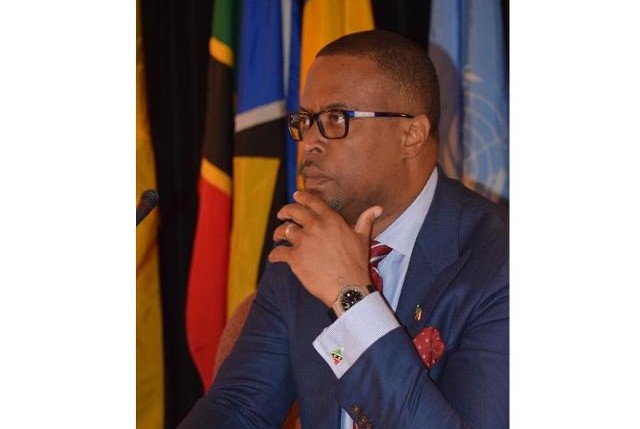

ST. KITTS: Basseterre, St. Kitts (April 25, 2016) – The twenty-sixth session of the Caribbean Development Cooperation Committee (CDCC) convened at the St. Kitts Marriott Resort in Basseterre on April 22. The opening session was chaired by Ms. Diane Quarless, Director, Economic Commission for Latin America and the Caribbean (ECLAC), and she expressed regrets of Ms. Alicia Bárcena for not being able to attend the session.
Introductory remarks were made by Mr. Antonio Prado, Deputy Executive Secretary of ECLAC. In his remarks he exhorted the gathering to “celebrate all things Caribbean” especially in light of the West Indies domination of T20 cricket recently. He also expressed the view that by far the most important challenge over which the Caribbean must gain control is how best to deal with the unsustainable levels of public debt in a manner that builds the resilience of our countries to external shocks, while re-igniting growth and promoting economic transformation by investment in green industries and climate adaptation initiatives.
Jamaica being the outgoing chair of the CDCC addressed the body and expressed gratitude on behalf of her country to ECLAC for their assistance during their tenure as chair of the CDCC. She further indicated that the chair, being rotated in alphabetical order, now became the responsibility of the Federation of St. Kitts-Nevis and handed over the chair accordingly.
Hon. Mark Brantley in assuming his responsibility as chair of the CDCC addressed the gathering and synopsized that the discussion of the Caribbean Development Roundtable set the stage for brainstorming on the topic: The Debt Overhang: balancing adjustment with sustainable development in the Caribbean. He spoke of the decrease of the Debt to GDP ratio in St. Kitts-Nevis by over 100 percentage points but also mentioned the risk of eroding the gains without proper fiscal discipline and if we fail to manage the debt overhang. He also highlighted the achievements of the Federation in providing a robust suite of social services to strengthen the safety net of vulnerable groups.
Following these statements there was elections of officers to serve the CDCC for the biennium 2016 – 2018. Elected were Antigua and Barbuda, the British Virgin Islands and the Dominican Republic as Vice Chairs and St. Vincent and the Grenadines as Rapporteur.
The meeting continued under the chairmanship of the Hon. Mark Brantley with a discussion on the Debt Overhang and Preparation for the Ageing population in the Caribbean. There were several resolutions considered and adopted at the meeting as well as the welcoming of the newest associate member to ECLAC to the CDCC, St. Maarten.
Marijuana eradication efforts prove fruitful
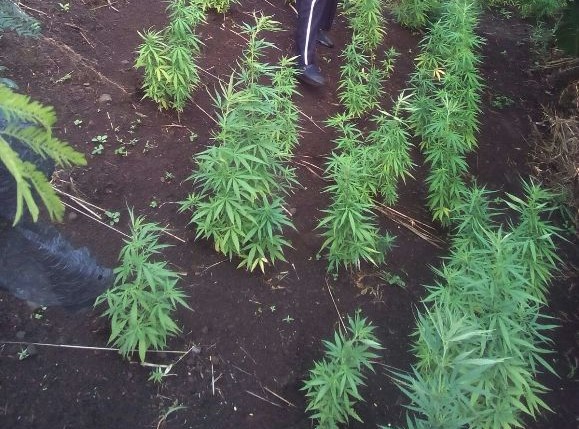
ST. KITTS: Basseterre, St. Kitts, April 25, 2016 (RSCNPF): Police Officers in Division “B” scored big on Saturday(April 23) when a routine marijuana eradication patrol uncovered 450 marijuana plants under cultivation and 150 seedlings in nursery.
The early morning search conducted in hills within the Division’s area of responsibility resulted in the discovery of the plants ranging in height from one(1) to six (6) feet.
All plants and seedlings were seized by the police.
Head of the Anti- Drug Unit, Police Inspector Travis Rogers said, “I want to commend the officers of Division “B” for their supportive ongoing eradication patrols in their area, your efforts support the mission of the Anti-Drug Unit and contribute significantly to the national counter-drug agenda.” He added, “we can’t be everywhere, so it is encouraging that you to are doing your part in this effort.”
The search team was also been commended by ACP Terrance James of the Operations Directorate, their Divisional Commander Supt. Lionell Moore and Commissioner of Police Mr. Ian Queeley.
(Press release courtesy of the Royal St. Christopher and Nevis Police Force)
Consumers to pay more for Petroleum Products
ST. LUCIA: Consumers in Saint Lucia will be paying more for both gasoline and diesel as of Monday, April 25, 2016. These increases are reflective of the increase in the price of oil on the world market. The CIF prices of products imported by the suppliers of petroleum products during the review period will reflect these adjustments in world market prices.
Gasoline will be sold for $0.67 more, at $10.59 per gallon. Diesel will be sold for $0.04 more, at $9.08 per gallon. Liquid petroleum gas (LPG) increases by $0.21 to $24.63 for 20lb cylinders; by $0.24 or $27.38 for 22lb cylinders; and by $1.06 to $163.08 for 100lb cylinders.
The price increase notwithstanding, the Government of Saint Lucia continues to subsidize the 20lb and 22lb LPG cylinders at a cost of $7.98 and $8.50 per cylinder, respectively.
Below is a schedule of the current retail prices for petroleum products:
| Petroleum Product | Existing Price | New Price | Change |
| Unleaded Gasoline | $9.92 per gallon $2.18 per Litre |
$10.59 per gallon $2.33 per Litre |
Increase by $0.67 Increase by $0.15 |
| Diesel | $9.04 per gallon $1.99 per Litre |
$9.08 per gallon 2.00 per Litre |
Increase by $0.04 Increase by $0.01 |
| Kerosene | $5.40 per gallon $1.19 per Litre |
$5.40 per gallon $1.19 per Litre |
Unchanged |
| LPG: | |||
| 20 Pound | $24.42 per cylinder | $24.63 per cylinder | Increase by $0.21 |
| 22 Pound | $27.14 per cylinder | $27.38 per cylinder | Increase by $0.24 |
| 100 Pound | $162.02 per cylinder | $163.08 per cylinder | Increase by $1.06 |
| Bulk | $1.49 per pound $3.29 per kilogram |
$1.50 per pound $3.31 per kilogram |
Increase by $0.01 Increase by $0.02 |
The next price adjustments will be made on May 16, 2016.
Passion fruit program excelling in Kalinago territory
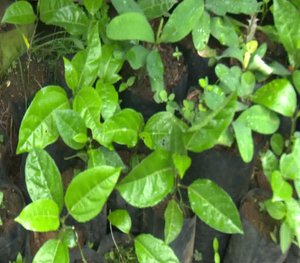

 DOMINICA: Government continues to identify cash crops and assist farmers to maximize production by providing inputs and technical assistance for their farms. One such crop is passion fruit.
Growing passion fruit as a way of life is proving to be fruitful for at least 35 farmers in the Kalinago Territory.
These farmers were trained and given technical assistance from the Ministry of Agriculture under the Support to Horticulture Programme.
On Wednesday April 20th, the Agriculture Division toured passion fruit farms in the Kalinago Territory to see their progress first-hand.
Jason Bruno, Coordinator of the Support to Horticulture Programme in the Division of Agriculture informed that the programme “has been implemented over a five year period. We have crops such as dasheen, yams and sweet potatoes, Tania and ginger under this program. We are looking for farmers who have registered farms and a produce seller I.D and interested in growing a particular crop. We work with them and we set targets with them and support them with the program.”
The programme, which started three years ago in the Kalinago Territory, was initially unsuccessful. Access to planting material was cited as one of the hindrances to the productivity of farmers in the area.
The Support to Horticulture Programme solved this problem by investing in one farmer who is responsible for propagating and providing farmers in the area with seedlings.
In order to qualify to be in the program, one must agree to plant no less than half an acre of the fruit and must also be certified as a farmer. Currently, farmers in the Kalinago Territory have planted 16 acres of passion fruit and are planning to expand.
2016 Nature Island Food and Drink Festival Launched

DOMINICA: The second edition of the Nature Island Food and Drink Festival and fifth Island Chef was launched on Wednesday April 20that the Anchorage Hotel Whale Watch and Dive Center.
This year, the activities for the festival will take place on April 23rd, 28th, and 29th.
During his address, CEO of the Discover Dominica Authority and Director of Tourism, Colin piper, noted the heightened importance of food and drink within the tourism industry.
 “There is a rising consumer consciousness about food quality sourcing, presentation in addition to the environmental and health effects of food. Along with this consciousness we see an increasing interest in celebrity food contests available through television such as food network, online and on social media. Culinary tourism here in Dominica, while it is an emerging niche market segment, is presently at its infancy stage. Dominica can be identified as a destination versed in cuisine culture once combined with other tourist activities such as adventure, health and wellness and cultural tours.”
He believes that this niche, once tapped, can bring Dominica ahead in the tourism industry.
“This niche has far reaching possibilities as it relates to our tourism product. A 2013 American Culinary Traveler study found that almost a third of American travelers deliberately chose destinations on the availability of activity related to local food and drink. We now see persons travelling for food experiences coupled with the adventure aspect of Dominica. We are ideally placed to engage in activities that would promote our local cuisine,” he said.
The CEO of the Discover Dominica Authority pledged his organization’s support to the festival which continues to grow yearly.
“With the cuisine niche of the DDA we are looking to complimenting the Nature Island Food and Drink Festival and all other smaller festivals incorporating food into a national festival which we have dubbed ‘Taste of Dominica’ and taste of Dominica will be featured for the first time in November. This event we hope will bring all Dominican culinary delights in one calendar of activities along with the Nature Island Food and Drink Festival,” he said.
United Nations envoy briefs Prime Minister Harris
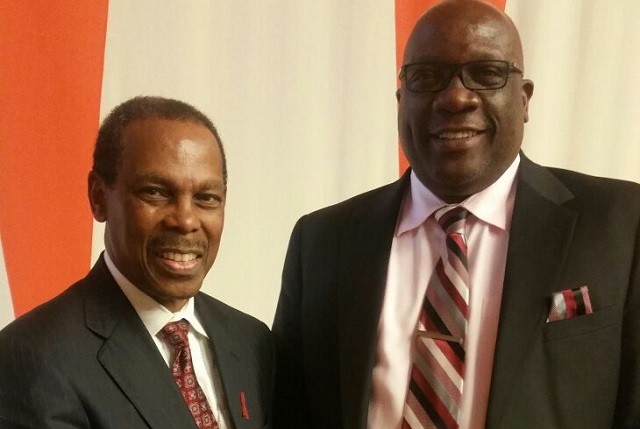
ST. KITTS: BASSETERRE, ST. KITTS, APRIL 23rd, 2016 (PRESS SEC) – Yesterday, at a meeting in New York, Dr. Edward Greene, the United Nations Secretary-General’s Special Envoy for HIV/AIDS in the Caribbean briefed Prime Minister Dr. the Honourable Timothy Harris on a number of upcoming events that will be crucial in procuring resources for one of the region’s most pressing health challenges.
Prime Minister Harris serves as CARICOM’s Lead Head on Human Resources, Health and HIV/AIDS.
The 2016 United Nations General Assembly High-Level Meeting on Ending AIDS, taking place in New York from June 8th to 10th, will focus on the need to accelerate the response to HIV over the next five years in order to end the AIDS epidemic by 2030. On September 25th, 2015, countries adopted the 2030 Agenda for Sustainable Development, which consists of 17 Sustainable Development Goals and 169 targets. Ending AIDS by 2030 is one of those targets.
Then, in July, several health symposiums will be held in South Africa, including the 9th International AIDS Economics Network (IAEN) Pre-Conference: Investing in Sustainable Responses to HIV and AIDS (July 15th to 16th) and the 21st International AIDS Conference (July 17th to 22nd).
Dr. Edward Greene, the UN Special Envoy, advised Dr. Harris that the region’s participation in these international meetings “can make a difference in resource distribution” to CARICOM.
The International AIDS Economics Network (IAEN), for instance, says the aim of the July 15th to 16th pre-conference is “to explore innovative, country-led approaches for supporting affected countries to prioritize, sustain and lead their national investments in HIV and AIDS responses. The related research will identify ways to create, optimize, and sustain fiscal space for HIV investment domestically, as well as explore innovative national and international financing mechanisms able to leverage allocated funds.”
This event will be hosted in conjunction with the Bill and Melinda Gates Foundation, IAEN, the Health Economics and HIV/AIDS Research Division (HEARD), UNAIDS, the World Bank, RUSH Foundation and Sida/Norad (the Swedish International Development Cooperation Agency/the Norwegian Agency for Development Cooperation).
Dr. Greene and Prime Minister Harris also discussed the fact that the Caribbean community has made excellent strides in reducing the mother-to-child transmission rate of HIV in its member countries.
Last October, Prime Minister Harris said that St. Kitts and Nevis was expected to have zero transmissions of HIV from mother to child by the end of 2015.
On June 30th, 2015, Cuba became the first country in the world to receive validation from the World Health Organization that it has eliminated mother-to-child transmission of HIV and syphilis.
According to UNAIDS, “The term ‘validation’ is used to attest that a country has successfully met criteria (internationally set targets for validation) for eliminating mother to child transmission of HIV and/or syphilis at a specific point in time, but countries are required to maintain ongoing programmes.”
– See more at: http://sknis.info/united-nations-envoy-briefs-prime-minister-harris/#sthash.SMZgTyrZ.dpuf
Prime Minister Harris meets with the Commonwealth Secretary-General
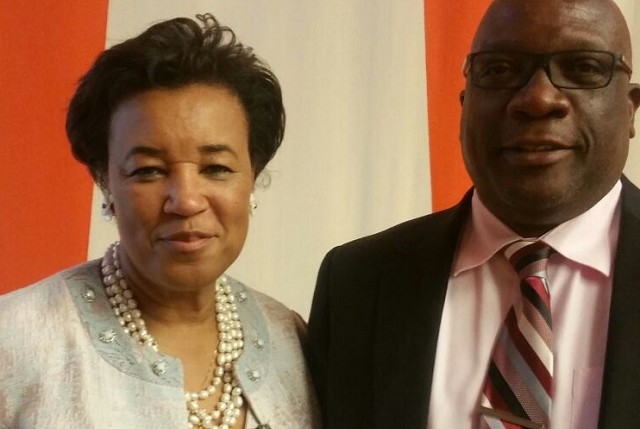
ST. KITTS: BASSETERRE, ST. KITTS, APRIL 23rd, 2016 (PRESS SEC) – Prime Minister Dr. the Honourable Timothy Harris has met with the Right Honourable Patricia Scotland QC of Dominica who assumed the office of Commonwealth Secretary-General on April 1st, becoming the first woman to hold that position.
Their meeting was held on the fringes of the Signing Ceremony for the Paris Agreement yesterday (April 22nd), Earth Day, at the United Nations in New York.
Prime Minister Harris said his discussion with the Commonwealth Secretary-General was informed by their shared values and concern for Small Island Developing States (SIDS), which face challenges to sustainable development such as vulnerability to external shocks.
“We embrace a pragmatic strategic approach that leverages the Commonwealth family in ways that advance the cause of small island states such as St. Kitts and Nevis on a number of matters, including the unfair graduation practice and the resultant exclusion of SIDS of a certain income level from receiving concessional financing by the Organization for Economic Cooperation and Development (OECD) or OECD member states.”
For instance, levels of official development assistance or ODA funding are determined and distributed to Small Island Developing States (SIDS) using the per capita income approach. This approach views a “high income: non-OECD” Small Island Developing State like St. Kitts and Nevis as having been upgraded, through a process called graduation, by the OECD, the World Bank and other international organizations. Having graduated to high-income level, the Federation of St. Kitts and Nevis is not eligible for preferential borrowing rates that lower income economies can access.
Prime Minister Harris and other Heads of CARICOM and Commonwealth states argue for a fairer system of assessing countries that takes into account their vulnerability. One such system is the structural gap approach, which acknowledges obstacles to sustained growth (“structural gaps”) and their critical impact on SIDS.
For instance, an upper-middle-income SID may be beset by developmental challenges that are out of its control, such as a small population size and vulnerability to droughts, hurricanes and other environmental shocks, and would therefore require special consideration for continued assistance at preferential rates. A case in point is Dominica, where the Commonwealth Secretary-General, the Right Honourable Patricia Scotland QC, was born. Dominica, which is classified as having an upper-middle-income economy, suffered significant loss to its GDP in the wake of Tropical Storm Erika last year.
The Commonwealth Deputy Secretary-General for Economic and Social Development, Mr. Deodat Maharaj of Trinidad and Tobago, said last year, “Tropical storm Erika demonstrates once again the vulnerability of small states.” He added, “As we embark on the Sustainable Development Goals, it is important that the vulnerability of countries like Dominica be taken into consideration in determining both the amount and the terms and conditions of development financing.”
During yesterday’s meeting with the Right Honourable Patricia Scotland QC, Prime Minister Harris said, “The Commonwealth has done a lot of work on developing a vulnerability index for Small Island Developing States, and we have to work strategically to convince the Organization for Economic Cooperation and Development to use this index.” The Prime Minister added that, “We also have to nurture better partnerships between CARICOM and African, Caribbean, and Pacific (ACP) Commonwealth states on issues of mutual interest.”
Of the 53 member countries of the Commonwealth, 31 of them are classified as small states. According to the Commonwealth’s website, “All members have an equal say – regardless of size or economic stature. This ensures even the smallest member countries have a voice in shaping the Commonwealth.”
– See more at: http://sknis.info/prime-minister-harris-meets-with-the-commonwealth-secretary-general/#sthash.dFxnfGq5.dpuf