Shamfa Cudjoe portrait on her first day at the Sports Ministry
Warm welcome for new Minister of Sport and Youth Affairs.
The Honourable Shamfa Cudjoe, newly appointed Minister of Sport and Youth Affairs received a warm welcome at the Ministry’s Head Office at St. Clair today, April 10, 2018, as she assumed her new portfolio. On hand to greet the Honourable Minister were Ms. Nicolette Duke, Permanent Secretary, Mrs. Marcia London -McKellar, Deputy Permanent Secretary, other Ministry officials and staff.
At a media briefing at her new office, the Honourable Minister indicated that she was humbled to continue to serve as a member of Cabinet and was honoured to be able to serve in any capacity to which she is called.
Minister Cudjoe added that Sport is very much linked to Tourism and in this regard, she will continue to have partnerships and work hand in hand with all stakeholders to build on the diversification process for this country.
The Honourable Minister also emphasized her passion for youth development, having been a youth activist, a CARICOM Youth Ambassador, a United Nations Youth Ambassador, Vice President and later President of the Tobago Youth Council and a participant in the Regional Youth Parliament initiative.
The Minister also extended congratulations to Gold Medallist, Michelle-Lee Ahye and Silver Medallist, Dylan Carter for their historic and remarkable achievements at the 2018 Commonwealth Games currently taking place in the Gold Coast, Australia. She also applauded the recent successes of the CARIFTA Athletics and Swim Teams who competed at the just concluded Games in Bahamas and Jamaica respectively.
In her closing remarks, Minister Cudjoe committed to building on the successes in sport and heightening and deepening the interactions with all stakeholders to raise the profile of youth engagement in Trinidad and Tobago.
We at the Ministry of Sport and Youth Affairs look forward to working with the Honourable Minister as we continue to promote holistic sport development and youth empowerment
Ministry of Agriculture working to expand production of white potato.
Farmers are receiving great yields from white potatoes this season and they are grateful. Shortly after the passage of hurricane Maria, Government to ensure food security and to quickly revive the agriculture sector, provided several farmers with free seeds and fertilisers for short term crops such as white potatoes.
Two containers of white potatoes were made available in collaboration with the government of Canada through PROPEL. The Hon Minister for Agriculture, Johnson Drigo and other officials of that ministry visited Calibishie last week to get a first-hand view of the abundant harvest.
“I want really to thank the government and people of Canada through PROPEL for its assistance in supplying to the ministry double the amount of seeds that we received for last year’s season and I also want to thank the farmers for their hard work. We are seeing a very, very big bumper crop of white potatoes this year and we are looking forward to next year when we will double the number of acres. This year we established over seventy acres, our hope is to do over 100 acres next year in white potatoes. It looks like a new crop that we will be producing not only for food security but also as part of the export strategy of this country,” Hon Drigo said.
He applauded particularly the women farmers who are very committed to the trade. The agriculture minister says several women are now leading several farmers groups around the country.
One such woman is Octavia Hunter who has been a farmer for forty years and currently serves as President of the North Eastern Women Farmers Group. She received eight bags of seeds at one hundred pounds per bag and fertilizer.
“We got the potatoes from the PROPEL company and we planted; we followed all of the instructions, we kept our records, we sprayed on time, we did what we had to do, and the weather also permitted us very well to be successful,” she said. “All in all, it was a very good harvest. Last week Monday I sold nineteen bags for DEXIA at 52 pounds per bag and yesterday we harvested eighteen trays at about 80 pounds in a tray and today we have the rest to harvest…I might get another ten trays today…”
She is excited about this crop which she says is relatively easy to grow. A good report for the ministry of agriculture which eyeing the white potatoes as a potential cash crop. “Single women can do it by themselves. I can come and plant my potato, I can get the tiller and do everything…plant my potato, weed my grass, fertilise my potato and I can move on without having men to come and do work for me so it’s a very crop, it’s a very crop and it coming in fast…I think its successful,” Hunter gloated.
Hon Drigo says his ministry’s aim is that in a few years from now there will no longer be a need to import white potatoes. To make sale of the produce even easier for farmers, Government has made special arrangements with the Dominica Export Import Agency (DEXIA) to purchase all the white potatoes and in turn sell to local retailers.
Hon Drigo informed, “There are retailers who have been in discussion with the ministry very early on who are prepared to purchase these potatoes through DEXIA…we do want the farmers to have the responsibility of looking for sale for these potatoes especially since we are looking at food security.” White potatoes in the Agriculture Resilience Strategy Meantime, Permanent Secretary in the Ministry of Agriculture, Reginald Thomas says the Ministry of Agriculture is eyeing the possibility of expanding the production of white potatoes through-out the country. It has already been ascertained that the crop can be successful in Dominica. This is the second year of harvest for the farmers in the North East.
“White potatoes are imported in large quantities annually and it has been shown we have the growing conditions for us to be able to produce potatoes. I think the government of Dominica which now looking at diversifying its productive base could look at expanding the production throughout the island and as the conditions provide, to grow it year-round if possible as a means of doing some import substitution,” he said.
He says other areas are being tested out to decide the most suitable locations for planting potatoes on island. While last year, only one container of seeds was imported, this year double the amount was given out free to farmers for planting. Dr Thomas says it is the ideal crop to build into Dominica’s resilience strategy in agriculture.
“White potatoes is not going to go away; it is a crop that is going to be part of our root crop programme; it is also a crop that lends itself to resilience (all the root crops) and this particular crop, we will try to build it into our resilience strategy as we look to actually have food in the event that there is something, a storm or some other event, that we have food for our population. These are some of the strategies that we will use at it relates to building resilience in agriculture, building resilience in our food system.”
Dr Thomas says there are several lessons to be learnt as the Ministry of Agriculture seeks to encourage more farmers to plant. He spoke of what success in this expansion would look like.
“Importantly, we want to reduce the sale price per pound of potatoes to ensure that it is competitive with the imported potatoes and that the farmers have no issue once they produce to sell that product. So, this is a strategy to build the sector, and to build the sub-sector as it relates to white potatoes. So, lessons learnt we will see how we can implement these measures to expand our production.”
Caribbean Export Development Agency to launch Direct Assistance Grant Scheme (DAGS) in Grenada.
The Caribbean Export Development Agency will be launching its Direct Assistance Grant Scheme (DAGS) in Grenada on Thursday April 12, 2018.
The Direct Assistance Grant Scheme offers financial assistance to registered businesses, individuals and business support organizations with potential to export products and services. The objectives of the scheme are as follows:-
to increase exports to the Caribbean region and international markets;
lower production costs;
identify new sources of suppliers of raw materials and other inputs;
increase productivity through training and personnel development;
facilitates trademarks, intellectual property and copyright protection;
reduce environmental impacts;
capitalise on the benefits of the Economic Partnership Agreement (EPA), Caribbean Single Market Economy (CSME), CARICOM-Dominican Republic Free Trade Area and other bilateral and multilateral arrangements;
foster intra-regional cooperation to enhance productivity and capitalize on economies of scale; and
promote programmes which will impact on underdeveloped areas or disadvantage sectors within the region (e.g. rural area development and gender).
The activity will commence with a launch and remarks by key stakeholders including representatives from the Government of Grenada, European Union Delegation and Caribbean Export Development Agency.
Subsequent to the launch is a workshop where a representative from Caribbean Export Development Agency will demonstrate the application process for accessing the grant.
The venue is the Grenada Investment Development Corporation (GIDC), starting at 9:30 a.m. until 5:00 p.m.
For more details please call the Ministry of Economic Development, Trade and Planning via telephone numbers 4402101/4358889 or email tradegrenada@gmail.com.
The media houses are invited
CARICOM Leaders Seeking To Revive West Indies Cricket.
Regional leaders are determined to do everything possible to revive West Indies cricket, and ways of achieving this objective will be on the agenda at this year’s Twenty-Ninth Inter-sessional Meeting of the Conference of Heads of Government of CARICOM, in Haiti.
This was stated by Prime Minister Freundel Stuart, who told the Barbados Government Information Service that the state of West Indies cricket had been a key agenda item for the last few CARICOM summits. He disclosed that the CARICOM Heads had received a number of reports and recommendations which would be carefully examined at the conference.
He gave the assurance that if regional leaders could do anything to revive West Indies cricket, which, he said, all Heads of Government agreed belonged to the people of the region, “we should take these steps”.
“Barbados’ very firm position is that the last thing we should try to do is to politicise West Indies cricket. I do not think that the International Cricket Council would tolerate that kind of intervention, but at the same time, we have to make sure that a game in which we have shone so spectacularly over the years and that has brought so much joy to the West Indian people is protected, and where necessary, revived,” Mr. Stuart stressed.
Prime Minister of Antigua and Barbuda, Gaston Browne, currently chairs CARICOM’S committee on West Indies Cricket.
Crime and Violence a heavy toll on (CARICOM) society – CARICOM SG.
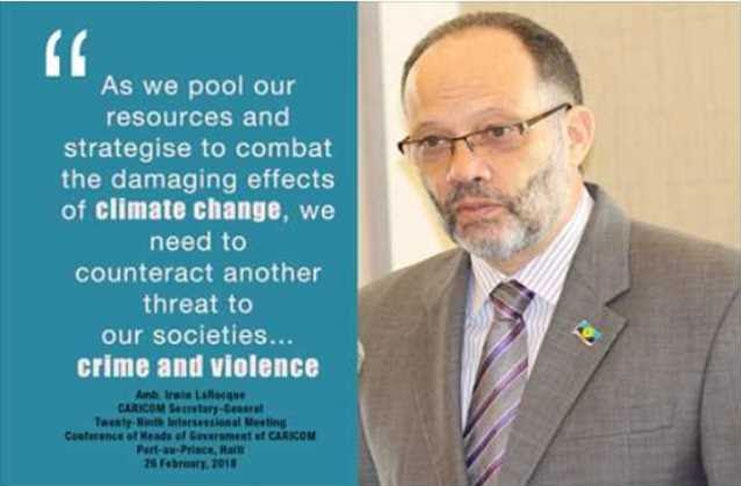
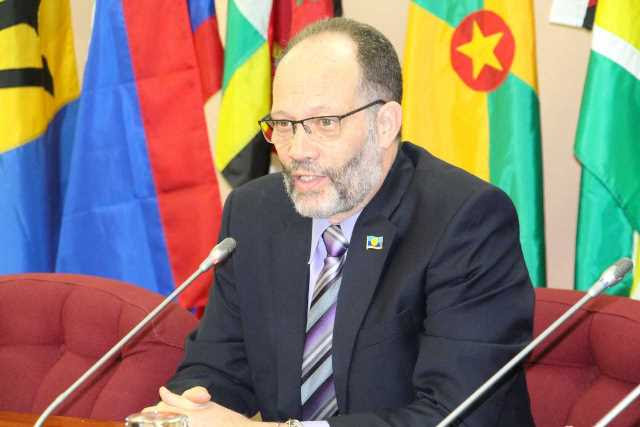
Amb. Irwin LaRocque, Secretary General of the Caribbean Community (CARICOM), called on CARICOM to counteract the threat of crime and violence, when he addressed the opening of the 29thInter-Sessional Meeting of the Conference of Heads of Government, earlier today in Port-au-Prince, Haiti.
“As we pool our resources and strategise to combat the damaging effects of climate change, we need to do so as well to counteract another threat to our societies…. I refer to the effects of crime and violence”, he said.
Amb. LaRocque pointed to the toll on societies through “loss of lives”, “injuries” and the “psychological trauma” and observed that the greatest impact was on families. “It was within that circle the battle against the scourge must begin”.At the regional level, the Secretary-General suggested revisiting the CARICOM Crime and Security Strategy (CCSS) signed five years ago in Haiti to identify areas for improvement in order to make it more effective.
He pointed also to a number of legal instruments which he said were significant additions to the Community’s armoury against trans-border crime. In this context, he singled out the CARICOM Arrest Warrant Treaty and the Agreement on the Return or Sharing of Recovered Assets, stating that he looked forward to the “Treaty being ratified as soon as possible” and to the completion of the negotiations for the Agreement.
The CARICOM Arrest Warrant Treaty simplifies the procedure of returning fugitives to the country where charges have been laid, while Agreement on the Return or sharing of Recovered Assets provides a framework for the return or sharing of criminal assets which have been moved to another jurisdiction.
The Secretary-General informed that the Region has been working on a Counter-terrorism Strategy. He drew attention to the very nature of the Community’s interconnection and its vulnerability, as a result.
“…an act of terrorism or violent extremism in one Member State will resonate and have repercussions through our Region, he said.
The Secretary-General reminded that the issue of crime and violence was regional problem demanding a regional solution and that it required the full cooperation of all the national and regional agencies charged with the responsibility for addressing crime and security. About Security in CARICOM
In 2007, the Caribbean Community made Security its fourth pillar of regional integration arrangements, as they sought to strengthen the security architecture and their efforts in harmonising the fight against crime.
The Ministerial Council for National Security and Law Enforcement (CONSLE) has oversight of the Region’s security architecture, while operationally, the CARICOM Implementation Agency for Crime and Security (IMPACS) is the coordinating Institution.
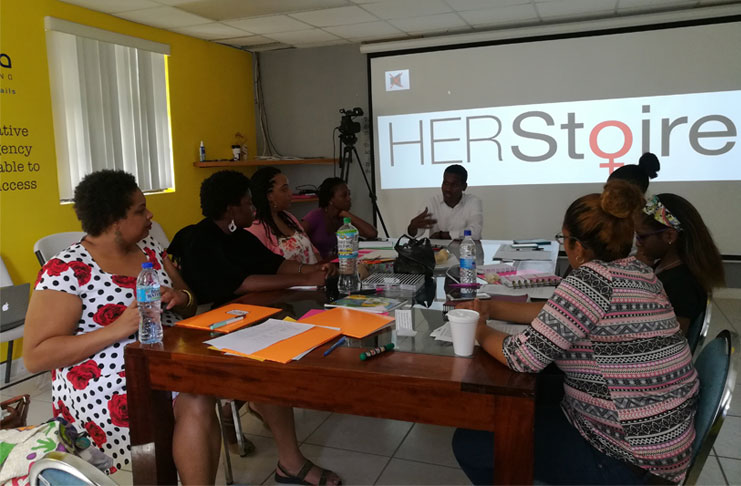
HERStoire – Local feminist organisation to launch Virtual Safe Space Program ahead of International Women’s Day.
The HERStoire Collective announces the upcoming launch of its Sister2Sister Safe
Space Programme. This programme is a CVC/OECS-funded pilot initiative encompassing
the utilization of an online forum serving as a virtual support group and safe-space
platform for young women aged 16-24 years old in Saint Lucia.
Sister2Sister targets young women affected by the service delivery gaps and lack of
access to existing Sexual and Reproductive Health (SRH) services and initiatives, while
simultaneously supplementing the impact, delivery and sustainability of in-person
programming in community-based safe spaces. Through this program, participants will
freely share and receive support, practical education and referrals to programmes and
services to meet their individual SRH needs.
The Sister2Sister Safe Space Program will consist of various components including
anonymous, virtual group chats; an ongoing online forum where participants can seek
expert advice on SRH issues; various blogs, videos and podcasts on pertinent SRH
topics; and SRH-themed community meetings, talks and workshops. The program will
be officially launched in March, just in time for International Women’s Day.
SG commends Saint Lucia’s leadership in sustainable development.
Caribbean Community (CARICOM) Secretary-General, Ambassador Irwin LaRocque has commended Saint Lucia for ensuring that issues related to sustainable development are placed at the forefront of the regional and international agenda.
In a congratulatory message to the Prime Minister of Saint Lucia, The Honourable Allen Chastanet, on the occasion of the country’s Thirty-Ninth Anniversary of Independence on Thursday 22 February, Mr LaRocque said:
“Saint Lucia’s efforts at promoting regional integration are most appreciated. With responsibility for Sustainable Development, the Environment and Disaster Management in the Quasi-cabinet of CARICOM, Saint Lucia is exercising great leadership in ensuring that these issues of vital importance to the Region remain in the forefront of the regional and international agenda.”
He told the Saint Lucian Prime Minister that he was looking forward to partnering with the Government and People of Saint Lucia as they continued their progress towards a viable, sustainable and prosperous country, which would serve to strengthen the wider Caribbean Community.
Secretary-General LaRocque said that the theme of this year’s celebration, I am Saint Lucia, conveys the sentiment of pride that inspires the continued commitment of the Government and People of Saint Lucia in their pursuit towards the development. The full text of the message reads as follows: “Honourable Prime Minister: It is my distinct pleasure on behalf of the Caribbean Community (CARICOM), to extend warmest congratulations to you and the People of Saint Lucia on the occasion of your country’s Thirty-Ninth Anniversary of Independence. Saint Lucia has made remarkable progress in those 39 years and is justified in celebrating its achievements with pride. The theme of this Anniversary “I am Saint Lucia” conveys the sentiment of pride that inspires the continued commitment of the Government and People of Saint Lucia in their pursuit towards the development of their country. Honourable Prime Minister, Saint Lucia’s efforts at promoting regional integration are most appreciated. With responsibility for Sustainable Development, the Environment and Disaster Management in the Quasi-cabinet of CARICOM, Saint Lucia is exercising great leadership in ensuring that these issues of vital importance to the Region remain in the forefront of the regional and international agenda. I look forward to continuing to work with the Government and People of Saint Lucia as they continue their progress towards a viable, sustainable and prosperous country which would serve to strengthen the wider Caribbean Community.”
Caribbean Export and the Caribbean Development Bank partner to provide greater access to finance for women-owned businesses.
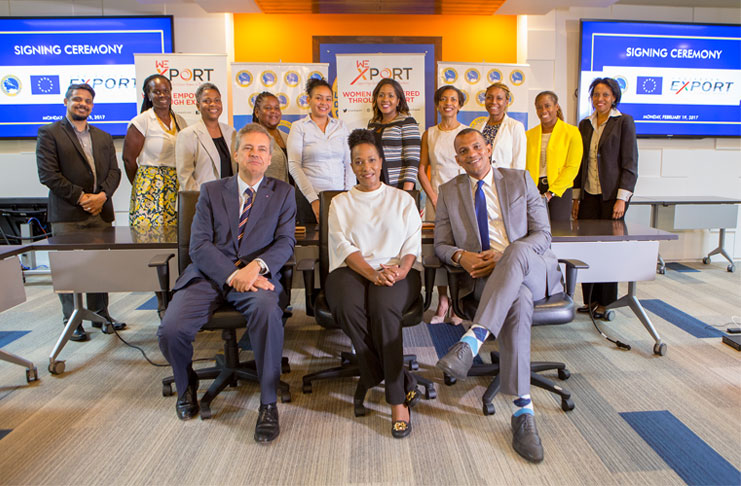
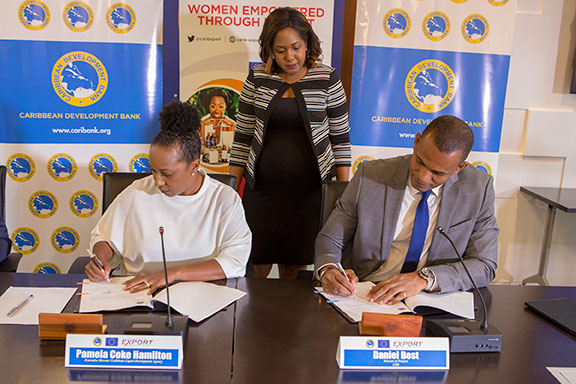
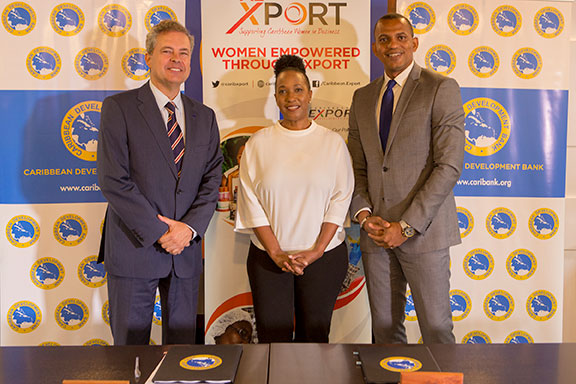
Accessing finance to fund business ventures has long been an issue across the Caribbean, especially for women. Now that the Caribbean Export Development Agency and the Caribbean Development Bank (CDB) have joined forces to tackle this challenge, sourcing funds could become easier for women-owned businesses in the Region. The two organisations today signed an agreement to collaborate on a new programme, Women Empowered through Export (WE-Xport), to support capacity-building for women-owned businesses to facilitate their access to finance. A key component of the new initiative to be launched in March 2018 by Caribbean Export, will be “Access to Finance”, and will include a two-day workshop that aims to increase participants’ understanding of the requirements of financial institutions and how best to meet them. Ongoing technical assistance through regional business support organisations will also be available to participating companies through the CDB-funded component. Pamela Coke-Hamilton and Daniel Best “CDB recognises the importance of micro, small and medium-sized enterprises as contributors to economic growth and development in our Region. We welcome the opportunity to partner with Caribbean Export to give women-owned businesses the support they need to gain better access to financing. We view WE-Xport as another opportunity for the Bank to directly advance women’s entrepreneurship, and help women business owners overcome one of the greatest obstacles they face when looking to grow their businesses—unlocking financing,” said Daniel Best, Director of Projects, CDB. During his statement at the signing of the agreement, Best noted that between 2013 and 2017, CDB provided lines of credit to micro, small and medium-sized enterprises (MSMEs) totalling approximately USD18mn and benefitting 974 MSMEs across the Region. The Bank’s support for interventions targeting women business owners builds on research it commissioned in 2016, which identified gender disparities in access to credit across the region. As part of its response, the Bank is also collaborating with regional development financial institutions to develop gender policies. Executive Director of Caribbean Export – Pamela Coke Hamilton expressed her gratitude to the CDB for catching the vision of the WE-Xport programme early in the initial planning of the project and partnering on the critical access to finance pillar. “As we brainstormed ways of supporting women owned businesses, we recognized that we needed to address the constraints they face in applying for funding. The project which we are collaborating on with the CDB will seek to increase the capacity of women entrepreneurs to better prepare proposals to meet the requirements of the financial institutions. Through your support we will be able to provide training and technical assistance (TA) to 10 women-owned Micro, Small & Medium-sized Enterprises (MSMEs) and 10 Business Support Organisations (BSOs).” Caribbean Export works closely with the European Union to implement a range of activities that support the development of the region’s private sector. Their cooperation for the empowerment of women via WE-Xport is poised to be a game changer for women who participate in the upcoming programme. WE-Xport aims to strengthen and support women-owned enterprises to increase their access to finance, improve and build their capacity as entrepreneurs, increase access to markets (including networking and being integrated to value chains) and advocate on issues and public policies that negatively affect female entrepreneurs. from left Luis Maia, Pamela Coke-Hamilton and Daniel Best At the signing, Mr. Luis Maia, Head of Cooperation at the EU Delegation to Barbados, the Eastern Caribbean States, the OECS and CARICOM/CARIFORUM reminded of the long relationship between the EU Delegation and Caribbean Export of close to 20 years of cooperation working towards the development of the region. “Caribbean Export has been a valued partner in our cooperation with the region and without their assistance we would not have been able to fulfil our mandate towards private sector development and otherwise. Currently the EU is contributing with €24 million to increase employment creation, inclusiveness, particularly for youth, women and indigenous groups, and overall poverty reduction in CARIFORUM countries through targeted interventions that provide new and innovative frameworks for growth and development” shared Mr. Maia to the attending audience.
Casa Cayuco – This paradise tropical eco-resort on a beach in the Caribbean could be yours for just $10
American couple Suzanne and Dave Smith are selling off their incredible Casa Cayuco Eco Adventure Lodge, in Bocas del Toro, Panama, Central America.
But instead of listing their stunning multi-million-pound island getaway for sale they are offering the chance for anyone who buys a $10 ticket to win their extraordinary lifestyle and profitable business.
Dave and Suzanne have spent five years turning a former rustic lodge into one that has just been voted number one resort on TripAdvisor in Panama.
Their incredible two-acre slice of heaven is bordered by sloth-filled rainforest to the rear and crystal clear coral sea to the front.
The lucky winner of the resort, with capacity for 24 guests, will become owner of four stand-alone cabins, a main lodge, two lodge suites, and an air-conditioned luxury owner’s suite designed by Dave and Suzanne themselves and built by skilled local carpenters.
Outside, Casa Cayuco comes with its own jetty and thatch covered sun terrace as well as everything you need to run a business, including commercial kitchen communication tower, laundry and maintenance building and THREE power boats, each over 23-foot long.
Kayaks, snorkelling, spear fishing and paddle boards and surf gear are also ready and waiting to be used by a new owner and guests alike.
And if that’s not enough, British competition organisers WinThis.Life www.winthis.life are offering a $50,000 cash injection to welcome the new owners.
All those wishing to take part have to do is buy one or more tickets and play a spot-the-ball-type competition on the website.
Dave, 35, and Suzanne, 33, first arrived on the island in 2013 with just seven suitcases having decided to sell up from their home and corporate lives near Detroit, Michigan, USA.
Now the Smiths – along with their two-and-a-half-old daughter Mina – run a thriving resort which attracts everyone from honeymooners and families to eco-scientists and yoga retreaters.
Dave said: “My wife and I had corporate jobs in the United States, which we did not like, and we kind of saw how everyone in our area was going in the same direction… jobs, college, get married, have kids, pay for their college, and then retire… which is a fine life, but we wanted something different.
“We started looking all over for something else and eventually we started looking at Panama, which we found has really friendly foreign investment laws and immigration laws.
“We came across Bocas del Toro which is this chain of islands in the Caribbean, which we weren’t really aware of at the time.
“We loved the idea of island life, and after some research we found Casa Cayuco for sale and I contacted the owner, who lived remotely.
“He was coming down for his one week of the year at the resort and so I came down on my own for three days and we hit it off and when I got back we bought it. I guess it was an impulse buy, but it’s turned out to be amazing.
“We sold everything you would have for a life, house, cars and everything and we ended up moving down here with seven suitcases and just enough to be able to buy this place.”
When Dave and Suzanne first arrived Casa Cayuco was off the electricity grid, which it still is so no bills, but there was virtually no internet and the electricity generator would give enough for a few hours of light a night.
Dave said: “The thought of off-grid living is pretty romantic, but actually living and running a business without those things is something else.
“We started right away re-building everything, and thankfully Bocas was starting to get really popular so we had enough business to pay for these renovations.
“So, the last four years we’ve just been rebuilding the whole place, the solar system, the communications tower, the house for Suzanne and I with air-conditioning, Apple TV and lots of space. It’s gone now from an eco lodge to more of a luxury eco resort.”
The Smiths’ employ 14 indigenous people from the local village and Dave said they had become more of a family now as well as people that work for them.
The locals help with everything from cooking and spear fishing excursions, to helping build and maintain the resort itself.
And Dave and Suzanne’s immediate family has expanded too, with the birth of their daughter Mina who has spent her first years in paradise.
Dave said: “It’s been amazing for Mina and we kind of envisioned having a family out here, that’s one of the reasons we wanted to move to raise our child in a really unique environment.
“I know in the United States and most places in the West now kids don’t really play outside anymore and they are just glued to their devices. It’s really special to see our daughter grow up around kids, who if they don’t have a toy they just play with nature or stick for four hours and they don’t get bored.
“To grow up with that imagination is something we’re really pleased she has, and we’re right on the Caribbean sea which has crystal clear waters and having the ocean be a big part of her life is very special.”
Dave said Mina was born in Panama City which is only a 40 minute flight away and has some excellent hospitals as well as all the amenities you would expect from a major city.
He said the couple’s reasons were moving on were because they wished to expand their family and build another resort from scratch in a different part of Panama.
He said: “We love hospitality and want to raise a family in a similar environment. Now that we feel Casa Cayuco is a well run operation and is truly ‘turn-key’, we’re ready for a new adventure and want to build something from the ground up.
“We could hire managers to run Casa Cayuco while we took on the next project, but we think our next adventure will require all of our energy.
“We’re pretty sure our next thing won’t be as magical as Casa Cayuco, but the plan is to build something that affords us more family time.”
Art Jenkins, from competition organisers WinThis.Life (part of the company Ultra Primus), said any prospective winner would not be left to sink or swim once they took over the business.
He said: “It’s very important to Dave and Suzanne that the local community are still involved in the resort and they have plenty of advice and tips to give any potential winner.
“As organisers, we have made sure all the proper contingencies are in place, and there are a wealth of resort managers in the area who can help run things should they be needed.
“It’s an incredible opportunity for anyone to win this amazing lifestyle and resort, just like Dave and Suzanne did you could leave the rat race behind and be living in your own slice of paradise before you know it, you only live once.”
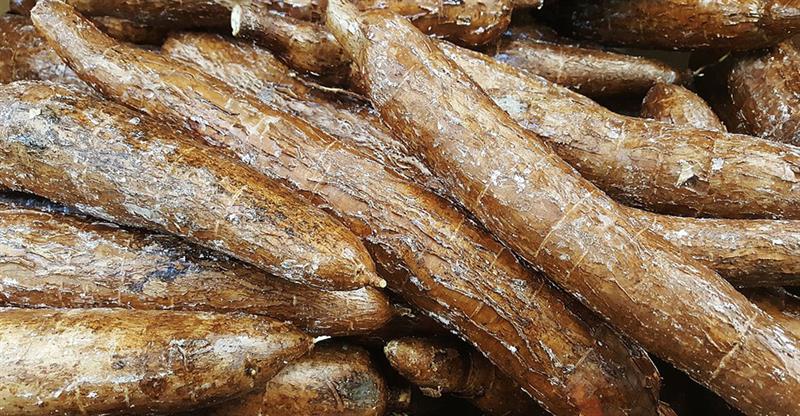
The Ministry of Health and Wellness, and the Ministry of Agriculture have collaborated on a Roots and Tubers Project that will not only increase the cultivation of cassava throughout the region, but will also encourage the production of cassava-blended bread as a healthier alternative to traditional white bread.
The project is funded by the Food and Agricultural Organization (FAO).
National Coordinator for the project, Marnus Cherry, said among the benefits of this project is a projected increase in sweet cassava production islandwide.
“It’s a crop that is drought resistant, so you can call it a climate smart crop,” he said. Cassava has been one of the most researched root crops by scientists. It also has a better finished product as compared to sweet potato and other root and tuber crops.”
Another component of the project is the value added aspect with the production of cassava mash which is used to make cassava-blended bread. The bread is currently being produced by at least four bakeries on island.
Manager for Manees Bakery, Sylvia Cadasse, said the cassava mash produced a better quality bread product.
“The FAO did an experiment in 2014 with us, they brought cassava flour and they brought cassava mash. What we found was the end product with mash as opposed to flour gives a much better and softer product, much better than flour.”
Chief Nutritionist in the Ministry of Health, Lisa Hunt-Mitchell, supports the use of cassava-blended bread as a healthier alterative to plain white bread.
“Research has shown that the 40 percent cassava mash – 60 percent flour mix gives a better product. Whole wheat flour has not been tested yet, but we would love for there to be cassava-blended bread with whole wheat flour as well, so that there is greater variety.”
Mitchel added that although cassava is high in carbohydrates, its glycemic index is very low.
“The glycemic index is a measure of how much a carbohydrate food can increase your blood sugar levels. When a food is low glycemic, it means that sugars from the food is released into the blood quite steadily, so that the body is able to regulate blood sugar better.”
Cassava blended bread is currently available at selected bakeries and supermarkets on island. Coordinators of the Roots and Tubers project are hopeful that both the cultivating of sweet cassava and the production of cassava-blended bread with increase.
Cassava is extensively cultivated as an annual crop in tropical and subtropical regions for its starchy, tuberous root which is a major source of carbohydrates.



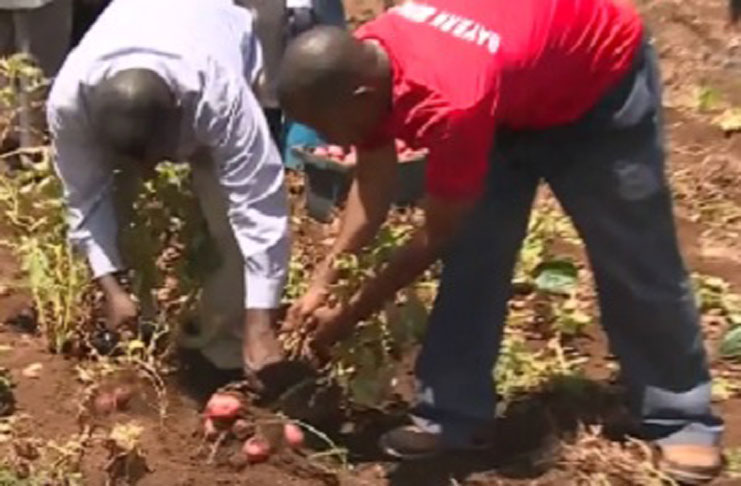
 Meantime, Permanent Secretary in the Ministry of Agriculture, Reginald Thomas says the Ministry of Agriculture is eyeing the possibility of expanding the production of white potatoes through-out the country. It has already been ascertained that the crop can be successful in Dominica. This is the second year of harvest for the farmers in the North East.