Barbados is a clean, well regulated, low tax jurisdiction and not a tax haven!
This was Prime Minister Freundel Stuart’s firm message when a delegation from the United States of America, including Chief Aides and Policy Advisors to Congressional Members Elliot Engel and Ileana Ros-Lehtinen, Eddy Acevedo and Eric Jacobstein, paid him a courtesy call recently at Government Headquarters. Those present included US’ Ambassador to Barbados, Linda Taglialatela; Chief of Staff of the Barbados Defence Force, Colonel Glyne Grannum and acting Deputy Permanent Secretary in the Prime Minister’s Office, Mark Franklin. Mr. Stuart said from time to time, this country has had to defend its reputation in that area and he called on the US to lend its voice in helping to clear up any misconceptions. “Because companies pay low taxes here, they repatriate large profits to their jurisdictions and that money is invested there, so there is a win-win situation,” he explained. According to him, the international business sector accounts for a significant amount of Barbados’ corporate tax revenue, brings in the second largest amount of foreign exchange and offers good quality jobs. The Prime Minister said another area of concern was Barbados being classified as a high middle income country and therefore did not qualify for necessary concessional financing. He stressed, however, that all countries in the Caribbean were vulnerable and identified hurricanes as being able to wipe out their GDP within a few hours. He noted that Barbados was leading the charge for a vulnerability index for small island developing states to deal with those issues and pointed out that New Zealand has joined the cause. Mr. Stuart thanked the US officials for their interest in Barbados, saying that Ambassador Taglialatela had been serving her country and the Caribbean very well. He noted that the relationship between Barbados and the US had deepened as a result of her being here. “Barbados values very highly its relationship with the US. It is an old relationship that predates our Independence, but there is still scope to deepen relations. The two countries understand that they need each other and that is why there is the US-Caribbean Strategic Engagement Act,” he stated. During the visit, Mr. Acevedo and Mr. Jacobstein met with key national and regional stakeholders to get a better sense of the impact of US support and assistance to the region. Mr. Acevedo serves as Senior Foreign Policy Advisor and Staff Director for the Subcommittee on Middle East and North Africa for the House Foreign Affairs Committee, under the leadership of Chairman Ileana Ros-Lehtinen. Mr. Jacobstein is a senior policy advisor on the House Committee on Foreign Affairs democratic staff, managing the Western Hemisphere portfolio for Ranking Member Eliot Engel and Committee Democrats. Mr. Engel and Ms. Ros-Lehtinen have been advocating for adequate funding for Caribbean specific programmes, including the Caribbean Basin Security Initiative.
The public is informed that the production quota for market queen conch meat for the season 2017-2018 has been set at 884,092 pounds.
The opening of conch season is from October 1st, 2017 to June 30th, 2018. The public is advised that if the conch production quota is realized earlier, the conch season will be declared closed.
The Fisheries Department hereby makes a special appeal to and urges responsible citizens to call 224-4552/203-2623, email fisheries_department@fisheries.gov.bzor Crime Stoppers Belize at 0-800-922-TIPS (8477) to report any Fisheries infractions. The Department assures that all information communicated will be treated in the strictest confidence.
Fisheries Regulation which relates to Queen Conch (Strombus gigas):
Regulation 6 (1) No person shall take in the waters of Belize, buy, sell or have in his possession:
a) any conch between the 1st July and the 30th September, inclusive, in any year;
b) i) at any time, conch the overall shell length of which does not exceed 7 inches (17.8 centimeters);
ii) the weight of unprocessed conch taken which does not exceed 7 ½ ounces (213 grams);
iii) the weight of partially process (market clean) conch taken which does not exceed 3 ounces (85 grams);
iv) the weight of fully process (fillet) queen conch taken which does not exceed 2 ¾ ounces (78 grams);
Any person who contravenes any of the provisions of the Fisheries Act, commits an offence and shall be liable on summary conviction.
*This above is in accordance with Regulation 24A (2) of Statutory Instrument No. 54 of 2012 of the Fisheries (Amendment) Regulations, 2012.
Nagoya Protocol: IUCN and UN Environment launch promotional videos in Saint Lucia.
The International Union for the Conservation of Nature (IUCN) and the United Nations Environment Programme (UN Environment) are increasing efforts to help Caribbean countries boost fair access to their genetic resources and equitable sharing of benefits derived.
The IUCN is the world’s largest and most diverse environmental union composed of both government and civil society organisations, working for a just world that values and conserves nature.Working through the Department of Sustainable Development in Saint Lucia, the agencies have developed and released two short videos on the Nagoya Protocol.The two videos – a short two and a half minutes and longer 10 minutes production – introduce viewers to the Nagoya Protocol and what it will mean for them individually and the Caribbean as a whole. The videos are a part of a regional/national awareness campaign on the Nagoya Protocol – which is still new to the Caribbean. “We made the videos because we wanted people to easily understand what the Nagoya Protocol is and what it means for the Caribbean Region,” said María Pía Hernández, Coordinator of the IUCN’s Biodiversity and Rights Unit, as she explained that prior to the Nagoya Protocol there were no guidelines in place to ensure that countries and individuals were properly compensated for the use of their traditional knowledge and genetic resources.
The Department of Sustainable Development in Saint Lucia is the Government agency responsible for overseeing implementation of the Convention on Biological Diversity and its related protocols.
It is vital that if our treasured local genetic resources are used for research or commercialisation the people of Saint Lucia must benefit. Regulating access to our genetic resources helps promote their conservation, while benefit sharing mechanisms help build national capacity by addressing limiting skill gaps for national growth and development. Promoting a culture of optimal knowledge sharing will help build awareness, strengthen our intellectual capital, international recognition and perpetual pride of Saint Lucia’s bountiful biodiversity.
The Protocol was adopted on 29 October 2010 in Nagoya, Japan, and entered into force on 12 October 2014. It has been ratified by seventy eight (78) parties, which includes seventy-seven (77) United Nations (UN) member states and the European Union (EU). Although the protocol has not been ratified by Saint Lucia, it is the second Protocol to the Convention on Biological Diversity (CBD); the first is the 2000 Cartagena Protocol on Biosafety. The project is funded by the Global Environment Facility (GEF) to work with regional governments, research institutions and other partners in the Caribbean to support countries to overcome barriers linked to poor understanding of Access Benefit Sharing (ABS), the Nagoya Protocol and the implications of protocol ratification and requirements for implementation.
National Statement of the Honourable Gaston A. Browne, MP Prime Minister and Minister for Finance, Corporate Governance and Public Private Partnerships of Antigua and Barbuda on the 36th Anniversary of the Independence of Antigua and Barbuda on the 1st of November 2017.
My Fellow Citizens and Residents,
Happy Independence.On this the 36th anniversary of our nation’s independence, we stand in the sunshine of history.
We are a people who are joined together as a single nation, with shared values, common purposes, and a common destiny.
Thirty-six years ago, the framers of our country’s constitution, laid down the principles upon which our nation was founded.
Those principles were formulated, not in the sunshine of history in which we bask today, but in the dark crannies and shadows of oppression and exploitation.
Those principles assert what we stand for as a society and what defines us as a people.
Our Constitution declares that we are a sovereign nation.
It proclaims that we acknowledge the supremacy of God.
It avows our fundamental belief in the dignity and worth of the human person and the entitlement of all persons to freedom.
And, it recognizes the central importance of the rule of law, to govern the operation of the State and the conduct of its people.
In all that has been done over the last 36 years, we have respected the religious and spiritual underpinnings of our society; we have upheld all freedoms and rights in our country; and we have adhered to the rule of law.
We are amongst the freest nations in the entire world.
There are no political prisoners in our country; no journalist is denied the right to criticise; no individual is arbitrarily deprived of freedom; no person is restricted from practicing their religion; and no one is prevented from expressing a political view, or belonging to a political party.
It is no coincidence, that for 26 of the 36 years of our country’s independence, during which those rights and principles have been institutionalised in our society, the Antigua and Barbuda Labour Party has held office.
This fact is a telling measure of the creed that has always guided – and continues to direct – the stewardship of Labour Party governments in our beloved country.
The supremacy of God; the rights and dignity of the human person; political, civil and economic rights within the rule of law, are the essential elements upon which our sovereign nation was established and upon which it has been built, essentially under Labour Party governments.
We should let no one threaten or erode that magnificent accomplishment.
We have every reason to be proud of our record of democracy, of freedom, and of the social and economic advances that we have made in less than four decades.
There are other principles set-out in our Independence Constitution about which we should remind ourselves.
They are particularly important today as we seek to consolidate the gains of our independence.
These principles expressed in the first set of recitals in our Constitution read as follows: “The people of Antigua and Barbuda respect the principles of social justice and, therefore, believe that the operation of their economic system should result in the material resources of their community being so distributed, as to serve the common good, that there should be adequate means of livelihood for all, that labour should not be exploited or forced by economic necessity to operate in inhumane conditions but that there should be opportunity for advancement on the basis of recognition of merit, ability and integrity”.
t is in advancement of these principles laid-down by the framers of our Independence Constitution, that I have proposed what I call “Entrepreneurial Socialism”.
Detractors of this proposal, particularly one non-national business enterprise, has maliciously described it as “anti-private sector”.
Nothing could be further from the truth.
And, I should set-down a marker, on this our 36th anniversary of independence, that private sector investment – both local and foreign – is both welcome and encouraged.
What is not welcome – and will never be encouraged – are slick and ruthless business practices that deprive the people of Antigua and Barbuda of their just earnings; exploits workers; ignores the rights of nationals; and misappropriates revenues properly due to the nation’s Treasury.
No sovereign government, which respects its accountability to the people and places the nation’s interest first, would ever adopt any other position.
Only governments, that have little regard for the people of their country; no respect for rights and contempt for the rule of law, would collude in such unacceptable activity.
In this regard, I am reminded of the words of the late John F Kennedy, President of the United States, who observed:
“No responsibility of government is more fundamental than the responsibility of maintaining the highest standard of ethical behaviour for those who conduct the public business”.
That is the maxim by which I want my government – and all who serve in it – to be guided.
In the coming weeks, I will spell out, in a written document, what is meant and intended by ‘Entrepreneurial Socialism’.
But, for now, let me say that, in essence, it is this:
A synthesis of socialism and capitalism in support of a new model of government and private sector partnership for profit.
It is intended to fill the entrepreneurial void created by inadequate domestic capital formation, lack of financial negotiating skills and product development and marketing, and a risk-averse culture.
It endangers no private sector investment that falls within the laws of our country. We want those businesses to flourish.
What it will do, is allow the government to partner with willing new and existing private sector investors to develop enterprises, including hotels, to facilitate increased domestic participation in ownership.
This is in Keeping with our objective of building a stakeholder society and the broadening of the ownership class. It will be accomplished by government putting money and other values assets into joint ventures with private sector partners, to create a capital base that many companies cannot manage on their own.
It will be a facilitator of increased domestic investments to support more robust economic growth, expansion and job creation.
Entrepreneurial Socialism is a form of state entrepreneurship that allows for private sector majority control and leadership by professional managers but, importantly, it will give the State – as custodians for the people – a minority stake in enterprises from which the nation would derive tax revenues and income from dividends as an owner.
For an example of the success of ‘Entrepreneurial Socialism”, we need look no farther than the West Indies Oil Company, which, today, with government as a major shareholder, is paying taxes and dividends in the region of $15M annually, to the Nation’s Treasury for the benefit of the people.
It should be noted that WIOC was purchased utilizing private capital for the benefit of the masses. This is a form of “reverse capitalism” in which private capital was utilized for the benefit of the masses.
‘Entrepreneurial Socialism” gives meaningful expression to the principle laid down in our Independence Constitution that “the operation of our economic system should result in the material resources of our community being so distributed as to serve the common good”.
It is a practical economic construct that will eliminate the abuse of other stakeholders by private owners, reduce the skewed distribution of wealth and empower the government to better meet its obligations.
Entrepreneurial socialism will not focus on exclusively on shareholder profit maximization but, will pursue equitable stakeholders objectives to serve the common good.
Nothing more, nothing less.
My fellow Citizens and Residents
We have just experienced both a huge disaster and a humanitarian crisis.
The decimation of Barbuda by Hurricane Irma, the forced closure of commerce on Antigua, on three occasions in the month of September, by the threats of Irma, Jose and Maria, and significantly increased costs to the government, have set-back the financial and economic strides that we had made.
It is worth recalling that, over the last three and half years, our achievements have been significant.
The Economic Commission for Latin America and the Caribbean (ECLAC) records that Antigua and Barbuda was the fastest growing economy in the Caribbean region in 2016 at 4.6%.
This rate of growth was subsequently revised by the IMF and ECCB to 6.5 percent, making Antigua & Barbuda’s economy the fasting growing in this hemisphere.
A few years ago, Antigua & Barbuda’s economy was the worst performing in the world, suffering a whopping contraction of over 20 Percent. My government, in approximately three and a half years, has recovered the lost grounds, making Antigua & Barbuda’s economy the largest in the OECS today.
We have cut our country’s debt to GDP ratio from 102% to 76%.
Unemployment has been reduced from over 25% to 10%.
And, an original IMF debt of $360 million has been decreased to $32 million.
In respect of total debt, the Caribbean Development Bank, in its ‘Economic Review and Outlook’ for 2017, registers that Antigua and Barbuda was the lead country in reducing debt by 5.5%, ahead of Grenada at 5.1%, and Jamaica at 4.5%.
These accomplishments were spearheaded by my Government, but they could not have been achieved without the patience, the understanding, and the contribution of the people of this Nation.
I congratulate the people of Antigua and Barbuda, and all who reside within our shores, for following in the best tradition of those who forged our path to independence.
Independence is not something that is achieved and automatically maintained.
It’s something that we have to fight to preserve and protect every single day.
For the day, we do not pay our debts; the days we lack the means to stand-up for ourselves in the international community; that is the day when our cherished independence will be plucked-away from us.
And, we will, once again, be subject to the dictates of external forces – alien to our society.
They, not we, will set the parameters of our social progress.
They, not we, will determine the pace and scale of our economic advancement.
We are still living in the aftermath of Hurricane Irma’s ravages.
The cost is high and our means small.
The road to rebuilding Barbuda will be long and hard. It will be made harder, as the develop countries with their vast financial resources, continue invoke the per capita income criterion, which precludes us from much needed concessional financing and official development assistance.
This is an extremely cold, uncooperative and unresponsive position of these wealthy nations, one that we continue to fight globally, in the interest of all vulnerable small island states.
But, so far, as one nation – Antigua and Barbuda – we have rallied together, extending the hand of brotherhood and embracing our common citizenship.
I thank the people on Antigua for their support to the inhabitants of Barbuda.
It is that spirit that will keep our nation whole and our independence strong.
I thank Antiguans too, for so willingly accepting onto our shores, as many as 3000 Dominicans, particularly young people of school age, whose future prospects would have been otherwise irreparably harmed. We will need much more of that spirit in the future.
For, I fear that Category 5 plus hurricanes are the new normal and that, with Climate Change, they will appear with even greater frequency and ferocity, threatening all our lives and all our property.
We will have to get ahead of such a calamity by building and reconstructing to higher standards of climate resilience.
And, abroad we will continue to carry that banner at the front lines of the war against Climate Change and Global Warming internationally.
Our voice may be small, but rest assured it will be loud – and it will be persistent and will be heard.
It is at times such as this that we should remind ourselves of the teachings of those who have struggled in great causes.
For instance, Dr Martin Luther King Jr, in the height of the struggle for Civil Rights in America, told his people:
“The ultimate measure of a man is not where he stands in moments of comfort and convenience, but where he stands at times of challenge and controversy.
Nothing worthwhile is easy”. There may be even personal risks, as I stand on universal principles to the chagrin of others. Notwithstanding these risks, I remain undaunted with an unshakable resolve.
My sisters and brothers, we have much for which to be thankful on this 36th anniversary of our Nation’s independence.
We have achieved much.
And, we are right to want to accomplish more.
But that is a joint task; a shared responsibility; a common goal.
Standing together, we can certainly achieve.
Standing apart, we will surely fail.
We should all recall that ours is a small economy, trying to do big things. We can accomplish each of those big things for the benefit of all, but only with one step at a time.
Immediately before us are three priorities: an effective system of distributing water; reconstruction of our road system and a system of reliable and less-costly electricity distribution.
Each of these is being tackled.
We are now producing enough water through reverse osmosis plants to satisfy our national needs; the problem is old and unsuitable distribution pipes that must be replaced.
In the coming weeks and months, that problem will receive priority attention.
So too will the matter of road reconstruction which will get underway within 30 days, as we trigger funds allocated to us and being administered by the Caribbean Development Bank.
My Government will invest $200M in repairing and expanding the road network in Antigua & Barbuda.
With regard to electricity generation and distribution, we are well on the way to integrating renewable energy modules in to the national grid.
We expect to reduce our dependence on fossil fuels considerably, thus bringing down the cost of electricity while reducing our carbon footprint.
My friends, in all that we have accomplished and that we continue to strive to achieve in the interest of every man, woman and child in our country, there are, of course, detractors and self-servers.
As Nelson Mandela observed: “It is so easy to break down and destroy”. But, that is the mischief of others.
It is not the business in which my government is involved for our nation’s good.
In 36 years, we have brought our country from the backwater of colonial underdevelopment, to the mainstream of a modern nation.
We stand today on the cusp of more rapid social and economic development.
And we should let none divide us in pursuit of that goal, or distract us from its achievement which is within our grasp.
Let’s unite to rebuild.
We are one people, one nation, with a common destiny.
We have shown that we are one caring nation.
Our bonds of affection and the better angels of our nature, will make our nation stronger and our prospects brighter.
Happy 36th Anniversary of Independence.
God bless each of you.
God bless our beloved nation, Antigua and Barbuda
On behalf of the Government and People of Trinidad and Tobago, the Honourable Attorney General wishes to express our absolute shock and dismay at the horrific attack on innocent civilians that took place in Manhattan on October 31st. Our hearts go out to the victims of the attack, their families and those whose lives will forever be affected by this terrible tragedy. No personal grievance, political agenda or ideological goal can ever justify such a callous and cowardly act.
Our citizens share a special sense of kinship with the people of New York, which is home to many people of Trinidad and Tobago origin. New York is indeed a melting pot of the global community and the wealth of diversity among all American people will continue to draw their strength to overcoming such challenges. Our friends in New York and the wider United States can also count on the support of the people of Trinidad and Tobago in this difficult time.
Attacks such as these are ultimately aimed at changing our way of life but the effect is quite the opposite, instead strengthening our resolve and the commitment to the values and ideals shared by our two peoples. Trinidad and Tobago remains steadfast in the fight against global terror. We shall continue to work side by side with our American counterparts to eliminate the threats of terrorism and terrorist financing as we have done over the last 2 years in particular.
HRForum 2017 – Rethinking HR: Embrace the Technology
Calling all CEOs, MDs, HR Managers, Payroll, Finance and Accounting Leads!Are you interested in cutting your overall business cost, saving time and accessing customizable, real-time business reports? HRWise in collaboration with HRMSolutions is pleased to invite you to register for our upcoming HRForum themed “Embrace the Technology”. Come to learn how you can improve HR administration, leave management and payroll processing for increased accuracy and efficiency.
On offer will be a FREE one-month subscription to our CUBE HRMS software. You will see first hand how this HR management and payroll system works. CUBE HRMS is specifically tailored to our local NIC and Inland Revenue requirements and is guaranteed to cut your payroll processing time by at least 50%.
Contact HRWise at 458-4001 or info@hrwiseinc.com for more information.
To register for the HRForum, go to www.cubehrms.com or click the button below and enter referral code HRForum under the “Free Demo & Trial” Section. Venue: Finance Administrative Center Conference Room, Pointe Seraphine Date: Wednesday 8th November 2017 Time: 9:00 am to 12:30 pm Registration: $100 (deadline Friday 3rd, November 2017) Full payment is required for confirmation of registration. Payments should be made to HRWise Inc. Please note that 48 hours cancellation notice is required and failure to meet this requirement will result in the full charge.
In the wake of the passage of Hurricane Maria some six weeks ago, Dominica is continuing its efforts to bring daily life back to a state of normalcy while conducting ongoing assessments of the damage incurred and the resources needed to Build Back Better! post Hurricane Maria. Independence Celebrations
Plans are in high gear to celebrate the island’s 39th year of Independence on Friday, November 3, 2017, under the theme “Building a brighter future together”. A praise and worship session is planned for 9 am at the Windsor Park Sports Stadium in the capital, Roseau. The celebration will include cultural performances, invocation by religious leaders, a parade of uniformed troops, and the Prime Minister’s Address to the nation.
Regarding the tourism infrastructure, the following should be noted: Accommodation
The following properties are opened to welcome visitors: Atlantique View Resort, Caribbean Seaview Apartments, Classique International Guest House, Coffeeriver Cottages, Hibiscus Valley Inn, Picard Family Guest House, Pointe Baptiste Guest House, Portsmouth Beach Hotel, Rejens Hotel, Rosalie Forest Eco Lodge, St. James Guest House, Suite Pepper Cottage, Sunset Bay Club, and Tamarind Tree Hotel. Access
Air Antilles, Air Sunshine, LIAT, Seaborne Airlines, WINAIR, and Trans Island Air have all announced resumption of services to Douglas Charles Airport. Costal Air Transport and Express Carrier have also resumed regular services to Canefield Airport. L’Express des Iles fast ferry service is operating daily between Dominica, Guadeloupe, Martinique, and St. Lucia. Travellers interested in visiting the destination should inquire with their travel agent or on the websites of the various carriers. Dive Sites
The Dominica Watersports Association has reported 35% damage to reefs at 10 dive sites. All dive operators are closed, however some are expected to reopen in January 2018. Once operations resume, the number of dives per site will be reduced to limit any negative impact on the fragile underwater ecosystem. Waitukubuli National Trail
All 14 segments of the Waitukubuli National Trail remain closed. Assessments are currently being undertaken to assess the damage to the trail. Relief Operations
Relief efforts are being coordinated by the Office of the Prime Minister through the Emergency Organizing Committee. Detailed information on daily Press briefings and relief operations can be found at http://www.opm.gov.dm.
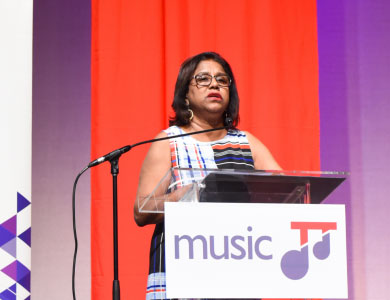
Senator the Honourable Paula Gopee-Scoon, Minister of Trade and Industry, delivers the feature address at MusicTT’s National Stakeholder Engagement event. Photo Credit: Epidemic Studios
MusicTT to Strengthen Industry Infrastructure with MTI Support.
At its second annual National Stakeholder Engagement event on Monday 30th October, 2017, the Trinidad and Tobago Music Company Limited (MusicTT) elaborated on several flagship projects that will build and strengthen the infrastructural capacity of Trinidad and Tobago’s music sector, thereby laying the foundation for long-term commercialization. Over 200 music creatives were present at Queen’s Hall to learn more about Trinidad and Tobago’s first Live Music District in the City of Port of Spain, The Artist Portfolio Development Programme and its training arm, the Music Export Academy, and the Music Tech Platform.
Endorsing these projects was Senator the Honorable Paula Gopee-Scoon, Minister of Trade and Industry, who not only disclosed the strategic alignment of these projects to the critical industry success factors suggested by stakeholders, but also reaffirmed Government’s support of the creative industries as a priority sector in the national diversification thrust. “This prioritisation is indeed warranted as the creative industry possesses great potential to generate increased revenue and employment, earn foreign exchange and create export opportunities in international markets for creative products and services,” Minister stated.
Her sentiments were echoed by Chairman of the Trinidad and Tobago Creative Industries Company Limited (CreativeTT), Mr. Calvin Bijou. “As a nation, our sustained economic well-being rests with effective diversification; and effective diversification rests with clear, thoughtful and deliberate strategy.”
General Manager of MusicTT, Ms. Jeanelle Frontin, then outlined the implementation timelines and expected outcomes for each flagship project, beginning as early as December 2017 with a public music showcase; the first stage in the Artist Portfolio Development Programme. Frontin also spoke to the importance of working together to ensure industry success. “We aren’t doing this alone. We are doing this collaboratively with the Ministry of Tourism, the Ministry of Community Development, Culture and the Arts and the city of Port of Spain. We are not working in a silo anymore. We are all going to work together to ensure that this music industry becomes more successful,” Frontin urged stakeholders.
Further information on MusicTT initiatives in the coming year can be found on MusicTT’s website, www.musictt.co.tt.
Minister of State, Mr. Joseph Harmon addressing the staff and Managers of the EPA at their retreat yesterday.
Minister Harmon calls on EPA for more focus on technical expertise, environmental management.
Minister of State, Mr. Joseph Harmon, who holds responsibility for the Department of Environment (DOE) under whose purview the Environmental Protection Agency (EPA) falls, yesterday, called on the agency to place greater focus on concrete research to guide environmental management in new and developing sectors such as oil and gas, towards the generation of technically defensible position.
The Minister said that emphasis should also be placed on technical expertise and environmental management as he noted that mechanisms to promote the implementation of low impact methods, technology and infrastructure and to address or monitor transboundary movement of pollutants are necessary. The Minister was at the time delivering the feature address at the EPA’s one day Staff Retreat and Capacity Building Workshop at the Mainstay Resort.
“Some of the positions taken by Government are challenged by some local experts and they are also challenged internationally. So you will find them challenging the technical competence of the EPA in the decisions that they make so that when you make a determination, we have to be satisfied that the technical basis of that determination is sound and that we can defend it anywhere in the world. That is why it is very important that we develop technically defensible positions in what we do. Also, your plans should not only be geared toward execution but also to the development of mechanisms to strengthen and enabling framework for execution,” he said.
Minister Harmon noted that through this process, ideas for policy, legislative, institutional and procedural reforms should be generated and not only for the EPA but also for the related sectors. “What I am saying is that the processes and the policies, which you generate must not only be seen as regulating internally, the EPA mechanisms, but the other sectors that are required to do things, which impact on the environment must also determine the way they act. So it is important for you to have very clear, very strong polices, which are defensible and is defensible because it is technically sound and we have competent people who are actually doing that,” he said.
The Minister said that since the establishment of the EPA, it has been one of the key agencies responsible for managing and safeguarding Guyana’s environment and biodiversity. The agency along with the Wildlife Conservation and Management Commission, the National Parks Commission and the Protected Areas Commission, are all positioned within the DOE, as the gatekeepers of the environment and it must, therefore, take that role seriously.
He noted that as an agency under the DOE, the EPA’s role is central to guiding Government, private sector and civil society towards striking a balance between the exploitation of the nation’s natural resources and environmental stewardship, thus the execution of the functions of the agency to ensure conservation protection and sustainable use of Guyana’s natural resources and the established, managed and enforced environmental regulations are key elements in pursuing sustainable development and securing the nation’s patrimony.
In this regard, he commended the agency for its recent restructuring programme, where the organisational structure has been amended to target and address through separate programme areas, all aspects of environmental management. It is part of strategic planning, he said, which is needed to take the agency forward. “I see and have been informed that these will include waste management, ecological and human health risk assessment, lands and terrestrial resource management, environmental analysis service, air quality management, water quality resource management, biological, coastal and marine resource management, and environmental communication and education and awareness. This restructuring was needed and was very timely and by this, you have established the framework for the development of a strategic plan for the agency, which I see as the main focus of your retreat. Your strategic plan must be one, which generates targets, clear timelines and annual work plans that guide the implementation of work within the EPA,” he said.
Minister Harmon noted that the EPA is, therefore, an important, not only in safeguarding the nation’s resources, but it is imperative to that success of Guyana’s progression towards becoming a ‘green state’.
Meanwhile, Ms. Ndibi Schwiers, Head of the DOE, in her brief remarks, said that planning strategically, which is necessary for the effective functioning of the EPA cannot be seen as a stand-alone target. She noted that in order for the Agency to achieve its objectives, it also requires the staff to get into the habit of ‘visioning’ so that the issues, which fall under its purview, can be adequately addressed.
“This Retreat comes at a time when President David Granger has stated that Guyana will become a ‘green’ state, at a time when the Ministry of Health has reported 200 new cases of cancer for this year, at a time when the mining sector is on track of reaching its target, at a time when major infrastructural works are planned and ongoing, when more housing schemes are being built and at a time when the oil and gas sector is emerging. The environment is a common theme in all of the above. As the principal environmental agency in the country, the EPA has to position itself to be on the frontline of development for the maximisation of benefits at the minimisation of risks to economic development and the EPA has to formulate up to date plans and policies based on knowledge to protect and improve the wellbeing of all Guyanese,” she said.
Dr. Patrick Williams, Chairman of the Board of the EPA, in his remarks, said that it is his hope that the Agency will now recognise that it cannot be business as usual and the EPA must not adapt and change it approaches.
“We have a responsibility to current and future generations and we must be able to bequeath to our future generations, not just things that make them happy but which can improve their lives and livelihoods. The EPA has that responsibility. While helping to management of the environment it has a role to play in the development of Guyana and we must be able to see the development in that manner… We have committed ourselves as Board to be able to change the organisation to meet the needs of the society,” he said.