

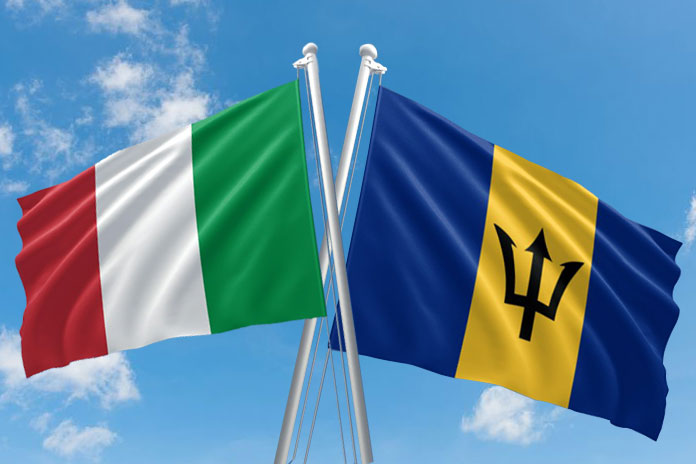
The exchange of instruments of ratification between Barbados and Italy to effectively conclude a Double Taxation Agreement was among the highlights of a visit to Barbados by Italy’s Special Envoy for the Caribbean, Paolo Serpi.
Ambassador Serpi and Minister of Industry, International Business, Commerce and Small Business Development, Donville Inniss, officially exchanged the instrument, which was first signed in August 2015, during a courtesy call at Parliament yesterday.
During the meeting, the envoy mentioned several areas of cooperation, including fashion design, agriculture, renewable energy and climate change.
Ambassador Serpi signalled his country’s intention to work more closely with CARICOM on the development of the fashion industry, as well as other areas to advance the social and economic development of both countries.
In turn, Mr. Inniss expressed his interest in that project, which he believed had the potential to strengthen the work at the Barbados Community College, where there was existing infrastructure and the teaching of some of the foundation courses in fashion.
He added: “We have always looked to Italy in the area of fashion, design and technology. Many Barbadians have benefited from the opportunities available by the Italian Government and Italian institutions to further their skills particularly through the Barbados Investment and Development Corporation.”
Regarding cooperation in agriculture, the Minister mentioned the University of the West Indies’ programme to transform the agricultural sector from farm to market, with the assistance of the Italian Government, by using the pelt of Black belly sheep to produce high-quality product.
Read More
Barbados and Italy pledge to strengthen ties
SLBS and CROSQ in joint Consultation

Saint Lucia will be the venue for a consultation organized jointly by the CARICOM Regional Organization for Standards and Quality CROSQ and the Saint Lucia Bureau of Standards SLBS on the Draft CARICOM Regional Energy Efficiency Building Code (DCREEBC). The code which was circulated to regional national standards bodies for comment will be discussed in a workshop with industry stakeholders.
The consultation has as its objectives;
To provide stakeholders with background information on the standard and the rationale for its development.
- To familiarize stakeholders with the technical content of the standard.
- To document stakeholders’ critical input into the standard for the consideration of the Electrical and Electronics Technical Committee
- To make stakeholders aware of the impact of such a standard which may become a regulation
The stakeholders for discussion of the draft code will include construction and engineering professionals, regulators, consumer representatives, policy makers and other industry interests.
The stakeholder consultation will take place on Thursday 19th October 2017 at the Bay Gardens Hotel from 9:00am.
For further information on this subject please contact Virnet St. Omer-Fontenelle at 453-0059 or 720-8756.
Read More
No New Reported Cases of Ciguatera Poisoning

The Ministry of Health would like to notify the public that over the last two months no new cases of Ciguatera Poisoning have been reported by consumers. It is believed that this random and unusual outbreak has concluded.
Although the Ministry considers the barracuda fish may be safe to consume once again, the public is advised to continue monitoring their eating of fish and report any symptoms of fish poisoning. This will allow the detection of any future outbreaks by the Ministry of Health and provide the necessary public health response in a timely fashion.
Symptoms of the poisoning may include tingling and numbness in fingers and toes, around lips, tongue, mouth, and throat; upset stomach, vomiting, diarrhea and/or abdominal cramps, joint pains, headache, and difficulty breathing.
Read More
Changes in petroleum prices – October 2017

The General public is hereby informed that, effective, Wednesday October 18th, 2017, the retail prices of petroleum products (Gasoline, Diesel, Kerosene and LPG {Cooking Gas}) in the State of Grenada will be as follows:
Grenada: |
||
| Products | Old Price | New Price |
| Gasoline | $15.02/IG | $14.47/IG |
| Diesel | $13.29/IG | $13.53/IG |
| Kerosene | $8.18/IG | $8.06/IG |
| L.P.G (Cooking Gas): | ||
| 20 lbs Cylinder | $42.00 | $40.00 |
| 20lbs Cylinder (Petrocaribe)* | $37.00 | $37.00 |
| 100 lbs Cylinder | $201.40 | $199.60 |
| Bulk | $2.10/lb | $2.10/lb |
Carriacou |
||
| Products | Old Price | New Price |
| Gasoline | $15.20/IG | $14.65/IG |
| Diesel | $13.47/IG | $13.71/IG |
| Kerosene | $8.37/IG | $8.25/IG |
| L.P.G (Cooking Gas): | ||
| 20 lbs Cylinder | $49.00 | $49.00 |
| 20lbs Cylinder (Petrocaribe)* | $46.00 | $46.00 |
| 100 lbs Cylinder | $224.40 | $222.60 |
| Bulk | $2.10/lb | $2.10/lb |
Petite Martinique: |
||
| Products | Old Price | New Price |
| Gasoline | $9.70/IG | $9.15/IG |
| Diesel | $7.97/IG | $8.21/IG |
| Kerosene | $8.37/IG | $8.25/IG |
The new Retail Prices are computed based on the average FOB costs: that is; (Ex-refinery prices), for the period, 15th September, 2017 to 15th October, 2017.
Consumers are encouraged to immediately notify the Price control/Consumer Affairs Unit in the Ministry of Finance of any instance of overpricing at telephone number 440-1369.
No further escalation of Industrial Action

Prime Minister expects no further escalation of Industrial Action.
Both the PWU and the TAWU instructed their members to remain at home on Monday, October 16 and Tuesday 17, in a move the Government Negotiating Team said is disappointing, because of the unions’ rejection of the Minister of Labour’s mediation efforts, regarding one-off payment to Public Service Employees.
During the Government’s weekly Post-Cabinet Briefing, Prime Minister Mitchell pointed out that in addition to honouring a commitment of the previous government and meeting salaries on time, his Government has paid an additional $106 million to public service workers and there is another $4 million being committed.
However, with the public workers asking for an additional nine million, the Prime Minister said they must be concerned about all workers, and not just one group.
“I do not see how the Government can continue to meet the responsibility to one set of workers in the country, while others are not able to have anything. So, you mentioned the fact that the country is going to suffer. My own reading of things is that people are beginning to understand what is taking place. I was at the Ministry of Finance a while ago. Our revenue base is intact. People are working.
The leadership is there doing their work. The few areas that had misunderstanding appear to be clarified, at this point in time, and I don’t see the impact that some people may have wanted to see for whatever reasons. I don’t see it occurring. So, I am very hopeful that common sense will prevail and that we will see an end to this impasse that appears to be occurring, at this particular time.”
Prime Minister Mitchell said his government cannot, in good conscience, ignore the needs of others in the country who also require assistance.
“The Government went way beyond its means. We have, my dear friend, we have the young people still out there without jobs. What do I do, forget them, as Prime Minister?” He asked. Continuing, the Prime Minister said, “A few weeks ago, Prime Minister Skerrit went to Barbuda and gave relief to Barbudans, water and everything.
Today, he needs more than that in Dominica. There are people whose homes are still wetting when rains falls in this country. Should I forget them?
Don’t give them anything; don’t give them a piece of board, but just give more and more and more? I can’t. I can’t. My conscience would not allow me to do it and I think anyone who has a conscience will not proceed to want that to happen.”
Caribbean region offers prime location for BPO services
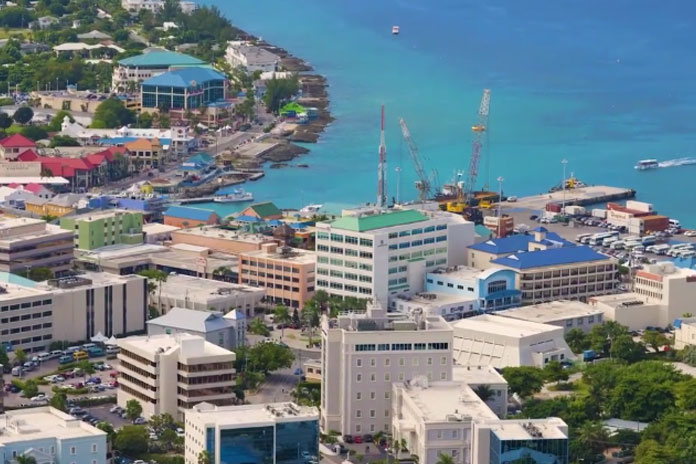
The global market for business process outsouring (BPO) is currently valued at USD $1 trillion with cross-border outsourced services trade between countries estimated at US$88.9 billion per year in 2015. The Caribbean is carving out its niche within this global
industry with the number of BPO operators and jobs growing exponentially. One company that’s thrived since outsourcing to the Caribbean is the Dutch owned company Cimpress (Vistaprint).
Vistaprint Jamaica Ltd. began operations in Montego Bay in 2003 to provide contact centre services for Cimpress (Vistaprint), a company based in the Netherlands which specialises in the mass customisation of marketing materials and web-to- print systems. By 2008 Vistaprint Jamaica was the first subsidiary of Cimpress (Vistaprint) to have a dedicated graphic design services unit. Between 2010 and 2012 it had some 600 employees and had constructed a state of the art customer service facility worth USD$25 million.
With the growing trend to outsource business processes to nearshore markets, and, governments, business representatives and other stakeholders throughout the Caribbean are seeking to capitalize on the potential economic benefits afforded by this sector.
Over 100 stakeholders will meet later this year in Jamaica to explore various avenues to secure BPO investment and to demonstrate to potential investors the advantages of doing business in the Caribbean.
Caribbean BPO services providers, government officials, telecommunications firms and training institutions will come together at the first-ever Outsource to the Caribbean Conference (OCC) which will take place on December 6, 2017, at the Iberostar Rose Hall Beach Hotel in Montego Bay. The Conference, which is organised by the Caribbean Export Development Agency in conjunction with the Caribbean Association of Investment Promotion Agencies (CAIPA) and the Jamaica Promotions Corporation (JAMPRO) will be held under the theme “Leveraging the Nearshore Caribbean for Outsourcing Services”. OCC2017 is being funded in part by the EU via the 11 th European Development Fund (EDF) and comes at a time when the Caribbean region is emerging as one of the most attractive
destinations for BPO.
Prime place for international companies to invest and outsource
Chief Executive Officer of Caribbean Export, Pamela Coke Hamilton, explained why the Caribbean is the prime place for international companies to invest and outsource their services. “The Caribbean is a reliable business partner; it has one of the lowest perceived risks in the Latin America – Caribbean region, is politically stable with well-functioning institutions, efficient government and low levels of corruption. The overall regulatory system is conducive to business activities.”
The President of CAIPA, Ms. Diane Edwards (who is also the President of JAMPRO) pointed out that the Caribbean’s geographic location makes the region a perfect gateway to markets in North, Central and South America. “And with the growing need for mainland North American firms to outsource functions to a competitively priced and easily accessible destination, the Caribbean is well positioned as a nearshore solution.”
According to Edwards, the region is also well placed to offer services to not only North America, but also Europe and South America, given the strong multi-lingual talent pool in the region. Ms. Diane Edwards also posited that beyond the talent pool, companies outsourcing business to the Caribbean have a wealth of other advantages. These include a supportive regulatory framework with many territories offering special economic zones where service providers can benefit from reduced tax benefits; low real estate costs and a cost efficient infrastructure, allowing for low operational costs. “The Caribbean,” she concluded, “has ably demonstrated, time and again, that it has much to offer.”
Impressive growth in BPO industry
For the past 15 years, the sector has grown exponentially thanks to the telecommunication liberalization in the early 2000s. This accelerating growth is expected to continue over time, with Caribbean destinations attracting more BPO investment.
Ms. Coke Hamilton noted that a 2015 study of nine selected countries in the region had revealed that the Caribbean BPO industry was comprised of more than 200 delivery centres and 74,000 agents, showing an increase of 44,700 workers in only five years.
“During this period the industry has grown at an impressive Compound Annual Growth Rate (CAGR) of 17%. BPO and other professional services generated over US$2 billion in revenue in 2014 and research shows that companies in the region generate close to US$25 million in revenue for every 1,000 agents. Additionally, the level of profit is around 7% for call centres and close to 15% for non-voice, back-office shared services,” she noted.
Securing investment beyond voice-based services
Another BPO company which is steadily growing and attracting investment from international companies is the Barbadian software startup, Simplified Apps. This business developed several web and mobile software applications for large organizations and for multiple markets and is focused on developing a cluster of software driven subsidiary startups that are able to strategically integrate and share resources.
Chief Executive Officer, Curtis Padmore, explained that the business was successful in attracting large organizations as customers for the software developed by his teams, pointing out that one such satisfied international investor was BlackBerry.
Speaking to the importance of BPO in Barbados, he noted: “I believe the BPO that best fits (Barbados), is where the intellectual property is created and owned in Barbados [and then] monetized, targeting offshore customers.” The young entrepreneur recently started another BPO company which will “allow Simplified Apps to structure as an umbrella company, leveraging its resources to accelerate the growth of the new startup.”
Part of the OCC2017 strategy for attracting BPO to the region is to secure investment beyond the usual voice-based services like contact centres. The focus will now also be on additional opportunities like Back Office Automation; Shared Services; Finance and Accounting; Human Resources; Legal Processes; Animation Services; Graphic Design; Web Design; and Data Entry Services.
Senior Advisor, Investment Promotion, at the Caribbean Export Development Agency, Suzette Hudson, is of the opinion that business persons who work in those sectors should attend OCC2017. “Participants will be able to network and gain some insight into regional offerings and the service possibilities available through an impressive programme of plenaries and one-on-one engagements,” she noted.
The Senior Advisor also discussed what persons attending the conference should expect. Prior to the main event a welcome reception for participants as well as the Regional Investor of the Year Awards will take place on December 5. The following day on December 6, activities will include a session on Outsourcing Trends for the Next Decade: Opportunities for the Caribbean; a discussion on the Caribbean Talent-pool; business-to-business meetings; and the sharing of Caribbean success stories. On December 7 a tour of BPO facilities in Jamaica will be conducted.
Read More
CZMAI: Coastal Environmental Management Workshop
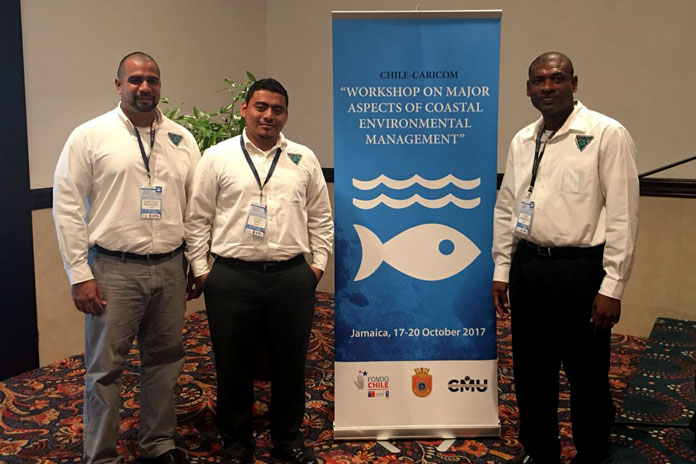
Coastal Zone Management Authority and Institute participates in the Major aspects of the coastal environmental management Workshop.
Representatives of Coastal Zone Management Authority and Institute (CZMAI) will be participating in the workshop “Major aspects of the coastal environmental management” to be held from 17th to 20th October in Kingston, Jamaica. The Workshop will include four days of theoretical and practical sessions to acknowledge the main sources of marine pollution in each country of the Caribbean Community. Its purpose is to develop a proposal of an environmental management instrument intended to improve marine environmental conditions of the participating countries.
Staff from CZMA’s technical programs which includes: Mr. Samir Rosado (Coastal Planner), Mr. Gilbert Andrews (Environmental Lab Technician), and Mr. Victor Sho (Sport Fishing Coordinator) will engage in the workshop through assisting to the developing proposals that will better the Caribbean communities’ marine environmental conditions. By doing this, CZMAI intends to harbor awareness to occurring marine pollutions.
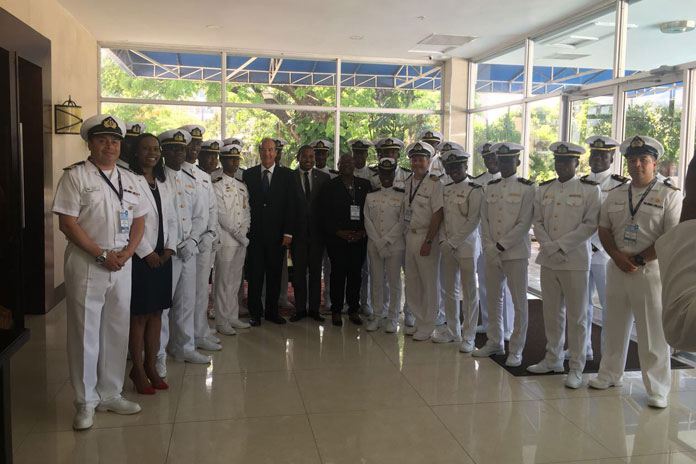
The “Major aspects of the coastal environmental management” workshop is officially recognized by DIRECTEMAR. The Caribbean Maritime Institute has sponsored this workshop, it will take place under the scheme of the cooperation agreement between the Directorate General of the Maritime Territory, Merchant Marine and the “Fondo Chile” (CHILE/UNDP). The overall objective of this workshop is to implement technical cooperation for the Caribbean Community (CARICOM), dealing with Conservation and sustainable use of the oceans, seas and marine resources.
For more information about Coastal Zone Management Authority and Institute, please visithttps://www.coastalzonebelize.org/ and/or Follow us on Facebook.
Caribbean and Japanese Youth Confront Climate Issues
Caribbean and Japanese youth confront climate issues at Youth Climate Change Conference.
Caribbean and Japanese youth have put forward their recommendations for climate-smart actions for the region following two days of intense dialogue between October 10-11, 2017 at the third staging of the Youth Climate Change Conference at the Jamaica Conference Centre.
The two-day event themed “Our Climate, Our Voice, Our Change – Advancing Partnerships for Global Impact” saw over 600 participants from over 60 high schools and youth organizations from Jamaica, the Caribbean region and Japan propose solutions to combat climate change.
The conference opened with a youth Conference of the Parties with nine youth delegations from Belize, Dominica, Grenada, Guyana, Jamaica, Saint Lucia, Saint Vincent and the Grenadines, Suriname and Japan presenting country reports and recommending youth led actions to climate change.
Youth draft statement on climate change
The recommendations which have been collated into a youth statement, ranged from research, capacity building, youth activism, policy and legal/regulatory framework needs, including: incentivising programmes to promote youth interest and involvement, particularly through educational opportunities; youth involvement in ongoing respective country research as required by the UNFCCC; active participation of youth in policy decision making, establishment of youth arm in ministries with specific responsibility for climate change, developing a social audit toolkit to assess the social and ethical performance of initiatives in tackling climate change; advocating that infrastructure and building codes mandate the use of sustainable and renewable sources of energy, such as the use of solar power, wind power, and geothermal power, with tax exemptions for those who comply, and mandatory fines for those that do not comply, by the year 2020. (This applies to new infrastructure built or commissioned after 2020).
Other activities at the conference included community and policy level advocacy trainings which benefitted some 60 attendees on day one. The conference also included an all-day exhibition and visual and performing arts competitions. Saint Lucia and Japan were among the international winners, with the former finishing second and third in the poetry competition and Japan finishing third in the poster competition. Jamaica’s May Day High
School copped the coveted champion school award for top participation across several competitions.
“It is conferences like this one that equip young people with the facts they need to champion the cause of combating climate change. After both days, I left empowered and inspired to be a part of the change the world needs to see. I believe I speak on behalf of all youth delegates when I say it was a fulfilling experience and we are now ready to vehemently put forth our proposals to our governments and Heads of State”, said Shanielle Allen, member of the Jamaica delegation in her reflection of the proceedings.
Shanika John of the St. Vincent and the Grenadines delegation held a similar sentiment. She noted that the next step is for each delegation to convey information to relevant stakeholders and authorities. Ms. John further explained that she now has a greater understanding of regional negotiations but maintained that there’s a need for consistency and determination so that results are realised. UNDP J-CCCP will support the participation of two persons from the Dominica and Jamaica delegation in COP23.
The conference is a joint initiative between the USAID-funded Jamaica Rural Economy and Ecosystems Adapting to Climate Change II (Ja REEACH II) Project, the United Nations Development Programme’s (UNDP) Japan-Caribbean Climate Change Partnership (J-CCCP) Project and the Government of Jamaica.
Read More
CDB new cycle of poverty reduction programme
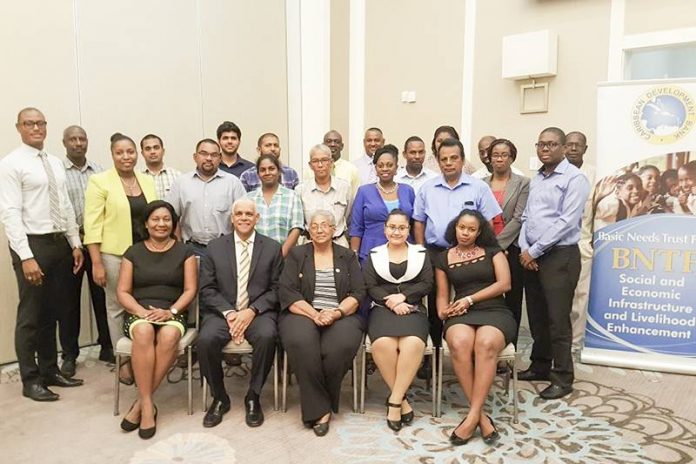
CDB unveils plan for new cycle of poverty reduction programme.
The Caribbean Development Bank’s (CDB) poverty reduction flagship programme, the Basic Needs Trust Fund (BNTF) has unveiled an ambitious plan for its ninth cycle. The Bank has negotiated more funds for the BNTF, taken steps to improve the programme’s efficiency and effectiveness, and will strengthen partnerships with the private sector.
These innovations are being outlined to BNTF stakeholders during a series of project launch workshops, which are taking place in the nine participating countries, where stakeholders will also receive guidance on implementing the new cycle.
CDB’s Acting Portfolio Manager for BNTF, George Yearwood, said the countries stand to benefit from a grant allocation of USD 40.8 million, which could be boosted by funding secured through private sector partnerships.
“CDB has negotiated increased contributions for the Special Development Fund, to secure grant resources for BNTF sub-projects to tackle poverty in the Region. Also, the Bank will seek to leverage additional resources through partnerships with the private sector, charities and other civil society organisations,” said Yearwood.
He also noted that Country Projects found to be performing well during the mid-term review may be in line for additional funding.
“The funds from BNTF are to be carefully targeted through an evidence-based Country Policy Framework or action plan which responds to poverty, particularly in rural areas. And, CDB has set aside an incentive amount of USD 5.2 million, which will be distributed at mid-term based on project performance,” added Yearwood.
Other changes designed to improve the efficiency and effectiveness of the BNTF programme and to accelerate social transformation include:
- restructuring of implementing agencies in some countries;
- expansion of the areas of support to include livelihoods enhancement;
- shortening the process flow from identification to implementation;
- increasing the upper limit of a sub-project’s cost to USD1 million;
- improving CDB’s internal processes for sub-project appraisal and approval; and
- introducing new tools for enhanced monitoring and evaluation.
Project launch workshop were held in Saint Lucia on October 4 and 5, and in Guyana on October 9 and 10. Other launches already scheduled include Jamaica on October 17 and 18; Belize on October 23 and 24; Grenada on November 7 and 8, and Suriname on March 30 and 31, 2018.
BNTF’s ninth cycle was approved in March 2017, and will run until December 31, 2020. Under the eighth cycle, BNTF allocated USD 12.388 million for supporting projects in Belize, Dominica, Grenada, Guyana, Jamaica, Montserrat, St. Kitts and Nevis, Saint Lucia, St. Vincent and the Grenadines and the Turks and Caicos Islands.
Barbados Visual Media Festival Media Launch

You are invited to the Media launch of the 4th annual Barbados Visual Media Festival.
Date: Wednesday October 18, 2017
Time: 1:30pm
Location: Conference room of Building #2, Harbour Industrial Park, Bridgetown, St. Michael (entrance opposite Oran’s entrance).
The Barbados Visual Media Festival
This year, the previously month-long festival will be condensed into an action-packed fast paced six day affair between October 24th-29th, 2017. The Barbados Visual Media Festival is an initiative of the Barbados Film and Video Association. Its objective is to celebrate the work of local, regional and international independent film makers while being a catalyst for the development of the Barbadian visual media industry.
The Barbados Film and Video Association
Founded in 2008, the Barbados Film & Video Association seeks to bring together individuals involved in the art and science of filmmaking. Its main objective is to work with stakeholders in order to build a film industry in Barbados supported by all aspects of visual media. The association seeks to do so through advocacy, training and by the hosting of the Barbados Visual Media Festival.
Feel free to reply to this email if you have any queries.
Damien Pinder
President
Barbados Film and Video Association
Mobile: 232-6835