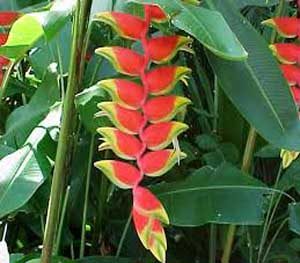
Forestry, wildlife and parks employees are now more knowledgeable on the subject of hummingbirds and heliconias (lobster claw flowers or balisier) of the Lesser Antilles.
On Friday, May 20th officers attended a lecture headed by ecologist, Ethan Temeles, who is a professor of biology and environmental studies at Amherst College in the United States.
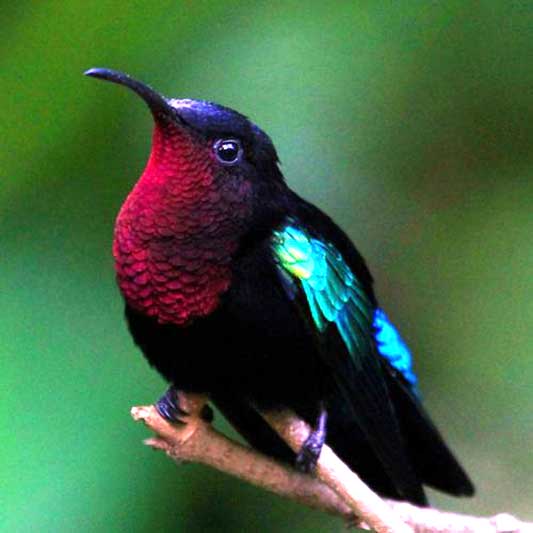
He presented his research on the purple-throated carib hummingbirds and their food plant, heliconia.
“The males and females of the species have very different bill sizes and shapes. The male bill is short and straight while the female is much longer and curved. The work which I’ve done shows that each sex is specialised for feeding at and pollinating one of two species of heliconia food plants. This is probably the best example of the world of the sex difference driven by feeding ecology more than anything else,” he reported.
The function was also attended by Director of Forestry, Wildlife and Parks, Minchinton Burton, local environmentalist, Arlington Jamesand others.
Professor Temeles describes what brought his studies to Dominica.
“I came to Dominica because of all the islands in the Lesser Antilles, Dominica is the most pristine. It has the moist natural rainforest remaining on it and the most natural cloud forest. Having studied these animals on islands where there was a great deal of disturbance; where people had cut down forests and planted bananas and resorts, I wanted to study them in a location that was more untouched. I have to say that the care that people have for Dominica, keep it that way. You don’t realise how unique it is until you to go the other islands.”
He stated that Dominica has received attention from the scientific community as a result of the research.
“By doing studies on this hummingbird and its food plant, we have been filmed by the BBC and Nature PBS. They have made films on that and shown them in both Britain and the United States. Every time they are raising money for the channels in the US, you see a purple-throated carib on TV. As a result of this, people elsewhere become aware f what Dominica has; that this bird is here and people want to see it and know about it.
“The work I’ve done has made it into textbooks in the United States, there’s a permanent exhibit on this animal in the national museum(s) of the United States because of its importance. It really has tremendous importance to the scientific community in terms of a sex difference driven by ecology and how the plants are adapted for the birds. So it really is unique and Dominica has more of them than anywhere else,” he explained.
The purpose of the observance is to raise awareness on the world’s biodiversity issues.
The International Day for Biological Diversity was recognized yesterday.
Biodiversity Coordinator at the Ministry of Sustainable Development, Energy, Science and Technology, Jannel Gabriel, said the purpose of the observance is to raise awareness on the world’s biodiversity issues.
“We all know what biological diversity is. Biodiversity is all the plants, all the animals, all the microorganisms, but this year we are asking why do we care about biodiversity? This year’s theme involves mainstreaming biodiversity, sustaining people, and their livelihoods. So we will get an opportunity to not just appreciate biodiversity but to also look at how we use it to sustain us and also for many, many different kinds of livelihoods, including agriculture, food production, fisheries, forestry, tourism. As part of our celebrations we will be featuring livelihoods that involve biological resources.”
A variety of careers dependent on biological diversity were highlighted at an event hosted in front of the Sir Stanislaus James Building on Friday, May 20.
“These included tour guides who conduct bird and turtle watching tours; persons making wine with local plants, for instance, the Latanye plant which is used to make wines as well as brooms; and persons who make shakes, smoothies, food items, punches all using biological, naturally and locally available goods,” Gabriel said. “There was also a section of fine boutique items such as handmade soaps, handcrafts, jewelry, souvenirs and fine chocolates that were locally made using local cocoa products.”
The United Nations General Assembly, in the year 2000, named May 22 the International Day for Biodiversity.
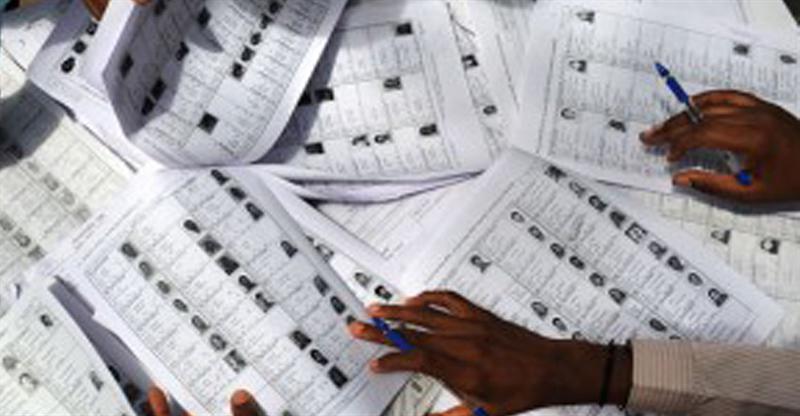
The list will be made public at community post offices, libraries, electoral sub offices, and also via the electoral department’s website.
The Electoral Department is busy finalizing the voters list following Prime Minister Dr. Kenny D. Anthony’s recent election date announcement.
Voters will go to the polls on June 6 to elect a government.
Civic and Voter Education Coordinator in the Electoral Department, Alymphia Lionel, said the priority now is to finalize and publish the voters lists by the end of May.
“The final voters list should be out by May 30 and it will be posted in all communities, on public buildings, post offices, and the Central Library. We’re going to have it on our website, and at all our sub-offices such as Gros Islet; Grande Riviere, Dennery; and Soufriere, and you can check the main office on High Street,” she said.
Last Thursday, Dr. Anthony announced that Parliament was dissolved to pave the way for the upcoming general election.
“Fellow Saint Lucians, the die is cast. Decision time has arrived. Today, I advised the Governor General to dissolve the Parliament of Saint Lucia, and to issue Writs of Election to pave the way for the general election. The general election will be held on June 6, 2016. Nomination day will be May 27, 2016.”
General elections are constitutionally due, for the latest, three months after the first sitting of Parliament, which was held on January 5, 2012. The government would have had until April 5, 2017 to call the next election.
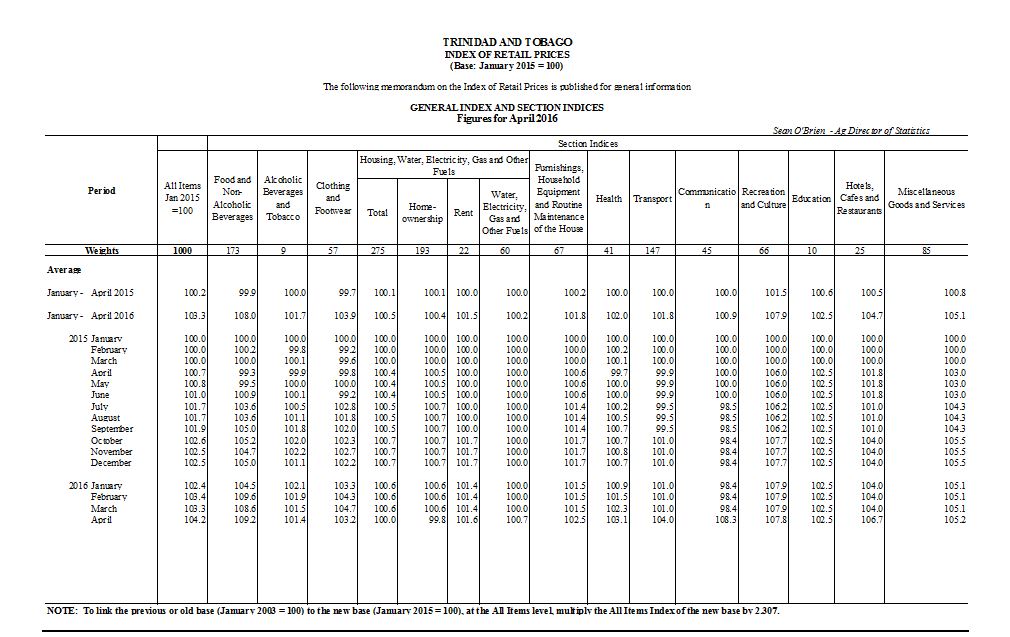
May 23, 2016:The Central Statistical Office is pleased to announce the release of the Index of Retail Prices for the month of April 2016. The information is based on data collected in the survey of retail prices during the month of April 2016.
Index of Retail Prices
The Index (All Items) was 104.2 in April 2016 from 103.3 which was recorded in the previous month (March 2016) as shown in the table attached.
The Index for Food and Non-Alcoholic Beverages increased from 108.6 in March 2016 to 109.2 in April 2016, reflecting an increase of 0.6%. Contributing significantly to this increase was the general upward movement in the prices of fresh whole chickens; garlic; grapes; celery; pumpkin; carbonated soft drinks; other edible oil; parboiled rice; macaroni; and mixed fresh seasoning. However, the full impact of these price increases was offset by the general decrease in the prices of fresh carite; tomatoes; Irish potatoes; fresh, chilled, frozen or seasoned beef; bodi; fresh king fish; fresh crab; fresh shrimp; biscuits; and oranges.
A further review of the data for April 2016 compared with March 2016 reflected an increase in the sub-indices for Furnishings, Household Equipment and Routine Maintenance of the House of 1.0%, Health of 0.8%, Transport of 3.0%, Communication of 10.1%, Hotels, Cafes and Restaurants of 2.6% and Miscellaneous Goods and Services of 0.1%. However decreases were noted in the sub-indices for Alcoholic Beverages and Tobacco of 0.1%, Clothing and Footwear of 1.4%, Housing, Water, Electricity, Gas & Other Fuels of 0.6%, and Recreation and Culture of 0.1%.
Inflation Rate
The Inflation Rate for April 2016 (measured as the percentage change in the Index for January to April 2016/January to April 2015) was 3.1%. This represents an increase from 3.0% which was recorded in the previous period (January to March 2016/January to March 2015). The Inflation Rate for the comparative period (January to April 2015/January to April 2014) was 6.3%.
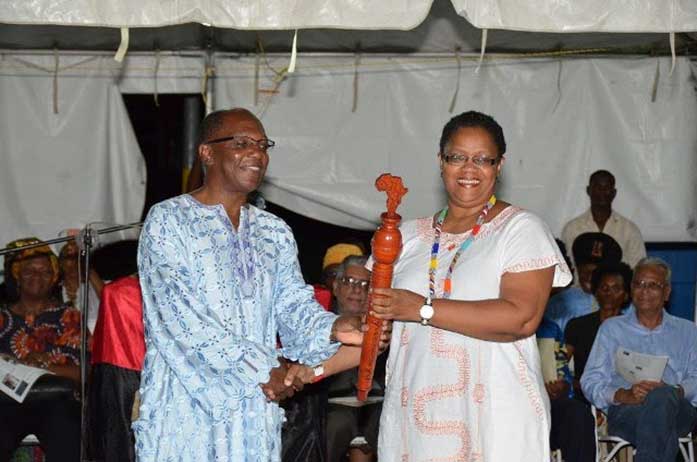
Programme Manger Culture and Community Development at the CARICOM Secretariat, Dr. Hillary Brown accepts the reparations baton from Chairman of the Guyana Reparations Committee Mr, Eric Phillips during the launch of the Guyana International Youth Reparations Rally and Relay on Friday evening.
(CARICOM Secretariat, Turkeyen, Greater Georgetown, Guyana) The Guyana Reparations Committee on Friday launched its leg of the International Youth Reparations Relay and Rally with an event at the Guyana Independence Park.
Speakers at the launch included President of Guyana H. E. David Granger and Chairman, Guyana Reparations Committee, Mr. Eric Phillips.
In his keynote address, President Granger said the call for Reparations was serious business and not a side show. He said the Trans-Atlantic Slave Trade was one of the greatest un-natural disasters of all time and a crime against humanity.
“There was a crime but there was no punishment. There was a crime but there was no justice” the President said.
He said the people of the Region are looking to their leaders to bring about redress for their ancestors and it was with this in mind that the CARICOM Heads of Government accepted a draft Regional Strategic Operational Plan for reparations at their Twenty-Fifth Intercessional Meeting in 2014.
“The Caribbean Community has taken a firm and irreversible stand in the call for reparations” said President Granger.
He explained that the plan was not about money but was a holistic plan that was carefully thought out so that Caribbean children can have a better deal in the future. He said the Caribbean was not begging for handouts, sympathy or favours but was demanding reparatory justice for the greatest crime against humanity in the world.
Chairman of the Guyana Reparations Commission Eric Phillips, in his remarks gave a brief report on the work of the Guyana Reparations Committee, which he said has completed its reparations claim which will be presented to Guyana’s Attorney General for a resolution to be passed in Parliament. He said the Guyana Reparations Committee believes in social cohesion which must be built on justice and economic inclusion.
“We seek reparations and social inclusion because we believe in the immortal declaration that all men are created equal” he said.
Chairman of the CARICOM Reparations Commission Sir Hillary Beckles was represented by Member of the Guyana Reparations Committee Mr. Johnathan Adams who brought remarks on his behalf. Sir Hilary in his message said it was fitting that the reparations relay in Guyana was being held just days before the country celebrates its fiftieth anniversary of independence from British colonial rule. He said the valiant and timely struggle for reparations for the descendants of slaves and indentured labourers in Guyana and across the Region could be viewed as the next stage in the Region’s quest to consolidate its independence and sovereignty.
“Strengthening our nations’ independence and struggling for reparatory justice are inextricably bound to each other. Our struggle for reparatory justice is part and parcel to strengthen regional integration” Sir Hillary said.
The international Reparations Relay and Rally series is being hosted by the CARICOM Reparations Commission in collaboration with the CARICOM Members States which have committed to being part of the reparations movement. The Commission said it recognized that youth engagement was significant in the Reparations dialogue. The rallies are being held on days of historical significance in relation to slavery, the slave trade or native genocide in each Member State. A baton and torch are passed from the current Member State to the next one which will host the rally. The first leg was hosted by Barbados in April.
DAKAR, SENEGAL, 27th April, 2016. Ministers from the Eastern Caribbean countries of St. Kitts and Nevis and St. Vincent and the Grenadines attending the 103rd ACP Council of Ministers and 41st ACP-EU Joint Ministerial Council in Dakar, Senegal, from 25th -29th April, 2016, seized the opportunity to promote the concerns and interests of Eastern Caribbean Small Island Developing States (SIDS) at the high-level forum offered by the bi-annual intergovernmental encounter.
ACP Ministers met from the 25th -27th April, in the land of Teranga (Senegal) to shape decisions on issues of relevance to the intergovernmental block of 79 developing countries such as trade and commodities, development finance cooperation, private sector development, climate change and the deployment of the 11th European Development Fund (EDF) at the intra-ACP level. Equally high on the agenda was the discussion on the future of the ACP Group. This was followed by a two-day ACP-EU Council session where major issues were debated, such as migration, negotiations on the revision of the Cotonou Agreement, trade cooperation and the 2030 Sustainable Development Agenda. Preliminary joint reflections were engaged on the future of ACP-EU relations at a high-level event organized to that effect.
Honourable Lindsay Grant, Minister for Tourism, International Trade, Industry and Commerce and Consumer Affairs from St. Kitts and Nevis apprised ACP and European Ministers of concerns related to the blacklisting by the EU of many SIDS, including St. Kitts and Nevis, as non-cooperative tax jurisdictions, and strenuously defended the integrity of the country with respect to OECD transparency requirements, as it was ranked “among the best performers…in the area of observance of international standards on Transparency and the Exchange of Information on tax matters”. He called for the EU to bring closure to this situation through a proper review of the blacklist that, it is hoped, would lead to a removal of St. Kitts and Nevis from that list.
Minister Grant raised concern at the potential impact of the negotiations of the EU-USA Transatlantic Trade and Investment Partnership (TTIP) and called for a study to be conducted on the implications for small economies of this effort towards “liberalization among the great”. Minister Grant also seized the opportunity to appeal to the European Union to reconsider its use of GDP per capita as a criterion for providing financial support for exogenous shocks and proposed the creation of vulnerability and resilience indicators to adequately gauge the impact of natural disasters and exogenous economic shocks on SIDS. The Commission agreed to undertake research on that matter. Minister Grant further appealed that “the accumulation of variables” in order to benefit from funding for exogenous shocks, “must not … serve as an impediment to being able to access these funds when necessary.”
Using his presence in Senegal, Minister Grant sought to build on and engage in bilateral encounters with a number of African Foreign and Trade Ministers in order to develop linkages within resource-rich Africa and to draw out the unique value of potential partnerships in the ever increasing areas of joint interest. It was also in that context that Minister Grant was confirmed by the current Chair of ACP Council of Ministers from the Congo, in the name of the entire ACP Group, as the incoming Chair of the ACP Council of Ministers, on behalf of the CARIFORUM region. St. Kitts and Nevis’ chairmanship of ACP Council and ACP-EU Joint Council is expected to cover the period 1st August, 2016, to 31st January, 2017.
The Honourable, Sir Louis Straker, Deputy Prime Minister and Minister for Foreign Affairs, Trade, Commerce and Regional Integration of St. Vincent and the Grenadines, underscored to Ministers in Dakar the need for development cooperation to take into account the vulnerabilities of St. Vincent and the Grenadines including the impact of climate change and natural disasters on major industries of the Island including agriculture and tourism, and called for a review of the Banana Accompanying Measures (BAMs) and for special consideration within the 11th EDF intra-ACP programmes for the development of cashew nuts as a high value product.
Sir Louis Straker also called for the EU to pursue dialogue with countries that were served with a yellow-card under the EU’s Illegal, Unregulated and Unreported (IUU) Fishing Regulation, and to provide relevant capacity building measures both bilaterally and to the relevant regional institutions where fisheries are dealt with. The Honourable Minister also praised St. Vincent and the Grenadines’ active promotion of youth entrepreneurship fostered by the Youth Empowerment Service (YES) and Supporting Education and Training (SET) programmes, and called on the ACP to take seriously the need to share experiences among the ACP Group as it seeks to reposition itself as a relevant organization for its Member States.
On the issue of the Belize-Guatemala and Guyana-Venezuela border disputes which was brought to attention of ACP Ministers, Minister Straker made an eloquent call to prefer the peaceful resolution of the matters and provided support to resolutions submitted for endorsement. The major issue of the future of the ACP and future of ACP-EU relations was debated by Ministers as they received a report from the Eminent Persons’ Group set up to reflect on options for the Group’s future perspectives. Minister Straker underscored that though a “revamped ACP may not meet the needs of everyone, we need to take task of refining the organization seriously as it is one which we have long desired…and seek to maintain the unity and solidarity that are reflected in the Georgetown Agreement”.
The Eastern Caribbean States Ministers made substantive input in the decisions, resolutions and declarations coming out of the ACP Council of Ministers including on Commodities and Fisheries, financing for efforts to stem the impact of the Zika virus in the Caribbean, as well as border disputes affecting Caribbean countries. The Honourable Ministers formed part of a wider CARIFORUM group of Ministers present in Senegal from Barbados, Guyana, Haiti and Jamaica. ECS Ministers were supported by Mrs. Paula Hippolyte-Bauwens, advisor, from the Embassies of the Eastern Caribbean States in Brussels.
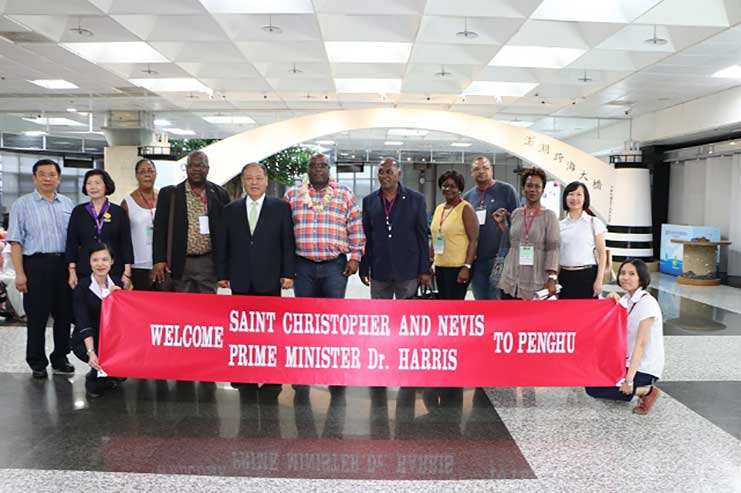
St. Kitts and Nevis delegation welcomed at Penghu Magong Airport
Penghu County, Taiwan, May 22, 2016 (SKNIS)—On May 22, Prime Minister of St. Kitts and Nevis, Dr. the Honourable Timothy Harris, and his delegation, paid a visit to Magong City, Penghu County, Taiwan, for the first time, where they were warmly welcomed at Magong Airport by Penghu County Magistrate, Kuang-Fu Chen and officials from the Penghu County Government.
The St. Kitts and Nevis delegation was then hosted by the Penghu County Government to an official dinner at the Four Points by Sheraton Hotel. Officials at the dinner included Director-General of Tourism Department, Mei-Ling Chen; Director of Civil Affairs Department, Chi-Chuan Hsu; Director of General Affairs Department, Shu-Shan Yun; Director of Economic Affairs Department, Hung Tung-Lin; Director-General of Agriculture and Fishery Bureau, Kao-Liang Chen; Director of Cultural Affairs Bureau, Hui-Shiang Tseng, and Director-General of Fire Bureau, Tien-King Yeh.
In welcoming Prime Minister Harris and his delegation, Mr. Chen said that he hopes that we “will have a very good stay” on the island. “Just like your country, Penghu is also a marine ocean island. We have beautiful coastal life and friendly people.”
Mr. Chen proudly declared that Penghu is a member of the International Organization of the Most Beautiful Bays in the World and will host the congress of the organization in 2018. “We invite you to attend the Congress of the Most Beautiful Bays in 2018,” he said to Prime Minister Harris and his delegation.
The Most Beautiful Bays in the World (MBBW) was established in 1997 and is headquartered in Vannes, France. The organization was founded by Jean Manquat, and is a UNESCO supported NGO tasked with promoting the protection of the natural and cultural resources of the world’s marine bays, including San Franciso Bay, Qingdao Bay and Vietnam’s Halong Bay.
Prime Minister Harris, who led the toast to the people of Penghu, lauded their hospitality.
“I want on behalf of my delegation and I to say how special we feel on this our first visit to Penghu,” Prime Minister Harris said.
“We have always enjoyed the warmth and the hospitality of the people of Taiwan and on this trip there is no exception. The support, the love, the admiration and care have been exceptional so far and we want to congratulate the good people and citizens of the Republic of China (Taiwan). Although we have visited many parts of Taiwan, this is our first visit to Penghu. I hear that Penghu is famous for its beauty, for its beaches and many culinary delights,” he said.
He added: “St. Kitts and Nevis, our home country, has relationships with Taiwan (The Republic of China) going back to 1983. The friendship is very strong and we are happy that we have over the years enjoyed a strong bond between the two governments and between the people of Taiwan and the people of St. Kitts and Nevis. Many of our students are here pursuing studies all over Taiwan. They have become the very able ambassadors of Taiwan at home.”
Prime Minister Harris went on to commend Mr. Chen and his team for working together to bring about the best quality of life for the people of Penghu County.
The St. Kitts and Nevis delegation while in Penghu will visit Penghu National Scenic Area Administration, the Marine Life Propagation Station, Kui Bisan Geological Park, Youth Activity Center of China Youth Corp and the Penghu Fireworks Festival. Areas for cooperation between the two governments will be explored. Like St. Kitts and Nevis, Penghu is pursuing renewable energy in the form of wind energy.
The St. Kitts and Nevis delegation includes Attorney General Honourable Vincent Byron Jr and Mrs. Byron, Premier of Nevis, Honourable Vance Amory and Mrs. Amory; H.E. Jasmine E. Huggins, St. Kitts and Nevis’ Resident Ambassador to Taiwan; and Mr. Lesroy Williams. Ambassador of the Republic of China (Taiwan) to St. Kitts and Nevis, George Gow Wei Chiou, is accompanying the delegation.
The Penghu or Pescadores Islands are an archipelago of 64 islands and islets in the Taiwan Strait. The largest city is Magong, located on the largest island, which is also named Penghu. Covering an area of 141 square kilometers, the archipelago collectively forms Penghu County of Taiwan and is the second smallest county, after Lienchiang. The traditional name of the islands, the Pescadores, comes from the Portuguese name LLhas dos Pecadores (Fishermen Islands).
President of the Caribbean Development Bank (CDB) Dr. Warren Smith says the region can be proud of what it has accomplished since Independence.
He was speaking in an address at the recently concluded 46th Annual Board of Governors Meeting of the Caribbean Development Bank held at the Montego Bay Convention Centre in St. James.
Dr. Smith pointed out that prior to the beginning of the 21st century; the majority of nations in the region reached middle income status and ranked relatively high on the United Nations Human Development Index.
“Good progress had been made in relation to the key development indicators, as most Caribbean countries moved towards full universal primary and secondary education,” he said.
“Life expectancy increased; child mortality rates fell; gender disparity in primary and secondary schools narrowed; and poverty, though still high, was on a definite downward trajectory,” he added.
In addition, Dr. Smith urged the countries in the region to invest in their human resource pool, which he said will enable the rapid and diversified development of their economies.
“Successful economies tend to invest the most in their human resources. They are also most likely to have excellent education systems with very strong feedback loops between academic research institutions, industry and commerce,” he stated.
Dr. Smith cited a recent World Bank Report which states that between 60 and 90 per cent of the growth achieved in Japan and other East Asian industrialized countries is explained by human capital rather than financial means or natural resources.
“The reform of the education system in the Caribbean, in support of robust and resilient economic growth, will have to achieve a closer alignment between the needs of the productive sector and the output of the education system. This is not dissimilar to what obtains in the fast growing countries of the world,” he noted.
Despite facing economic challenges, the Venezuelan Government has reiterated its commitment to maintaining its arrangements with Jamaica under the PetroCaribe Agreement.
The President of the Bolivarian Republic of Venezuela, His Excellency Nicolás Maduro Moros, along with a delegation of government officials, was in Jamaica on a working visit from May 21-22.
In his remarks at a press briefing at the Office of the Prime Minister on May 22, he allayed uncertainty about his country’s commitment to the agreement, noting that both governments discussed the need to strengthen the scheme.
He said this is important, as the PetroCaribe Agreement has been successful in bolstering the economic and energy exchanges of the member countries.
“We are fully convinced that in the last 10 years, PetroCaribe has clearly demonstrated that it’s only together that we can reach development and (achieve) happiness for our peoples,” President Maduro said through an interpreter.
He noted that the meeting with Jamaica’s Prime Minister, the Most Hon. Andrew Holness, and Jamaican Government Ministers was marked by dialogue on cooperation and a strong will to continue efforts to further unite both countries.
President Maduro added that improvements to trade relations particularly through the PetroCaribe Agreement, will serve to further strengthen the stability and economic development of the Latin America and Caribbean regions.
He said both governments will hold high-level meetings in three months to finalise agreements made on economic trade policies.
Prime Minister Holness, in his remarks conveyed appreciation for Venezuela’s expressed commitment to the PetroCaribe Arrangement.
He said Jamaica is committed to the Agreement which has contributed to the country’s energy security as well as its economic and social development.
PetroCaribe, which began in 2005, is an agreement between Venezuela and some Caribbean territories to purchase oil on preferential payment conditions. It allows member nations to buy oil at market value and only pay a percentage of the cost up front, with the balance being paid over 25 years at 1 per cent interest.
Countries under the agreement are allowed to purchase 185,000 barrels of oil per day on these terms.
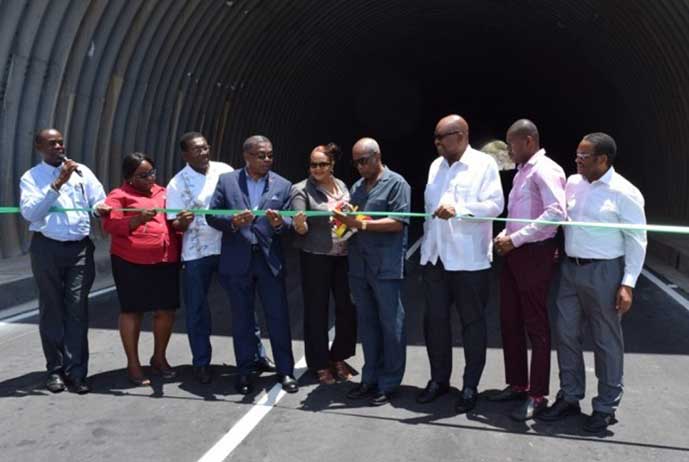
Dr. the Right Honourable Sir Kenny Simmonds, (4th from left) cuts ribbon while Minister Liburd (4th from right), Members of the Federal Cabinet and others look on
Basseterre, St. Kitts, May 21, 2016 (SKNIS): A momentous occasion was witnessed on Friday May 20, as the newly constructed South-East Peninsula tunnel in St. Kitts was opened after years of extensive work.
At a ceremony to mark the event, the Honourable Ian Patches Liburd, Minister of Infrastructure, highlighted the importance of the new tunnel and explained that it would aid in the protection of lives.
“Sections of the road were built through the hills on the Peninsula and huge boulders, rock fall and mudslides caused by weathering overtime threatened the safety and the lives of motorists and persons who traverse along the route,” said Minister Liburd. “Opening this tunnel is therefore about the protection and security of all those who travel on this South East Peninsula road.”
Martell Lee, Managing Director of ADeB Consultants Limited, Jamaica, gave an overview of the project and stated that initial planning began some 30 plus years ago. He commented briefly on the overall construction and design of the tunnel.
“The real challenge was in the construction of this project,” he said, while making reference to a consortium of equipment owners. “I think the objective was to ensure that in the process of these designs and construction, apart from involving local labour contractors, was to ensure that there were certain levels of expertise that we should have passed on that would continue to build the [Caribbean] countries fundamentally in terms of the areas of construction.”
Minister Liburd recognized the stakeholders and landowners in the area who provided the use of their lands during the construction process. He apologized to business owners on the Peninsula, taxi drivers and the general public at large who were inconvenienced during the construction. The minister stated however, that the “result is a new, improved and safer roadway.”
The minister with responsibility for roads made a public plea for concrete truck drivers to try to avoid spillage of concrete on the roads as it will reduce the lifespan of the road.
“We will have a more developed and a more accessible St. Kitts road network,” Minister Liburd said. “That, I believe was your vision Sir Kennedy and I am honoured and humbled to be part of its fulfillment.”
The South East Peninsula road is officially known as the Kennedy A. Simmonds Highway, named after St. Kitts and Nevis’ first Prime Minister Dr. the Right Honourable Sir Kennedy Simmonds.
The project was funded by the Government of St. Kitts and Nevis and the work was executed by the National Association of Heavy Equipment Operators Limited. The tunnel is 130 meters or 390 feet in length with a maximum clearance of 22 feet.
The opening ceremony was attended by His Excellency Sir S.W. Tapley Seaton, Governor General; Members of the Federal Cabinet; Brenda Boncamper, Permanent Secretary in the Ministry of Public Infrastructure, Post, Urban Development and Transport; Sir Kennedy Simmonds, who was instrumental in cutting the ribbon to symbolize the opening of the tunnel, as well as members of the Diplomatic and Consular Corps, officials from Surrey Paving and Aggregate Co. Ltd., invited guests and media.


 and Nature PBS. They have made films on that and shown them in both Britain and the United States. Every time they are raising money for the channels in the US, you see a purple-throated carib on TV. As a result of this, people elsewhere become aware f what Dominica has; that this bird is here and people want to see it and know about it.