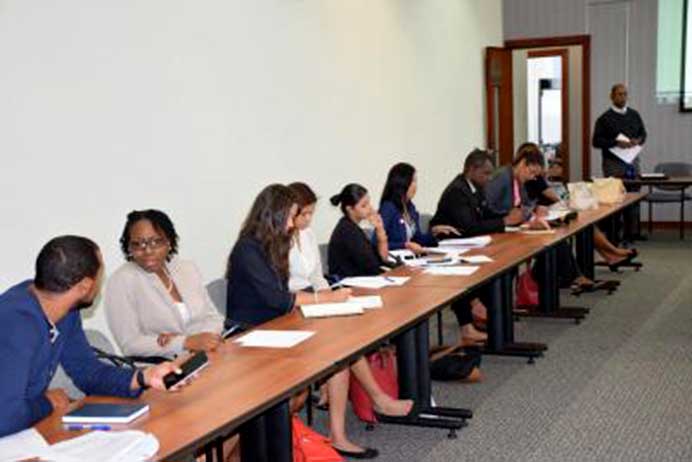
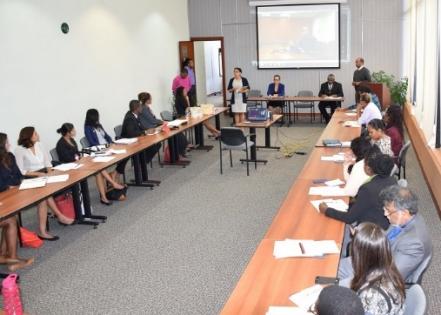
(CARICOM Secretariat, Turkeyen, Greater Georgetown, Guyana) The final mission under the CARICOM Secretariat’s ‘Students Engaging the CSME through Field Promotion’ project kicks off Monday, May 23 in Dominica.
Nineteen students from various tertiary institutions in Suriname will visit local public and private sector entities to determine the level of implementation of the CARICOM Single Market. For the week-long mission, the students will be accompanied by Suriname’s CSME Focal Point, a university lecturer and the CARICOM Youth Ambassador (CYA). The project is funded under the European Union’s 10th European Development Fund (EDF) and executed by the CARICOM Secretariat.
The aim of the exercise is for tertiary students to investigate the extent of implementation of the CARICOM Single Market and Economy (CSME) in participating Member States. Additionally, they are apprised of the employment and business opportunities offered by the single market and its provisions for CARICOM nationals. Upon returning to their home country, the students will prepare a report on their findings and make recommendations based on the visit. The project was started under the 9th EDF in which over 280 students were trained and due to its success, it was continued under the 10th EDF. This second phase was launched in April 2015 and this latest mission brings the total number completed to 12, covering all CSME-participating Member States.
With the completion of this phase under the 10th EDF, over 500 students will have been trained in the operations of the single market and exposed to the opportunities that it presents to them. This project has been integral to promoting the tangible benefits of a single economic space and the importance of the regional integration movement as a whole to CARICOM nationals.
1. Since May 2013, Jamaica has been implementing an economic reform program supported by the IMF’s Extended Fund Facility (EFF). Significant strides have been made in restoring macroeconomic stability, reducing public debt and deficits, undertaking comprehensive reforms in tax policy and administration, building financial sector resilience, and removing supply-side obstacles to growth. Macroeconomic fundamentals have significantly improved. Inflation is at historical lows, the current account deficit has more than halved, net international reserves have doubled, and access to domestic and international financial markets has been restored, supported by upgrades in credit ratings.
2. The program remains on track. All quantitative performance criteria for end-December 2015 and end-March 2016 were met. Tax revenues reached the budget target for the first time since the global financial crisis in 2007. The central government primary surplus for FY15/16 (April to March) slightly exceeded the program target of 7.25 percent of GDP. Capital expenditures accelerated during December to March, fully utilizing the additional fiscal space for growth-enhancing capital spending that was approved at the 10th review. Structural reforms are broadly on track, albeit with some minor delays due to the February elections and government transition. The mission reached preliminary staff-level agreement with the authorities on a package of measures that aims to complete the combined eleventh and twelfth reviews under the EFF. Consideration by the IMF’s Executive Board is tentatively scheduled for June 2016. Upon approval, SDR 56.7 million (about US$80 million) would be made available to Jamaica.
3. Economic recovery continues but growth remains weak.Confidence indicators are at an all-time high, inflation declined to 2.4 percent in April, and the current account deficit has significantly decreased, aided by low oil prices. The unemployment rate dropped to 13.3 percent in January 2016, down from 14.2 percent a year earlier. Foreign direct investment inflows increased by nearly 30 percent during the first three quarters of FY15/16. Nevertheless, real GDP is estimated to have expanded by only 0.8 percent in FY15/16; with ongoing agricultural recovery and higher investment, growth for FY16/17 is projected to rise to 1.7 percent.
4. Achieving sustained higher growth and job creation requires continued reforms. Fiscal discipline is critical for further reducing debt and creating space for productive capital spending. Combating crime, reducing the costs of energy and tax compliance, and improving infrastructure are essential to attract private investment. Greater banking sector competition, reforming financial sector taxation, reducing collateral requirements, improving credit risk assessment, and developing non-traditional financial services will help improve access to financial services and reduce the interest rate spread.
5. Continued exchange rate flexibility is needed to maintain competitiveness. The level of the exchange rate appears broadly in line with fundamentals but the balance of risks points toward a modest overvaluation. To avoid eroding external competitiveness, the currency should be allowed to depreciate to offset the inflation differential with trading partners. A flexible exchange rate implies that any intervention in the foreign exchange market should be predominantly to build reserves and smooth out excessive exchange rate volatility.
6. The ongoing phased reform of the personal income tax is a bold step to rebalance the tax system towards indirect taxation. The shift from direct to indirect taxes will reduce the marginal and average tax rates for the majority of the income tax taxpayers, improve work incentives, and encourage workers and employers to move out of the informal economy. The decision to take offsetting measures to safeguard revenues and avoid undermining debt sustainability was both bold and essential. Prior to undertaking the second step in raising the minimum threshold for income tax, attention should be directed to strengthening conditional cash transfers and improving targeting in order to protect the poor and vulnerable from the shift from direct to indirect taxes. Other reforms to further reduce distortive taxes (such as asset taxes, stamp duties and transfer taxes) will also help support private sector growth.
7. Efforts are needed to reduce the size of the public sector, improve public sector resource allocation, and protect social and capital spending. The large public sector wage bill continues to crowd out crucial expenditures. As such, concrete measures are needed to achieve a wage to GDP ratio of 9 percent by FY18/19. The additional fiscal space created during the 10th review for FY16/17 has been directed at growth-enhancing capital spending.
8. Reforms to the monetary framework should center on achieving price stability. A firmly established single mandate for achieving price stability will bolster the Bank of Jamaica’s credibility and lay the foundation for an eventual move to inflation targeting. In addition, the central bank’s liquidity provision should be made consistent with the loosened interest rate stance.
9. Financial sector stability requires further actions.Enhancements to the legal and operational frameworks for the resolution of banks and securities dealers should be determined and set up without delay. The amended Bank of Jamaica Act needs to be backed by concrete tools, procedures, and complementary regulations in order to truly vest the central bank with overall responsibility for financial stability. Information exchange and collaboration between the various supervisory agencies needs further improvement. Strengthening prudential requirements for securities dealers will bolster systemic stability. The IMF team thanks the Jamaican authorities and other interlocutors for their candid and constructive discussions during the mission.
The Honourable Michael Peyrefitte, Speaker of the House of Representatives, met with the Honourable Mario Taracena Diaz-Sol, Speaker of the Congress of the Republic of Guatemala at a meeting hosted by the Nicaraguan Government through the XVIII Extraordinary Meeting of FOPREL (Forum of Presiding Officers of National Parliaments of Central America, Mexico, and the Caribbean Basin). The meeting was held on Thursday, 19th May 2016, at the Congress Conference Room in Managua, Nicaragua.
The meeting also had the participation of Speakers and Deputy Speakers of the parliaments of El Salvador, Nicaragua, Honduras, and Costa Rica. At the meeting, the Honourable Peyrefitte briefed the Speakers of Central America about Belize’s perspective in relation to the recent incident that occurred in our Chiquibul Reserve where a young boy lost his life.
The one-day meeting resulted in the signing of an agreement between the member countries of FOPREL in the framework of strengthening good relations and parliamentary friendship among the counties in the region. The agreement between the National Assembly of Belize and the Congress of Guatemala declares among other things the following:
To invite Guatemala and Belize to promote and facilitate the solution to all disagreements involving them through dialogue and parliamentary diplomacy, in accordance to due process and international agreements;
For FOPREL to encourage Guatemala and Belize to support the ongoing processes between these two countries under the auspices of the OAS;
FOPREL will encourage the Congress of Guatemala to promptly consider the ratification of the protocol signed between Belize and Guatemala in May 2015, to amend the Special Agreement signed in 2008.
It must be noted that, after 150 years of the dispute, it is the first time that the parliaments of Belize and Guatemala are getting involved in the discussion at this level.
Accompanying the Honourable Peyrefitte at the meeting in Nicaragua was Mr. Eddie Webster, Clerk to the National Assembly.
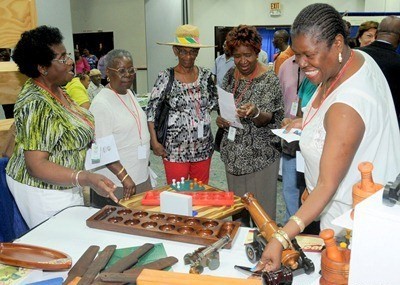
A group of participants from the Barbados Network Consultation 2014 view the locally crafted products. (FP)
Plans are moving ahead to make this year’s Barbados Network Consultation (BNC), the 4th Diaspora Conference, the most successful one so far.
This assurance was given by Minister of Foreign Affairs and Foreign Trade, Senator Maxine McClean, during a press conference today to launch the diaspora conference at the Ministry.
According to her, the BNC will run from July 31 to August 5, under the theme: One Nation, One Family – Celebrating 50 Years of Independence – Shaping Global Citizens and will begin with a church service on Sunday, July 31, at the Cathedral Church of St. Michael and All Angels.
After taking a break for Grand Kadooment on Monday, August 1, the BNC will recommence on Tuesday, August 2, at the Lloyd Erskine Sandiford Centre (LESC) with the registration of participants who had not pre-registered. Later that evening, there will be an Old Fashion Bus Party Tour.
The official opening ceremony will be held on Wednesday, August 3, at the LESC, after which officials and the media will tour the exhibits comprising a number of local goods and services available to Barbadians at home and abroad.
A Youth Career Showcase will also be held on that day, which will focus on innovation through Science, Technology, Engineering and Mathematics (STEM) Education, and the Arts.
Other activities scheduled for Wednesday include a session featuring the screening of local films entitled: Lights Camera Action! and the opening of the BNC Rum Café.
On Thursday, August 4, there will be a discussion on the topic: Fostering Philanthropy – Matching local needs with Diaspora capacity, which is intended to highlight the positive impact of philanthropy, and by extension the non-governmental sector, in nation building.
There will also be a session on Investing in Barbados – Putting our Combined Savings to Work – Creating a Venture Capital Fund, as well as a meeting to look at Promoting Barbados’ Cultural Heritage to the World: the role that Overseas Barbadians can play. Activities on Thursday will end with the Prime Minister’s Crop Over Gala.
A Genealogy Fair will be held on Friday, August 5, the final day of the conference, at the Archives Department. There will also be a session entitled: Investing in Barbados: The United States Foreign Account Tax Compliance Act (FATCA) at the LESC. BNC activities will culminate with a ‘Bajan Night’ event at Divi Southwinds Resort.
To register for the conference or for further information, persons may visit the official website. Queries can be sent to bnc2016@foreign.gov.bb.
The Commonwealth of Dominica hosted a reception in honour of its Cuban friends on Wednesday, May 18th.
Among invited guests were His Excellency the Cuban Ambassador to Dominica, Juan Carlos Frometa de la Rosa; Cuban graduates; Cuban diplomats; dignitaries of other friendly countries, and members of the Opposition United Workers Party.
His Excellency the President of Dominica, Charles Savarin presided over the event at the State House.
Wednesday, May 18th marked twenty years since the two island states formalised diplomatic relations.
The Cuban Ambassador stated, “Today, exactly 20 years ago, the Government of the Commonwealth of Dominica and the Republic of Cuba established diplomatic relations however, long before relations were established between our peoples, the first and a small group of 11 young Dominicans went to study in Cuba in the late 70s returning as professionals to the Nature Isle.
“Certainly after we established diplomatic ties, cooperation and brotherhood between our countries increased substantially. In all these years, almost 400 young people from Dominica have graduated from the Cuba scholarship programme.”
The Cuban Scholarship Programme is the highlight of the longstanding relationship.
The Ambassador thanked Dominica for its support of the campaign to end the US embargo against Cuba. For that, he says, his country is grateful.
Hon Minister for Foreign Affairs is Senator Francine Baron.
“Since 2000, the Dominica Labour Party Administration has expanded and deepened the friendship and solidarity between Dominica and Cuba and we have increased the cooperation and engagement between our two countries. The fraternal bonds between Cuba and Dominica therefore go beyond establishing formal diplomatic relations. We consider Cuba a sister Caribbean island with a similar history and culture. It is for this and other reasons that Dominica has stood steadfastly with the Cuban people against actions that have negatively affected them. The support of Prime Minister Roosevelt Skerrit and his Dominica Labour Party Administration has been manifested by our unwavering solidarity and support for Cuba in the international arena and in particular at the United Nations,” she said.
Cuban educators complement DSC lecturers at the State nursing school, and over 1,000 Dominicans have travelled to Cuba for eye care surgery.
The Hon Prime Minister, Dr. Roosevelt Skerrit was represented by the Hon Minister for Education and Human Resource Development, Petter Saint Jean.
He shared, “In the areas of housing, engineering technology and education, we have seen that the Cuban-trained graduates have made and continue to make a meaningful contribution to our national development. We can only hope, Ambassador, that in the coming years, we will see a strengthening of the relationship between our two countries and two peoples.”
In addition to longstanding cooperation in health and education, Cuba now wishes to expand collaboration to agriculture.
While Dominica toasts to at least another 20 years, according to the Cuban Ambassador, Cuba too hopes for a long and fruitful relationship.
“I would like to ratify the political will of the Government and people of Cuba to continue the enforcement and relation of friendship and cooperation with Dominica,” Ambassador Frometa de la Rosa said.
He said to guests, “Dominica, tell me how we can help you and Cuba will do it.”
Minister of Labour, Social Security and Human Resource Development, Senator Dr. Esther Byer Suckoo, has pledged her Ministry’s continued support for WorldSkills Barbados.
Minister of Labour, Senator Dr. Esther Byer Suckoo and Brenda Pope of KPMG Barbados presenting the Best Overall Competitor prize to Akeil Craig-Browne at the closing ceremony of WorldSkills Barbados. (C.Pitt/BGIS)
Delivering remarks at the closing ceremony of the competition at the Lloyd Erskine Sandiford Centre, Senator Byer Suckoo stated: “WorldSkills is important because too often we focus so hard on the destination that we forget to appreciate the journey.
“This developmental exercise has been an eye opener for the rest of us…to appreciate how the raw talent actually becomes developed.”
WorldSkills Barbados forms part of the regional component of the WorldSkills International competition, which targets technical and vocational education and training students between ages 16 and 21.
Copping gold medals in the categories of Culinary Arts and Automotive Technology respectively were Tinisha Janine Hall and Akeil Craig-Browne, both students of the Barbados Vocational Training Board (BVTB).
Striking gold in the Hairdressing and Garment-making categories were Takiya Jordan, also of the BVTB; and Roshida Griffith of the Samuel Jackman Prescod Polytechnic.
Akeil Craig-Browne emerged the overall winner, walking away with the Best of Competition Award. The competition was held under the theme: Shaping a World Class Workforce through: Innovation, Creativity and Skills Development.
A team of Jet Ski enthusiasts from Martinique spent the past week-end in Saint Lucia exploring logistical arrangements for Saint Lucia’s possible involvement in an international Jet Ski race in 2017.
Martinique recently hosted the first round of Jetracer World Championship IJSBA, an international Jet race competition. The International Jet Sports Boating Association is the worldwide sanctioning body for personal watercraft competitive racing. Team 972 from Martinique comprising 17 Jet Skis visited Saint Lucia in response to an invitation from the Consul General in Martinique Yasmine Walcott for discussions and first-hand experience of Saint Lucia as a likely host for next year’s International Jet Ski race in Martinique.
The proposal is for the race to start in Martinique and culminate in Saint Lucia; the first time an international Jet Ski race will start in one country and end in another.
Edson Eugene of Team 972 [Martinique’s area code] says this trial run brought a total of over 40 persons to Saint Lucia including three boats with security, emergency and other logistical personnel.
He said the international Jet Ski race in Martinique this year attracted over 50 participants from the United States, Russia, Canada, Kuwait, Qatar, Belgium, Peru, the United Kingdom, Italy, China, South Korea, Japan, Saudi Arabia and France. The hope is that Saint Lucia Jet Ski Pilots will participate in the 2017 international race.
Team 972 is expected to provide training and race orientation to the Saint Lucian Jet Ski pilots.
Cross section of Members at GIS and Climate Change meeting: R-L: Mr. Terry Mohomed, UNFPA representatives, TEMA Director Mr. Allan Stewart, Candice Ramkissoon of the ODPM, Ministry of Agriculture, Works and Transport, Institute of Marine Affairs Representatives. (Photo courtesy the Ministry of Planning and Development.)
May 19, 2016: Mr. Terry Mohomed of the Technical Cooperation Unit of the Ministry of Planning and Development spearheaded a meeting on May 18 with representatives from the United Nation Population Fund (UNFPA), the Central Statistical Office (CSO) and representatives from various Ministries on using geographic information systems (GIS) to address population dynamics and climate change resilience in the Caribbean.
The three year project aims to establish a framework, utilizing census data, to map and analyze the socio-demographic components of the climate-related vulnerability on specific communities in a given geographic area to inform sustainable development. This meeting was also the first part of a regional Climate Change GIS Project also involving Jamaica and St. Lucia who are already in the second phase of the project.
The initiative is a collaboration among the Government of Trinidad and Tobago; the United Nations Population Fund (UNFPA); and technical personnel from the Ministry of Social Development; the Office of Disaster Preparedness and Management (ODPM); the Institute of Marine Affairs; the Ministry of Agriculture, Land and Fisheries; the Ministry of Works and the Tobago Emergency Management Agency (TEMA).
The effort comes at a key time when exacerbated climate change has left several areas in the Caribbean reeling from the effects of prolonged drought and rainy seasons resulting in heavy flooding, landslides and depleted water supplies. According to Ms. Candice Ramkissoon of the ODPM, “the effects of these weather conditions especially affected those from low socio-economic backgrounds from both rural and urban areas and as such, these demographic statistics are central in identifying key groups and communities that would be especially vulnerable to climate change phenomena and informing policy to address their specific needs”. Mr. Sean O’Brien of the Central Statistical Office mentioned that “it is important to gain population data on those persons heavily involved in agriculture, fisheries and forestry jobs as they are some of the groups that would be adversely affected by climate change”.
Additionally, the initiative is also helpful in mapping those zones in Trinidad and Tobago that contain high population densities, hazard sites as well as coastal and low lying communities since the data on these areas will allow first responder groups such as the health, disaster and security personnel to properly forecast, plan and inform actions and policy in terms of disaster management.
The meeting ended with stakeholders committing to appointing a steering committee to oversee the implementation of the key phases of the project over the next three years. Cross section of Members at GIS and Climate Change meeting held at the Ministry of Planning and Development, La Lune Room, Level 20 Eric Williams Financial Towers.
Minister of Planning and Development, the Honourable Camille Robinson- Regis with the Jamaican Minister of Finance, the Honourable Audley Shaw at the 46th Annual Meeting of the Caribbean Development Bank in Jamaica. (Photo courtesy the Ministry of Planning and Development)
May 19, 2016: The panel discussion on “Micro, Small and Medium Enterprise (MSME) Development: Towards a New Frontier” was held during the 46th Annual Meeting of the Caribbean Development Bank (CDB) on Wednesday, May 18th, 2016 at the Montego Bay Convention Centre, Montego Bay, Jamaica. The session was chaired by the Minister of Planning and Development, Honourable Camille Robinson Regis.
The CDB’s MSME Study, which is the subject of the panel discussion is intended to provide practical policy and other recommendations for expansion and development in borrowing member countries (BMCs): Antigua and Barbuda, Barbados, Belize, Guyana, Jamaica, Trinidad and Tobago, St. Lucia and Suriname. According to the President of the CDB in his statement for the Study he outlines the hope of the bank in saying, “the proposal willopen the door for healthy debates among policymakers, academics, and students and provide the platform for the long-term transformation and sustainable development of the MSME sector”.
Minister Robinson Regis, in her address also underscored the importance and potential impact the proposal can make to Borrowing Member Countries, she stated, “The promotion of the MSMEs sector can be viewed as a viable approach to economic and social transformation. The development of the MSMEs sector represents one of the most realistic vehicles for confronting the challenges of unemployment and poverty currently being faced by Borrowing Members Countries (BMCs). MSMEs have the potential to operate both in rural and urban areas thereby ensuring equitable income distribution, rural development and decentralization of industries.”
The Honourable Minister along with highly acclaimed presenters with backgrounds in Finance and Economics discussed findings of the Study and presented strategies for the way forward. The presenters were:
Dr Justin Ram; Director of Economics, Caribbean Development Bank
Dr. Arnold McIntyre, Deputy Division Chief, Caribbean Division I, Western Hemisphere Department, International Monetary Fund
Mr. Milverton Reynolds, Managing Director, Development Bank of Jamaica (DBJ) and
Mr. Daniel Arthurton; Adviser, Eastern Caribbean Securities Regulatory Commission (ECSRC), Eastern Caribbean Central Bank (ECCB)
The MSME Study is well aligned with many of the fiscal measures being undertaken by the Government in restoring growth, diversity and confidence to Trinidad and Tobago’s economy. Minister Robinson Regis took the opportunity to outline some of the initiatives currently being pursued by Trinidad and Tobago’s government:
The FairShare Programme: The ‘FairShare’ Programme is a set-aside programme that provides micro and small enterprises (MSEs) in Trinidad and Tobago access to public procurement opportunities up to TT$1 Million.
Enterprise Investment Fund: The Enterprise Investment Fund (EIF) is intended to encourage and support the implementation of programmes that improve the capacity and capability of the micro and small enterprises and cooperatives (MSECs), thereby allowing them to improve their competitiveness at the local, regional and international levels.
National Integrated Business Incubator System (IBIS): IBIS is a business development system that creates promising new businesses and strengthens existing ones by bringing together a wide range of business support services to act as needed interventions for small enterprises. Its primary service is to provide mentoring, coaching and network development for its clients. Additional services such as physical infrastructure, financing and training are important components that are also being provided.
MSE Private Financing Programme: One of the chief challenges to sustained MSE development is the availability of innovative funding, suited to the needs of micro and small businesses and to star-ups particularly in new business areas.
Green Enterprise Development: A partnership between the Ministry of Labour and Micro and Small Enterprises and other agencies to facilitate the provision of training and certification in green building in Trinidad and Tobago. It will seek to create more opportunities for green procurement by encouraging such programmes in Government Ministries and State Agencies, thus expanding the capacity and competence in this sector in Trinidad and Tobago.
May 19, 2016: The Minister of Public Administration and Communications, the Honourable Maxie Cuffie, hosted the Post Cabinet Press Briefing today (Thursday 19th May, 2016) at the Office of the Prime Minister, St. Clair, Port of Spain.
At the briefing the Minister of National Security, the Honourable Edmund Dillon commented on an article in which the Leader of the Opposition seemed to be politicising crime. Minister Dillon emphasised that crime affects each citizen of Trinidad and Tobago and that the present crime situation ought not to be politicised.
Minister Dillon also responded to the call for a meeting of the National Security Council by stressing that the Leader of the Opposition does not control the meetings of the National Security Council. He announced that Prime Minister Dr. Rowley was in fact briefed on national security upon his return to Trinidad and Tobago on Saturday (14th May 2016), as is the norm. Further information was provided on Monday 16th May 2016 and a meeting of the National Security Council was scheduled for the following day (Tuesday 17th May, 2016).
The Minister of National Security also announced that he has met with the nine (9) divisional heads of police. The main aims of the meeting were to empower the heads to take control of the divisions as well as to make them more accountable for the goings-on in their territories. The Intelligence Fusion Centre, which coordinates and provides operational intelligence, has also been incorporated in strategies so as to ensure a coordinated and integrated approach to dealing with crime at this level.
Minister Dillon announced that, coming out of the meeting, several operations were conducted throughout Trinidad and Tobago resulting in ninety-three (93) arrests and the seizure of weapons and narcotics. Additionally, it was announced that persons who are considered “known perpetrators”, according to intelligence gathered, will also be targeted based on the existent legal framework. The Minister stated that such individuals must not be allowed to carry on “normal lives” or to hold the country to ransom.
Minister Dillon also provided some statistics on the nature of murders in 2016 (Altercations – 8; Domestic violence – 9; Gang related – 54; Reprisal/revenge killings – 29; Robbery – 15; Drug related – 35; Still being investigated – 28). He emphasised that the Government is not comfortable with the murder rate and is continuing to put all the required resources to work in order to bring the country back to a secure environment.
The Honourable Stuart Young, Minister in the Office of the Attorney General and Legal Affairs and Minister in the Office of the Prime Minister, announced that Cabinet had taken a decision regarding the composition of the Board of Directors of First Citizens Bank (FCB). This action was taken as the term of office for a number of directors comes to an end on the 17th June 2016.
Mr. Anthony Smart will be re-appointed as Chairman of the FCB Board of Directors while Mr. Courtney Williams will also be re-appointed to the position of Deputy Chairman.
Four (4) new appointees were also named:
• Mr. Idrees Omardeen
• Mr. Troy Garcia
• Mr. Samuel Henry
• Ms. Giselle MacFarlane
Minister Young also announced that the President of Venezuela, His Excellency Nicolás Maduro, will visit Trinidad and Tobago on Monday 23rd May 2016.
President Maduro will be accompanied by the Minster of the People’s Power for Foreign Affairs, H.E. Delcy Rodriguez, Minster of the People’s Power for Petroleum and Mining, H.E. Eulogio Del Pino and H.E. Miguel Perez Abad , Minster of the People’s Power for Industry and Commerce.
Representatives of the national gas company of Venezuela will also form part of the delegation.
Discussions during this visit will be based on the enhancement of bilateral cooperation between Trinidad and Tobago and Venezuela, namely in the areas of energy, foreign policy and trade.
Furthermore, progress made since the last visit to Venezuela by a Trinidad and Tobago delegation (26th October 2015) will also be discussed.






 Martinique recently hosted the first round of Jetracer World Championship IJSBA, an international Jet race competition. The International Jet Sports Boating Association is the worldwide sanctioning body for personal watercraft competitive racing. Team 972 from Martinique comprising 17 Jet Skis visited Saint Lucia in response to an invitation from the Consul General in Martinique Yasmine Walcott for discussions and first-hand experience of Saint Lucia as a likely host for next year’s International Jet Ski race in Martinique.